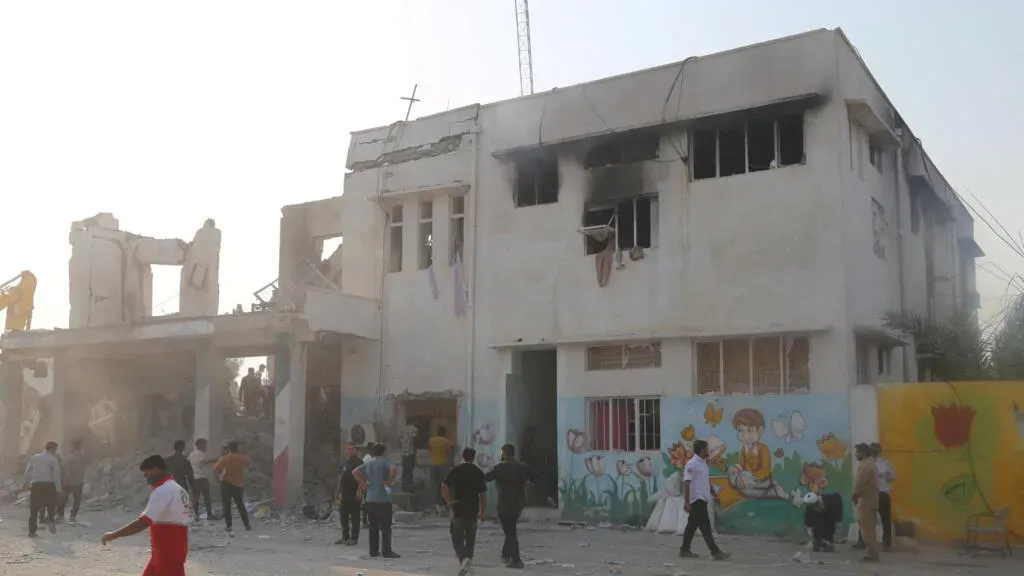
The civilian deaths in Minab turned an American missile strike from a military-targeting claim into a political and humanitarian reckoning. The Minab reports widened on March 11, 2026.
Minab Adds Civilian Horror to the War
Minab was once known for its sprawling date palm groves and its vibrant Thursday market. On Wednesday morning, those images were replaced by the charred remains of a primary school and the frantic screams of recovery teams. Evidence surfaced this week suggesting that an American Tomahawk missile, launched as part of the ongoing offensive against Tehran, struck the educational facility after a catastrophic targeting error. Early reports from the ground indicate that more than 150 people, many of them children, perished in the blast. Rescue workers continue to pull bodies from the concrete slabs while local hospitals struggle to manage a deluge of burn victims. Reports published by the New York Times on Wednesday morning describe a failure of intelligence that led to the carnage. Analysts within the defense community suggest that the missile was guided by outdated targeting data, intended for a nearby military installation that had already been neutralized or relocated. Errors in the Digital Scene Matching Area Correlator (DSMAC) systems can occur when geographic landmarks have been altered by previous strikes. Such technical lapses have turned Operation Epic Fury into a logistical and humanitarian nightmare for the White House. While official channels in Washington initially remained silent, the scale of the civilian loss has made further evasion impossible. President Donald Trump offered a different version of events during a press briefing late Tuesday. He suggested that Iran might have been responsible for the strike on its own citizens, an assertion that contradicted his earlier optimism about the war's trajectory. Despite the mounting evidence of an American hardware failure, the President maintained that the United States is ahead of schedule in its mission to dismantle the Iranian military. He highlighted the destruction of Iranian mine-laying boats in the Strait of Hormuz as a sign that the conflict could end soon. This assessment appears increasingly detached from the reality of a campaign that is now entering its twelfth day with no clear resolution in sight.
Operation Epic Fury Burns Cash and Credibility
The civilian deaths also collided with the immense cost of Operation Epic Fury, forcing officials to defend both the targeting failure and the price of the campaign.
War remains an expensive endeavor, but the current conflict is reaching levels of expenditure rarely seen in modern history. Operation Epic Fury is currently draining between $1 billion and $2 billion from the United States Treasury every twenty-four hours. This expenditure exceeds the peak costs of the occupations in Iraq and Afghanistan, driven by the heavy reliance on precision-guided munitions and carrier-based sorties. Each Tomahawk missile costs approximately $2 million, and hundreds have been launched since the opening salvos of the campaign. Fuel costs for the massive naval presence in the Persian Gulf add hundreds of millions more to the daily ledger.
Pentagon officials, speaking on the condition of anonymity, indicated that preparations for further strikes are continuing despite the President's claims that few targets remain. Israeli officials have signaled their support for an expanded air campaign, arguing that Iran's nuclear infrastructure has not yet been sufficiently degraded. Yet the Iranian government has vowed to retaliate by permanently blocking oil shipments through the Strait of Hormuz. Global energy markets have already reacted to the threat, with crude prices surging as tankers remain anchored in safe harbors. The economic fallout is beginning to rival the direct military costs of the strike missions.
Military analysts are questioning how a sophisticated weapon system could fail so spectacularly in a high-stakes environment. Tomahawk missiles rely on a combination of GPS, inertial guidance, and terrain contour matching. If the underlying data sets provided by the National Geospatial-Intelligence Agency are even slightly misaligned with the current terrain, the missile can deviate from its intended path. Twelve days of intense bombardment have likely altered the physical environment of southern Iran, making older maps more of a liability than an asset. Tragedy followed when the missile's sensors mistook the school's thermal signature for a legitimate military target.
Washington and Tehran Battle Over Blame
Trump remains insistent that the US has little left to target in the Islamic Republic. He claimed that the Iranian military capacity has been decimated, yet the vow from Tehran to block oil shipments suggests a regime that is far from defeated. Intelligence sources in the United Kingdom have expressed skepticism regarding the White House's timeline. They point to the survival of mobile missile launchers and the deep-buried command centers that have so far evaded American bunker-busters. Such contradictions suggest that the conflict may be shifting from a surgical strike campaign into a prolonged war of attrition.
Russian news agency TASS amplified the reports of American culpability, noting that the international community is likely to demand an independent investigation. The Kremlin has used the Minab strike to frame the United States as a reckless aggressor, further complicating the diplomatic position of Washington's allies. In London and Paris, politicians are facing increased pressure from their constituents to distance themselves from Operation Epic Fury. The images of the Minab school have become a rallying cry for anti-war movements across the globe, threatening to isolate the United States at a time when it needs regional cooperation the most. American taxpayers are starting to feel the pressure of the $2 billion daily burn rate.
Congress has already begun debates over a supplemental funding bill to replenish the stockpiles of munitions being used in the Persian Gulf. Critics argue that the money would be better spent on domestic infrastructure or border security, particularly if the war is, as the President claims, nearly over. The math doesn't add up.
Why Surgical Strike Myths Keep Failing
Can we finally discard the myth of the surgical strike? For decades, the American public has been sold a version of warfare that is clean, digital, and devoid of human error. The blood-soaked rubble in Minab proves that no amount of billion-dollar technology can compensate for the fog of war and the arrogance of outdated intelligence. Washington's obsession with high-tech solutions has created a military-industrial complex that is more efficient at burning cash than achieving strategic objectives. A campaign burning through $2 billion a day cannot call itself precise when one of its most visible outcomes is a destroyed primary school.
Spending $2 billion a day to bomb a country into the Stone Age only to hit a primary school is not a demonstration of strength.
It is a confession of systemic incompetence. Donald Trump's attempt to deflect blame onto the Iranians is a predictable yet pathetic maneuver from an administration that cannot admit a mistake. By claiming the war is almost over while the Pentagon prepares for months of additional strikes, the White House is treating the American public like children who cannot handle the truth. We are not seeing the end of a conflict. We are seeing the birth of a multi-trillion dollar quagmire that will haunt the global economy for a generation.
If the United States truly has nothing left to target, then every subsequent missile launch is not an act of war, but an act of sheer, expensive vanity. It is time to stop the bleeding, both financial and human, before the Strait of Hormuz becomes the graveyard of the American century.