Claude Moves From Text to Tools
Silicon Valley researchers frequently describe the struggle of large language models to explain physical reality through text alone. Anthropic attempted to bridge that gap by launching a significant update to its Claude AI assistant. Users can now generate custom charts, diagrams, and complex visualizations directly within the chat interface. Unlike previous iterations that relied on static text descriptions or external links, the new Claude renders interactive graphics in real-time.
On March 12, 2026, Anthropic pushed Claude closer to a workspace where answers become interactive objects. This functionality leverages HTML code and XML vector graphics to provide a digital whiteboard experience. Anthropic intends for these visuals to appear when the AI determines a graphic would clarify a concept better than a paragraph could. Engineers at the San Francisco startup emphasize that this is not a move into traditional AI image generation.
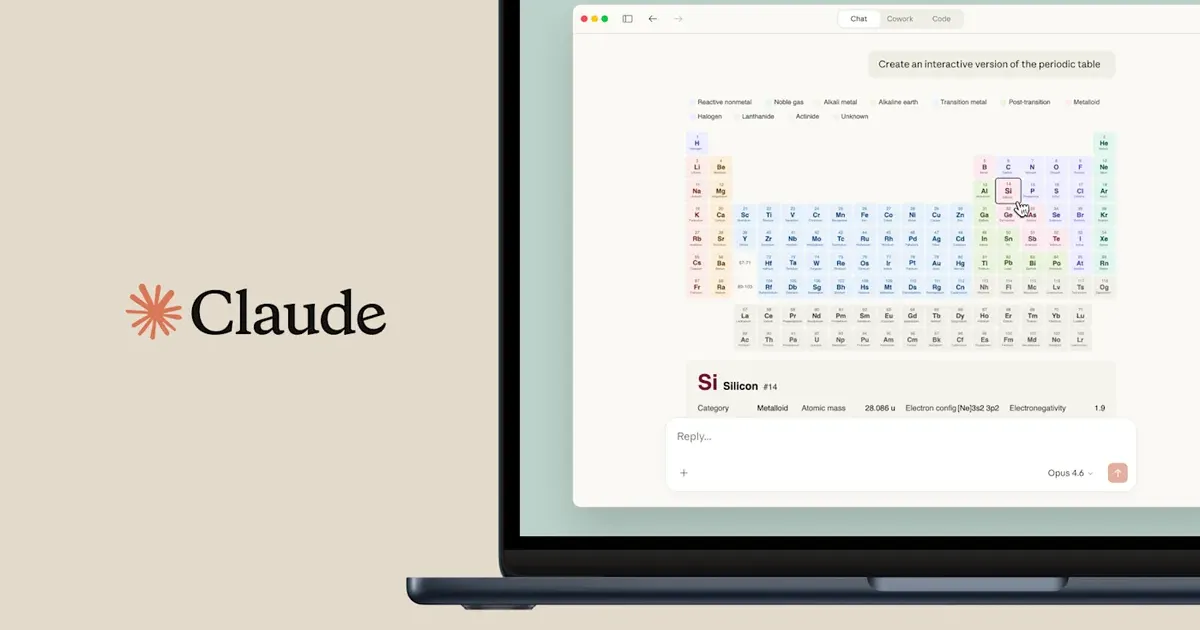
While tools like Midjourney or DALL-E focus on artistic pixels, Claude generates structural data. One internal demonstration showed the chatbot explaining the periodic table. Instead of a flat list of elements, Claude produced a fully interactive table where users could click specific cells to reveal atomic weights and electron configurations. Another test case involved architectural physics. When asked how weight travels through a multi-story building, Claude drew a structural diagram illustrating load-bearing paths. These visuals reside in-line with the conversation, moving away from the side-panel constraints that previously limited user interaction.
Visual Output Changes the Workflow
The objective is to make the AI feel less like a search engine and more like a collaborative tutor. Choosing XML vector graphics over standard JPEG or PNG files is a calculated technical decision. Vectors allow for infinite scaling without loss of clarity, a necessity for professionals viewing complex data on high-resolution displays. Since Claude generates the underlying code for these graphics, users can theoretically ask the model to adjust specific variables in the chart.
A business analyst could request a change in a bar graph's color or a shift in its data points, and the AI would rewrite the code to reflect the update instantly. This level of malleability is impossible with pixel-based images, which remain static once the AI generates them. By using code as the medium for visual communication, Anthropic ensures that the graphics remain lightweight and accessible even on slower internet connections. Industry analysts at Gartner suggest that this shift toward code-based visualization reflects a broader trend in explainable AI.
Text has reached a point of diminishing returns for many users. If a student asks how to fold a Nakamura lock paper plane, a 500-word instruction set often fails to convey the precision of a well-placed fold. Claude now provides a step-by-step visual guide to that specific paper plane design, showing the geometry of the paper at each stage. Such clarity moves the needle for educational technology.
Still, the company admits the software remains in a beta phase. Quirks in the rendering of complex 3D structures have been noted by early testers, and the system occasionally misaligns labels on dense scatter plots.
Safety Pressure Follows Interactivity
OpenAI recently introduced similar interactive visuals for science and math concepts within ChatGPT, creating a direct competitive pressure on Anthropic. The timing of this release suggests a frantic pace of development among the top-tier AI labs. While OpenAI has a larger user base, Anthropic has cultivated a reputation for safety and precision. By offering these visual tools to all users, including those on free tiers, Anthropic is clearly aiming for a wider market share.
The strategy appears to be working, as Claude has seen a surge in popularity among regular users who find its tone more human and its explanations more structured than its rivals. But the lack of mobile support at launch could hinder its adoption among students who rely on smartphones for quick assistance. The battle for the prosumer market depends heavily on these utility-focused features. Business professionals need more than creative writing from an AI.
They need tools that can parse a CSV file and turn it into a boardroom-ready presentation. Anthropic's move targets this exact demographic. Bloomberg reports that enterprise interest in AI has shifted from simple chatbots to integrated workflow tools. If Claude can act as a data scientist by visualizing trends in a company's quarterly earnings, it becomes far more valuable than a mere text generator.
Yet, the current beta limitations mean that users should verify the accuracy of the charts before including them in official reports.
Precision Over Interface Flash
Why should we settle for a machine that merely speaks when we have spent decades perfecting the art of the visual? Anthropic is finally admitting that text is a claustrophobic medium for complex thought. The tech industry loves to brag about multimodal models, yet for years, these models have treated images as a novelty rather than a utility. This update to Claude suggests a welcome realization that a chart is not just a picture, it is a form of reasoning. However, the tech sector's obsession with beta releases is becoming a tired excuse for unpolished products. Launching a feature this significant without mobile support in 2026 is an arrogant oversight that ignores how half the world actually uses the internet. Still, the reliance on HTML and XML is a safe bet, but it stops short of true innovation. We are seeing a digital whiteboard, not a revolution. If Anthropic wants to truly lead the market, it needs to stop reacting to OpenAI's feature sets and start defining its own. The real test will be whether these diagrams can survive the scrutiny of a professional engineer or if they will remain a flashy toy for students looking to shortcut their homework. Precision matters more than a pretty interface.