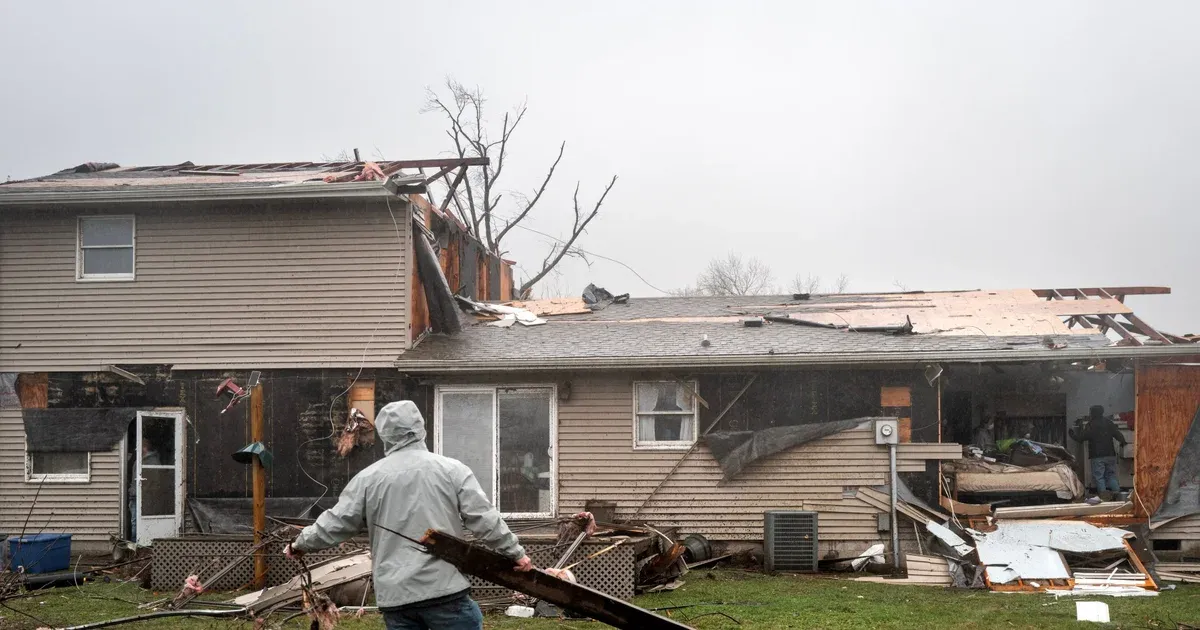
Record-low Arctic sea ice and deadly Midwest storms are turning climate instability into a local emergency-management problem. The climate signals sharpened on March 11, 2026, as polar data and deadly U.S. storms appeared in the same news cycle.
Record-low Arctic sea ice and deadly Midwest storms are converging into a wider warning about climate instability.
Arctic Data Sends a Warning
Residents of DeKalb County, Illinois, woke up to the sound of sirens for the second time in six days as the region saw a violent renewal of the storm patterns that have plagued the American Midwest since the beginning of the month. Two people died in the latest wave of supercell thunderstorms, according to reports from emergency management officials in Illinois and Indiana. These fatalities join a growing list of casualties as eight people were killed by similar tornadoes last week. The frequency of these storms has increased, pushing local authorities to reconsider their emergency response timelines during what used to be a shoulder season for severe weather. Scientists at the National Snow and Ice Data Center (NSIDC) revealed data on Tuesday showing that Arctic sea ice reached its lowest winter reconstitution levels ever recorded. The winter of 2025-2026 saw ice formation fail to meet even the previous historic lows set in 2025. This pattern of warming in the high north creates a cascading effect on the jet stream, the high-altitude river of air that directs weather across the United States. When the Arctic is warm, the temperature gradient between the pole and the equator weakens, causing the jet stream to meander like a slow river. Such wobbles allow warm, moist air from the Gulf of Mexico to surge much further north than usual, colliding with cold air masses to create the violent supercells seen in Illinois. Arctic sea ice acts as a planetary heat shield, reflecting sunlight back into space. Its absence means the ocean absorbs more solar radiation, accelerating a feedback loop that warms the entire Northern Hemisphere.
The data analyzed by the NSIDC shows that the ice cover is not just shrinking in area but also in thickness. Younger, thinner ice melts more quickly during the summer and struggles to solidify during the brief, warming winters of the 2020s.
Midwest Storms Make the Risk Local
This winter is a failure of the natural cooling system that traditionally stabilizes North American weather during the transition into spring. Casualties in the Midwest remain a primary concern for the Federal Emergency Management Agency. Illinois and Indiana bore the brunt of the most recent supercells, which produced at least four confirmed tornadoes. Search and rescue teams worked through the night in rural counties, sifting through debris where homes once stood.
Local hospitals reported dozens of injuries ranging from minor lacerations to critical trauma. The two deaths confirmed on Wednesday morning occurred when a mobile home park was struck by a fast-moving vortex that left residents with less than five minutes of lead time after the initial warning. Last week's storms, which killed eight, had already exhausted local resources and emergency stockpiles. The math of our atmospheric stability is breaking.
Meteorologists in Chicago and Indianapolis are seeing a change in how these storms behave. Supercells are developing earlier in the day and sustaining their intensity well into the night, which is a departure from historical norms. Historically, the loss of solar heating at sunset would cause most thunderstorms to lose their fuel. Now, the sheer volume of moisture and latent heat in the atmosphere allows these storms to persist as nocturnal threats.
Nocturnal tornadoes are twice as likely to be fatal because people are asleep and less likely to receive emergency alerts. Emergency sirens in Indiana were triggered at 2:00 AM, a time when many residents had their phones on silent or were away from weather radios.
Disaster Planning Has to Change
Insurance markets are reacting to the increased frequency of these events with predictable severity. Premiums for homeowners in the Midwest have risen by double digits for three consecutive years. Companies are increasingly citing the lack of Arctic ice and the resulting volatility of the jet stream as long-term risk factors in their underwriting models. Farmers in the region also face a difficult choice.
They must decide whether to plant early to take advantage of the warmth or wait to avoid the high-intensity hail and wind that these supercells produce. Many crops in central Illinois were decimated last week by golf-ball-sized hail, a phenomenon usually reserved for late May or June. Winter has become a season of transition rather than preservation. Global climate observers are monitoring the NSIDC findings with a sense of dread.
The Arctic region is warming nearly four times faster than the rest of the planet, a process known as Arctic amplification. This thermal gap is narrowing, and the consequences are being felt in the cornfields of the United States. While some local politicians continue to focus on immediate disaster relief, scientists argue that the root cause lies thousands of miles to the north. Every square kilometer of ice lost in the Beaufort Sea or the Siberian coast contributes to the energy imbalance that fuels the Midwestern supercell.
Logistical hurdles have hampered the cleanup efforts in Indiana. Roads blocked by fallen trees and downed power lines prevented utility crews from reaching several thousand residents who remained without electricity for over 48 hours.
The Arctic Is Not a Distant Problem
Does anyone still believe that what happens in the Arctic stays in the Arctic? For decades, policymakers treated polar melt as a niche concern for environmentalists and polar bear enthusiasts, but the dead in Illinois and Indiana prove that the high north is actually our front line. We are watching the systemic collapse of the planetary heat exchange, and the response from global capitals is nothing short of negligent. To talk about disaster relief without talking about the NSIDC ice data is like treating a gunshot wound with a vitamin supplement. It is time to stop calling these events natural disasters. They are the predictable outcomes of a thermal debt that we refuse to pay. If the Arctic does not recover, the American Midwest will continue to be a shooting gallery for supercells fueled by an overheated ocean. We should stop pretending that building stronger barns will solve a problem that starts with melting ice. The reality is that our current agricultural and residential infrastructure was built for a climate that no longer exists. If we continue to ignore the clear relationship between polar stability and domestic safety, we are simply waiting for the next siren to sound.