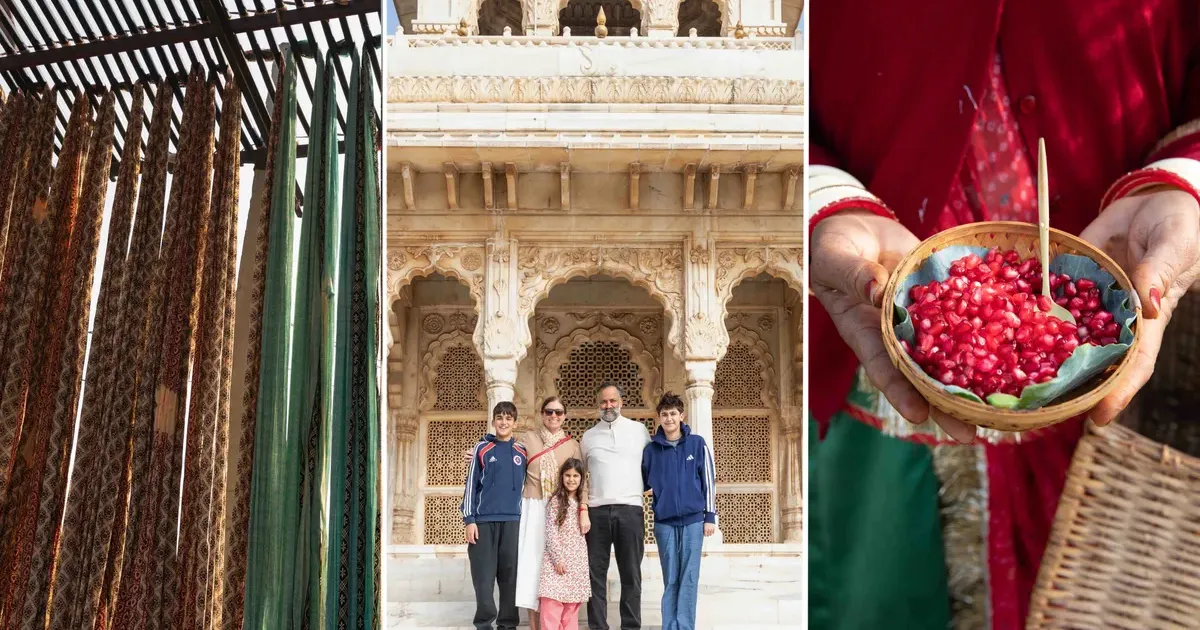
Rajasthan welcomed a family of five in early 2026 to explore the state's storied artisan corridors. Artisan workshops provided the structural structure for a journey that focused on tactile creation over passive sightseeing. Parents and three teenagers traded typical museum routes for the dusty floors of printing sheds and the precise atmosphere of miniature painting studios. This transition from observer to participant reflects a broader shift in luxury travel within India, where high-net-worth families increasingly seek intellectual and physical immersion in local heritage.

Bagru, a village located outside Jaipur, was the primary classroom for traditional block printing. The Chhipa community has resided here for over three centuries, maintaining a specialized mud-resist technique known as Dabu. Families entering these spaces immediately encounter the rhythmic thud of wooden blocks meeting stretched cotton. Teenage travelers, often accustomed to the friction-less interface of digital devices, found themselves managing the heavy, hand-carved teak blocks used to apply vegetable dyes. Each block must be aligned with mathematical precision to prevent the pattern from breaking.

Bagru Block Printing Dynamics

Natural dyes define the aesthetic of Bagru, utilizing ingredients like indigo, pomegranate rinds, and harda fruit. Artisans teach families how to create deep blacks from fermented iron filings and jaggery. The process requires patience, as fabric must be dried in the intense Rajasthani sun between each layer of color. Children in the group learned that a single slip of the hand could ruin meters of cloth, a reality that forced a level of focus rarely seen in classroom settings. Physical labor provided the necessary friction to slow their pace.

Separately, the environmental impact of these traditional methods offers a counter-narrative to industrial fast fashion. Traditional block printing consumes far less water than factory-scale screen printing. The family observed how waste water from the dyeing process is often recycled to irrigate local fields. Educators and travel experts note that these experiences serve as a practical lesson in sustainable chemistry. Indigo fermentation vats, some of which have been active for decades, represent a living biological history that no textbook can replicate. Heritage remained the ultimate currency.

Jodhpur Indigo Traditions and Textile History

Jodhpur, frequently called the Blue City, offered a different technical challenge involving the chemistry of natural indigo. The family engaged with master dyers who manage the complex oxidation process required to turn fabric from a murky green in the vat to a vibrant azure upon exposure to air. This chemical reaction fascinated the teenagers, who participated in dipping and wringing heavy cotton sheets. $15 billion in annual revenue is generated by India's handicraft sector, yet the survival of these specific, labor-intensive techniques depends on continued international interest and direct patronage.

Still, the difficulty of the work is what kept the younger travelers engaged. Manual labor in the heat of the Thar Desert outskirts provided a sensory anchor that digital entertainment could not match. In fact, the physical exhaustion resulting from a day at the dye vats changed the group dynamic, replacing screen time with discussions about the day's technical hurdles. According to Conde Nast Traveler, hands-on experiences transformed the trip from a series of photo opportunities into a shared vocational trial. Skill acquisition became the primary metric of the journey's success.

Working with your hands forces a different type of memory retention than taking a photo of a monument.

Indigo dyeing requires a specific rhythmic movement to ensure even color distribution. The family worked alongside local artisans, many of whom have practiced the craft for five generations. In turn, the children witnessed the immense physical toll of traditional textile production. The vat masters showed how the skin on their hands had become permanently stained, a mark of their lifelong commitment to the trade. This exposure to the reality of artisanal life removed any romanticized notions of the craft. Success was measured in the depth of blue achieved on the cloth.

Miniature Painting Evolution in Udaipur

Udaipur provided the setting for the family’s introduction to the Mewar school of miniature painting. The art form requires brushes made from a few strands of squirrel hair and pigments derived from crushed semi-precious stones. Master painters instructed the family of five on the steady hand required to render the minute details of palace life and local flora. The sheer scale of the task, where a single square inch of painting might take hours to complete, presented a sharp contrast to the rapid-fire consumption of modern social media. Precision was non-negotiable.

But the focus required for miniature painting served a meditative purpose for the teenagers. Each member of the family attempted to recreate traditional motifs under the watchful eye of a local master. They used real gold leaf and malachite green, learning how different minerals react to the local humidity. 1.4 billion people live in India, yet only a small fraction maintains the expertise required for these high-precision arts. The workshop highlighted the fragility of this human capital. Every brushstroke was a lesson in historical preservation.

Miniature painting in Rajasthan dates back to the 16th century, originally commissioned by Rajput royalty. Travelers today find that these studios often function as small family businesses where knowledge is passed from father to son. The family from the report observed three generations of painters working in the same room, each at a different stage of mastery. The proximity to a working guild provided a perspective on career longevity and vocational dedication that is absent from modern corporate structures. Time moved differently in the studio.

Experiential Tourism Growth and Economic Impact

Tourism accounts for approximately 15 percent of the Rajasthan economy, with a growing segment shifting toward these participatory models. Traditional sightseeing is being replaced by what industry analysts call the creator-traveler model. Families are no longer content with viewing the Taj Mahal or the Amber Fort from a distance. They want to know how the marble was inlaid and how the silk was woven. So, the state government has begun encouraging artisan-led tours to distribute tourism revenue more equitably among rural communities. Economic stability follows these intentional visitors.

Yet, the pressure on these communities to perform their craft for tourists is still a complex issue. The family of five noted that while their presence provided income, it also required the artisans to pause their actual production schedules. The trade-off between education and productivity is a constant tension in the craft hubs of Jaipur and Bagru. Despite this, the direct interaction ensures that the next generation of travelers understands the value of handmade goods. Direct engagement remains the most effective tool for heritage conservation. Labor is the bridge between cultures.

The Elite Tribune Perspective

Why do we pay to perform the very manual labor that modernization was supposed to eliminate? The rise of craft-focused family travel in Rajasthan is not merely a search for authenticity, it is a desperate reaction to the weightlessness of the digital age. Wealthy Western families are spending thousands of dollars to sit on dirt floors and stain their hands with indigo, seeking a friction that their selected, comfortable lives have scrubbed away. It is not just a vacation, it is a corrective measure for a generation of children who have never produced anything more real than a digital file. We have reached a point where manual labor is marketed as a luxury amenity.

There is a quiet irony in the survival of centuries-old Indian traditions now rests on the short attention spans of American and British teenagers. While these workshops provide essential capital to the Chhipa or Mewar communities, they also risk turning ancient vocations into a theme-park experience for the global elite. If the only way to save a craft is to turn it into a two-hour workshop for tourists, we must ask what is actually being preserved. Is it the craft itself, or just a performance of it? Real heritage is found in the grueling, unglamorous daily grind of the artisan, not the sterilized version sold to families seeking a meaningful backdrop for their next update.