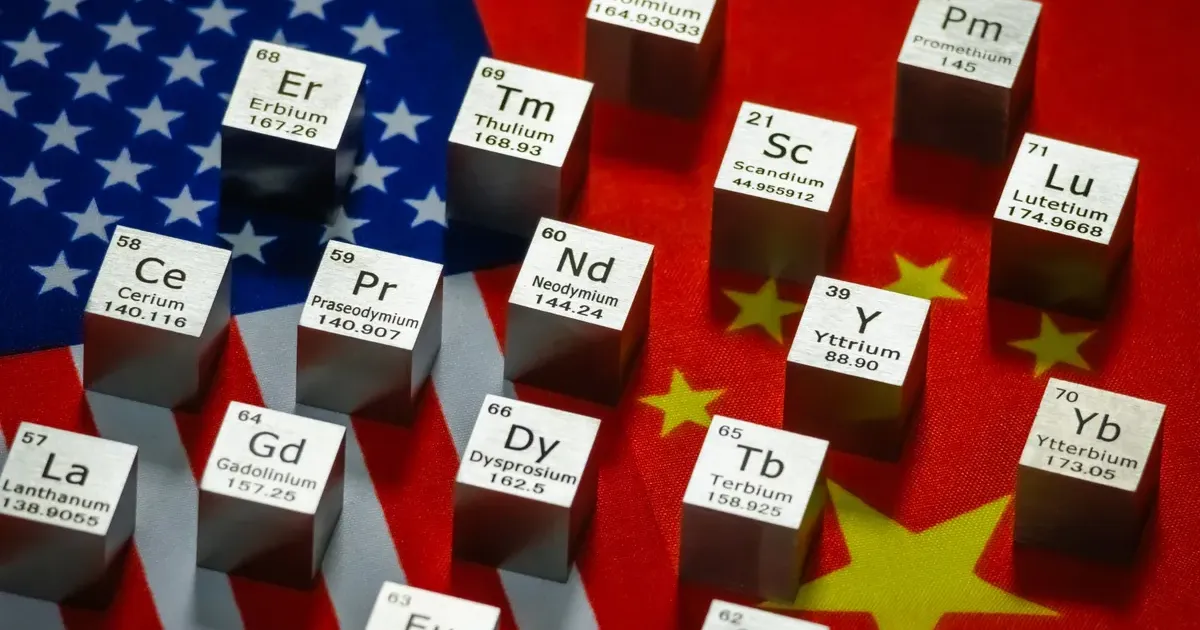
China's grip on rare earth processing has turned a materials supply chain into a strategic choke point for global technology companies and governments. Mining executives gathered at the U.S. Capital Access Forum in Singapore with a level of bluntness rarely heard in public diplomatic circles. The March 10, 2026 forum placed the warning inside a broader supply-chain debate. Mick McMullen, a veteran of the extraction industry, stood on the sidelines of the event and laid out a grim reality for Western industrial planners. Beijing has spent three decades securing a stranglehold on the rare earth elements required for modern existence, and the United States has only recently woken up to its vulnerability. China currently controls approximately 70 percent of global rare earth production. Processing capacity tells a more lopsided story, with Chinese facilities handling nearly 90 percent of the world's refining. This dependence has turned an obscure corner of the mining sector into the sharpest edge of geopolitical leverage. China is the leader, and the U.S. is far behind, McMullen told reporters. He noted that it is difficult to believe Western nations took so long to realize the necessity of housing these supply chains domestically. Beijing did not achieve this dominance through market forces alone. Since the 1980s, the Chinese state has funneled billions of dollars into subsidies and long-term infrastructure to ensure that no other nation could compete on price or scale. Western companies found it cheaper to outsource the environmentally hazardous and chemically intensive refining process to Chinese provinces. That short-term financial gain created a long-term security nightmare. The math doesn't add up for a quick recovery.
Refining rare earths involves separating 17 different elements that are often found clumped together in ore. Elements like dysprosium, terbium, and samarium are essential for the high-strength magnets used in electric vehicle motors and wind turbines. Defense contractors rely on these same materials for precision-guided munitions and the radar systems of advanced fighter jets. Because Beijing controls 90 percent of the processing, it essentially decides which global industries live or die during a trade dispute. Last year, that power was used as a weapon.
Trade Warfare and Export Controls
Retaliation became the primary tool of Chinese diplomacy in 2025 when President Donald Trump imposed a new round of aggressive tariffs on Chinese goods. Beijing responded by slapping strict export controls on samarium, dysprosium, and terbium. These specific metals are the lifeblood of the semiconductor and defense sectors. Global automakers suddenly faced the prospect of halting production lines within weeks because they could not source the magnets required for their electric drive units. Supply chains were pushed to the brink of collapse before a tentative tariff truce was reached last November. Temporary peace has returned, yet the underlying threat remains unchanged. Beijing has demonstrated that it can sever the carotid artery of Western high-tech manufacturing at will.
Historical precedents show this is a recurring tactic rather than an isolated event. Japan experienced similar export freezes during territorial disputes years ago. Every time a diplomatic friction point arises, rare earths become the pressure point. While the United States tries to revive the Mountain Pass mine in California and subsidize new processing plants in Texas, these projects will take years to reach the scale of Chinese operations. Beijing has a 30-year head start that cannot be erased by a single budget cycle or a handful of grants.
Global markets remain jittery because the truce is fragile. Investment flows into Western mining have increased, but the technical expertise for large-scale refining has largely migrated to China. Engineering talent and chemical processing patents are concentrated in Chinese universities and state-owned enterprises. Replacing that intellectual capital is proving as difficult as digging the ore itself. Still, the external strength of China's monopoly masks a growing internal rot that could eventually undermine its global ambitions.
The Shrinking Chinese Dream
Economic reports for 2025 showed China hitting its 5 percent GDP growth target, but those figures are increasingly viewed with skepticism by analysts on the ground. Statistics often hide the lived reality of a generation that has stopped believing in the promise of upward mobility. The housing market, which once accounted for a massive portion of household wealth, continues to buckle under the pressure of unpaid debts and unfinished high-rises. Young Chinese citizens are the ones feeling the impact most acutely. Millions of Gen Z and millennial workers are trading down their lifestyles, moving from luxury brands to discount apps and from ambitious career paths to survivalist minimalism.
Youth unemployment has climbed to 17 percent, according to official data, though independent researchers suggest the true figure may be higher once those who have given up looking for work are included. Stories of overqualified graduates have flooded social media. One doctoral graduate gained national attention after posting about his transition to food delivery work to pay for basic necessities. A gas company recently made headlines for recruiting master's degree holders to work as simple meter readers. This structural failure in the labor market suggests that the return on a college education has decoupled from reality. Young people are no longer convinced that hard work leads to a middle-class life.
Caution has replaced the frantic consumerism of the early 2000s.
Sociologists observe a growing scarcity mindset among the youth in major cities like Shanghai and Shenzhen. Zak Dychtwald, head of the Young China Group, notes that while a formal recession might not be on the books, the symptoms of one are everywhere. Underemployment and stagnant wages have created a deep sense of morass. This generational retreat into safety and saving is a direct threat to a government that relies on domestic consumption to offset shrinking export demand. If the youth stop spending and stop aspiring, the engine of the Chinese economy begins to stall from the inside out.
Divergent Paths of a Fragile Superpower
While Bloomberg suggests that China can manage its debt crisis through state intervention, Reuters sources indicate that the social contract between the Communist Party and its citizens is fraying. The promise of prosperity in exchange for political compliance is harder to maintain when graduates are delivering noodles. Xi Jinping's administration faces a paradoxical challenge. It must project strength abroad by leveraging its rare earth monopoly while managing a domestic crisis of confidence that threatens long-term stability. The global economy is now caught between a China that is too dominant to ignore and too fragile to trust.
Economic ties remain deeply entwined despite the talk of decoupling. Western companies cannot build a green energy future without Chinese refined metals, yet they cannot rely on a partner that treats trade as a weapon. That disparity creates a volatile environment for the remainder of 2026. If the domestic economy continues to sour, Beijing may be tempted to use its external leverage even more aggressively to distract from internal failings. The world is watching to see if the leader in rare earths can solve its most rare problem: restoring the hope of its own people.
Technology Leverage
Has the West finally realized that a superpower built on state-sponsored monopolies and suppressed internal dissent is eventually going to crack? We have spent decades feeding the Chinese dragon because it was convenient for our quarterly earnings reports, and now we act shocked when it breathes fire. The 2025 export controls on samarium and dysprosium were not just a trade move. They were a declaration of war on Western technological independence. The fact that the U.S. and Europe allowed 90 percent of rare earth processing to move to a single, hostile actor is perhaps the greatest strategic failure of the post-Cold War era.
Relying on a truce signed by a populist American president and a Chinese leader facing a domestic youth revolt is a fool's errand. Beijing is not our partner. It is a landlord that owns the foundation of our house and is threatening to pull the lease. While young Chinese graduates deliver food and give up on the future, their government is busy ensuring that we cannot build a single F-35 or Tesla without their permission. We must stop pretending that China is a stable participant in the global order. It is a wounded giant, and wounded giants are the most likely to lash out when their internal dreams begin to die.