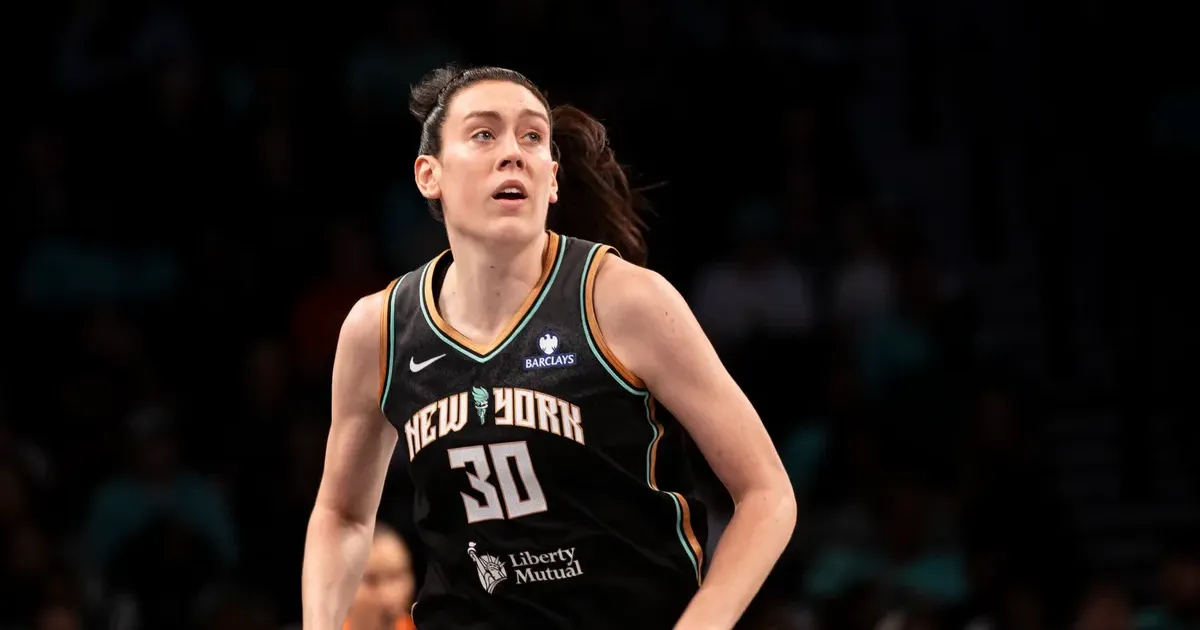
Breanna Stewart confirmed that she will remain with the New York Liberty instead of exploring the open market. Speaking during a podcast appearance with Myles Turner of the Milwaukee Bucks, the three-time champion clarified that her status as an unrestricted free agent would not translate into a departure from Brooklyn. The relevant events were dated April 1, 2026. Loyalty to the franchise and personal family stability drove her choice to bypass meetings with rival organizations. Stewart enters this new phase of her career after leading the team through three consecutive postseason appearances.
Negotiations for the veteran forward come at a transformative time for the league economics. A huge leap in the salary cap from $1.5 million per team to $7 million under the new collective bargaining agreement changes the math for every franchise. Supermax contracts now reach as high as $1.4 million per year. These figures represent a meaningful departure from the $222,400 Stewart earned during the 2025 campaign. Financial analysts expect the Liberty to offer a deal that reflects her status as the primary engine of their offense.
Liberty Financial Stakes and Salary Cap Expansion
Market conditions for elite players underwent a total overhaul during the recent labor negotiations. New revenue streams from broadcast rights and increased attendance pushed the league to accept a model that allows for seven-figure individual salaries. Stewart stands at the front of the line to capitalize on these gains. League sources indicate that the transition from a $1.5 million cap to a $7 million cap provides the New York Liberty with the flexibility to retain their core while offering record-breaking compensation. Players who signed short-term deals through 2025 are now positioned to see their lifetime earnings trajectory shift upward instantly.
Executive decisions in the front office focus on long-term sustainability. General Manager Jonathan Kolb faces the task of balancing a roster that includes multiple high-scoring threats. Retaining Stewart is the requirement for any future title contention. While the official contract paperwork remains pending, her public declaration removes the leverage other teams hoped to use during the signing window. Rival scouts had identified several potential landing spots for the 31-year-old before her announcement on the Game Recognize Game podcast.
Consistency in leadership defines the current era of basketball in Brooklyn. Stewart has averaged league-leading numbers in points and defensive rebounds since her arrival from the Seattle Storm. Personal ties to the New York area played a decisive role in her refusal to entertain outside offers. Her family has established roots in the city over the last three years. Physical proximity to business ventures and marketing opportunities further solidified the case for staying in the Atlantic over the Pacific or Midwest.
Championship Pedigree and Roster Stability
Success on the court remains the strongest reason for Stewart to stay put. The roster features an elite secondary scorer in Sabrina Ionescu and a dominant interior force in Jonquel Jones. These three pillars formed the foundation of the 2024 championship run. Ionescu averaged 18.2 points and 5.7 assists last season, providing the perimeter spacing necessary for Stewart to operate in the high post. Chemistry between these stars has improved with each passing month of competition.
‐I’m gonna just set the record straight here, I will be staying in New York,‐ Stewart said on ‐Game Recognize Game w/Stewie & Myles.‐ ‐I’m not planning on taking any free agency meetings even though I am an unrestricted free agent. My family is set up here. We’re solid here. I’m going to be back in New York and that’s all there is to it.‐
Depth issues that plagued the team in earlier seasons found resolution through the acquisitions of Emma Meesseman and Natasha Cloud. Meesseman provided 13.4 points per game while Cloud added double-digit scoring and defensive versatility. This supporting cast allows Stewart to maintain high efficiency without bearing the entire offensive load. Maintaining this specific group requires a precise navigation of the new cap rules. Most observers believe the Liberty ownership group is willing to enter luxury tax territory to keep this specific starting five intact.
Roster continuity gives the Liberty a distinct advantage over teams undergoing total rebuilds. Stability in the locker room translates to fewer missed assignments on the defensive end. Coaching staff members have noted that Stewart functions as a secondary coach on the floor. Her basketball IQ allows the team to run complex defensive schemes that other squads cannot replicate. Opposing coaches often complain that the Liberty starting lineup feels like a national team selection.
Global Impact of WNBA CBA Changes
International prospects and domestic veterans alike are monitoring the New York situation. High salaries in the United States might reduce the need for players to compete in Europe or China during the winter months. Stewart has been a vocal advocate for better player compensation and improved travel conditions. Her decision to stay in a major market like New York amplifies the league's visibility during this expansion phase. Sponsors are more likely to commit long-term capital when the biggest stars are tied to the biggest cities. The presence of a 31-year-old icon in the Brooklyn market ensures sell-out crowds at the Barclays Center for the foreseeable future.
Domestic television ratings for Liberty games have climbed by 40 percent over the last 24 months. Network executives attribute much of this growth to the rivalry between New York and emerging powers in Las Vegas and Indiana. Stewart is the face of this growth. Her individual accolades, including three All-Star appearances as a Liberty player and two All-WNBA first-team selections, provide the league with a marketable hero. Fans buy jerseys and tickets to see a player who has already secured a league MVP and a championship in New York colors.
Future expansion teams in Golden State and Toronto will look at the Liberty model as the blueprint for success. Building around a generational talent who is willing to commit long-term is the goal for every new owner. Stewart’s refusal to engage in the drama of a free agency tour shows a preference for legacy over headlines. This choice keeps the focus entirely on the upcoming training camp. Pre-season projections already place New York at the top of the power rankings. Betting markets moved the Liberty to even-money favorites for the title immediately following her podcast reveals.
Preparation for the 2026 season begins with a focus on load management. Stewart has logged heavy minutes over the last decade of professional and Olympic play. Training staff in Brooklyn has designed a specialized recovery program to ensure her longevity into her mid-thirties. This level of institutional support is difficult to find elsewhere. Continuity in medical care and personal training is a perk that veterans prioritize as they age. Every detail of the Liberty organization is now improved to support their franchise centerpiece.
Liberty Roster Signal
Does the elimination of free-agency drama actually benefit the league, or does it simply cement a hierarchy where the rich get richer? Stewart’s decision to bypass negotiations is a calculated move that reinforces the ‐superteam‐ era while effectively killing any hope for parity among smaller franchises. By staying in Brooklyn, she ensures that the competitive imbalance remains skewed toward markets with the deepest pockets and the most aggressive ownership groups. It is not about loyalty; it is about the consolidation of power in a league that is still trying to figure out if it can survive without a handful of dominant dynasties.
Parity is dying in the professional ranks. When the best players refuse to even listen to pitches from other teams, the concept of a free market becomes a total illusion. The new salary cap was supposed to distribute talent more evenly across the map, but instead, it has given the Liberty the financial firepower to build a fortress. Smaller markets cannot compete with the off-court opportunities or the sheer institutional inertia of a championship core in New York. If every superstar follows this path of least resistance, the WNBA risks becoming a two-team race every single year. Boring is the verdict.