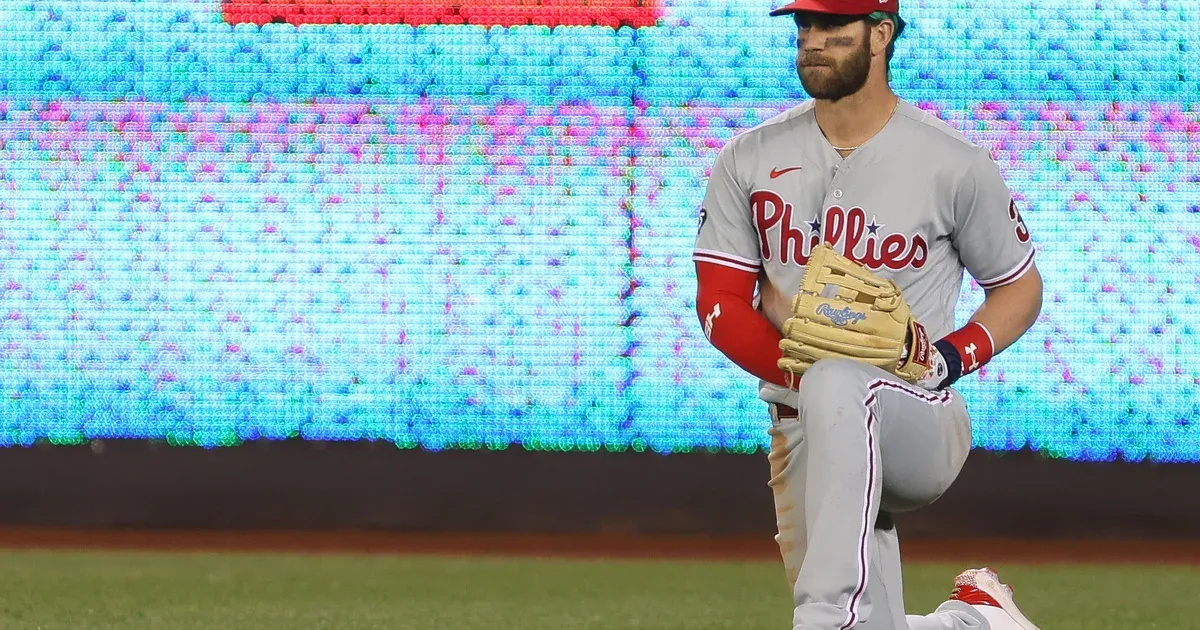
Bryce Harper’s slump has become harder for Philadelphia to treat as a short-term statistical dip. The slump became a national story on March 11, 2026
Harper Becomes the Symbol of the Slump
Bryce Harper stood frozen at home plate in Miami as the third strike whistled past his jersey, a scene that has become a haunting repetition for Team USA during the 2026 World Baseball Classic. The stadium atmosphere, once electric with the anticipation of a dominant American run, now carries the heavy weight of local disappointment and national scrutiny. Critics have turned their attention toward the two-time MVP, whose performance has cratered at the worst possible moment for a roster built on the promise of inevitable victory. Statistics tell a grim story for the Philadelphia Phillies star, who entered the tournament as a centerpiece of the American offense only to find himself in the middle of a historic cold streak.
Harper's batting average has plummeted into the basement of the tournament rankings, leaving fans and analysts questioning his preparation for this international stage. While some observers point to the awkward timing of the spring tournament, others see a lack of focus that has plagued the entire roster since the first day of camp. Reports from the clubhouse suggest a disconnect between the star-studded lineup and the gritty reality of international competition where every out carries the gravity of a playoff game. This lack of urgency has left the American side fighting for its life in the group stages, a position that many thought impossible given the talent on paper. National pride is on the line, yet the performance suggests a team that believed its own press releases before the first pitch was even thrown.
Team USA's talent advantage no longer looked like a guarantee, turning Harper's slump into a symbol of a larger cultural problem.
Arrogance has permeated the American dugout, manifesting in a relaxed attitude that contrasted sharply with the disciplined intensity of opponents like Japan and Mexico. Veteran observers note that Team USA players appeared more concerned with their personal brands and social media presence than the fundamental mechanics of small-ball baseball. This sense of entitlement created a vacuum where leadership should have been, leaving younger players without a roadmap for handling the unique pressures of the World Baseball Classic. Newsweek reports indicate that the internal culture has been described as more of a celebrity exhibition than a professional pursuit of a gold medal. Managers from opposing teams have quietly noted that the American side seemed to treat early-round matchups as glorified spring training exhibitions.
Pitchers for the United States have struggled with location, seemingly surprised by the aggressive hitting styles of nations that possess far lower payrolls but sharply more heart. Success in previous tournaments was built on a foundation of chemistry and desperation, two traits that seem entirely absent from the current iteration of the squad. The 2026 roster possesses plenty of hardware and championship rings, but it lacks the cohesive bond required to survive the high-variance environment of a short tournament.
Team USA's Culture Problem Shows Up at the Plate
Complacency became the primary opponent for a team that forgot how to grind for a win. Mechanical issues have also plagued Harper specifically, as his swing appears long and mistimed against international velocity. Scouts watching from the stands in Miami noted that the slugger is lunging at breaking balls and failing to protect the plate with two strikes, a regression that has neutralized his power. He has managed only two hits in fifteen plate appearances, striking out eight times and leaving more than a dozen runners on base during important late-inning scenarios. These numbers represent a catastrophic failure for a player tasked with anchoring the middle of the order.
The controversy surrounding his selection over younger, hungrier hitters has only grown louder with every empty trip to the dugout. Coaching staff members have attempted to work with Harper in the cages, but the adjustments have not translated to the field under the bright lights of LoanDepot Park. Rival pitchers have discovered a clear blueprint for neutralizing the American superstar, using high-fastballs and sweeping sliders to exploit his current lack of timing. If the United States fails to advance to the quarterfinals, this hitting drought will be remembered as the primary catalyst for their downfall. Pressure continues to mount as the standings show a precarious path forward, requiring a series of wins and favorable tiebreakers just to stay in the hunt for a medal.
Nations like the Dominican Republic and South Korea have historically prioritized this tournament as the pinnacle of the sport, creating a disparity in motivation that is now glaringly obvious. American players often view the WBC through the lens of injury risk and regular-season preparation, a mindset that prevents the total commitment seen in their rivals. The current struggle in 2026 reflects a broader debate about whether MLB stars are truly invested in the concept of a global championship. While the league offices in New York desperately want the tournament to succeed as a marketing vehicle, the on-field product currently suggests a lopsided interest level that favors the underdogs.
Failures on this stage carry long-term implications for the growth of the game in the United States, where baseball already faces stiff competition from the NFL and NBA for the attention of younger fans. A humiliating exit in the group stage would reinforce the narrative that American baseball is stagnant or out of touch with the evolving global environment. Fans in Miami have already begun to voice their displeasure, with boos echoing through the stadium during Harper's most recent strikeout.
Why Global Baseball No Longer Waits for America
American exceptionalism died a quiet death on a dirt diamond in Florida this week, buried under the pressure of oversized egos and microscopic batting averages. Why do we continue to pretend that a collection of millionaires who view international play as a chore will ever match the fire of players from Curacao or Panama? The arrogance displayed by Team USA is not just a locker room problem; it is a systemic rot that comes from rewarding individual highlights over collective triumph. Harper has become the avatar for this failure, a star with a massive contract and reputation but almost no production when the lights are at their brightest.
Bryce Harper is the perfect avatar for this failure, a man with a massive contract and a massive reputation who has provided zero production when the lights are at their brightest.
Professional baseball in the United States has become so insulated by its own wealth that it has forgotten how to compete in a world that no longer fears the pinstripes or the stars and stripes. If these athletes cannot find the dignity to hustle for a ground ball in a national uniform, they should stay in Arizona and Florida for spring training. We are tired of the excuses about timing and pitch counts. Either the United States needs to send a roster of hungry minor leaguers who actually care about the jersey, or we should stop participating in the World Baseball Classic entirely. The current circus is an embarrassment to the sport and a slap in the face to every fan who bought a ticket expecting a championship effort.