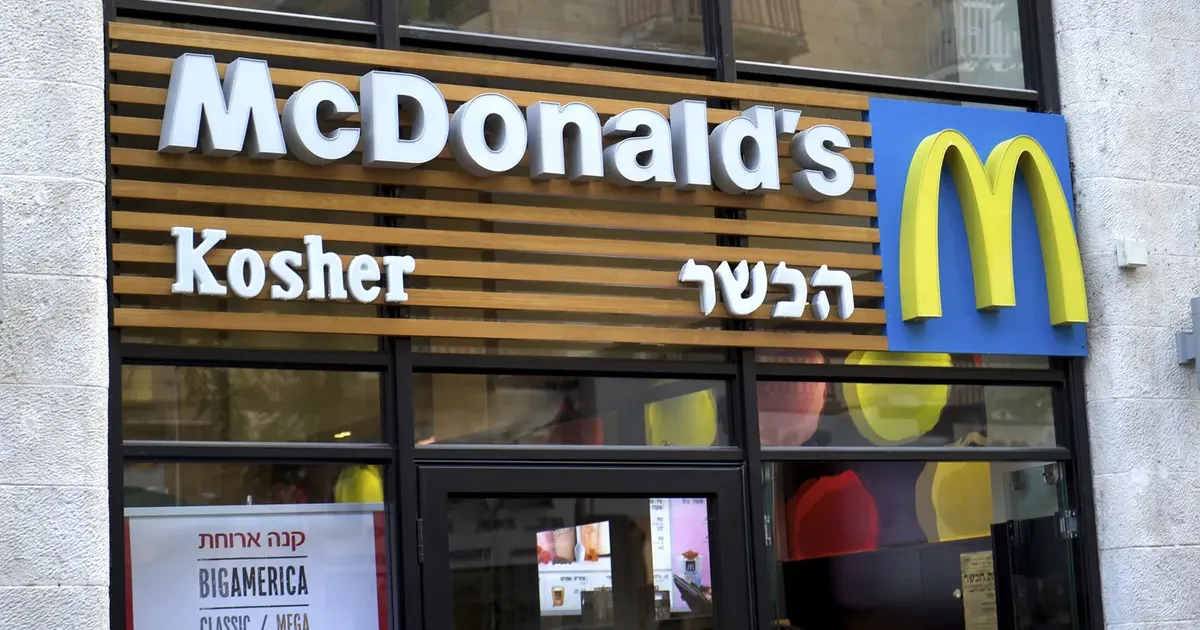
Religious Tradition Meets Global Fast Food
Shoppers walking through the vaulted corridors of the Abasto de Buenos Aires mall often stop in their tracks when they reach the food court. Neon signs glow with the familiar golden arches, but the text below them is written in Hebrew script. Customers do not find the standard menu options common to the thousands of other locations across the globe. There are no cheeseburgers here. Bacon is nonexistent. Instead, this specific franchise operates under the strict dietary laws of Kashrut, making it the only kosher McDonald's on the planet that is not located within the borders of Israel.
Buenos Aires serves as the epicenter for one of the most vibrant Jewish communities in the world. Argentina holds the largest Jewish population in Latin America, a demographic reality that paved the way for this unique culinary experiment in 1998. While McDonald's maintains a handful of kosher locations in Israel, the logistical and financial hurdles of maintaining such a facility elsewhere have deterred operators in New York, London, and Paris. The Abasto location stands as a solitary outlier, surviving economic fluctuations and cultural shifts for over a quarter of a century.
Historical Roots of the Argentine Jewish Community
Jewish immigration to Argentina began in earnest during the late 19th century. Thousands arrived to escape persecution in Europe, settling in agricultural colonies and later moving into the bustling neighborhoods of the capital. The Once district, where the Abasto mall is located, became the heart of Jewish life. Synagogues, schools, and community centers flourished here, creating a localized demand for services that respect religious traditions. Arcos Dorados, the massive company that operates McDonald's across Latin America, recognized that a kosher location would serve as both a functional restaurant and a powerful statement of community respect.
Woods Staton, the founder of Arcos Dorados, saw an opportunity to integrate global branding with local identity. His decision to open the branch in the Abasto mall was deliberate. The building itself is a restored 1930s central fruit and vegetable market, an architectural marvel that symbolizes the city's commercial history. By placing a kosher restaurant in this prominent space, the company signaled that it was willing to adapt its rigid global standards to meet the spiritual requirements of a loyal customer base. The branch remains a point of pride for residents who view it as a symbol of the city's pluralism.
Challenges of Maintaining a Kosher Kitchen
Operating a kosher fast-food restaurant requires far not merely removing cheese from a burger. Every aspect of the supply chain must be scrutinized. The meat must come from animals slaughtered according to specific rituals performed by a trained professional known as a shochet. Once the meat reaches the restaurant, it must remain entirely separate from any dairy products. In a standard McDonald's, milkshakes and ice cream machines are staples, but here, the kitchen is designed to ensure no cross-contamination ever occurs. This kitchen uses separate utensils, grills, and storage areas to satisfy the requirements of the Gran Rabinato de Agudath Israel.
Rabbinical supervisors, or mashgiach, are frequently present to monitor the preparation of food. These experts ensure that all ingredients, including the oil used for fries and the buns for the burgers, meet the high standards of kashrut. The fries are cooked in pure vegetable oil, and the patties are prepared on grills that have never touched pork or cheese. Because of these requirements, the menu is slightly more expensive than a standard Argentine McDonald's, reflecting the higher costs of certified ingredients and constant supervision. Yet, the restaurant continues to thrive, drawing tourists from around the world who want to experience a McKosher meal.
Economic Logic of Arcos Dorados
Business experts often point to the Abasto location as a study in niche marketing. Arcos Dorados manages over 2,000 restaurants, yet they maintain only this one kosher outlet outside of Israel. The financial math is complicated. Standard McDonald's locations rely on high volume and standardized processes to maintain profit margins. A kosher kitchen breaks that standardization. It must close every Friday evening for Shabbat and remain shuttered all day Saturday, missing out on some of the busiest hours for a shopping mall. It also closes for major Jewish holidays like Passover and Yom Kippur.
Reliable revenue comes from the local community, but the branch also benefits from being a unique destination. Travelers from the United States and Europe frequently visit the Abasto just to photograph the Hebrew signage and taste a burger that adheres to their religious needs. While a single restaurant may not sharply impact the bottom line of a multi-billion dollar corporation like Arcos Dorados, the reputational value is immense. It fosters brand loyalty among a demographic that might otherwise feel excluded from the global fast-food experience. The company proves that its systems are flexible enough to accommodate ancient laws without losing the core identity of the brand.
Why New York and London Failed to Compete
Questions often arise as to why similar branches do not exist in Brooklyn or North London, areas with massive Jewish populations. The answer lies in the competitive environment. In New York, the market for kosher food is saturated with local delis, high-end steakhouses, and independent burger joints. A kosher McDonald's would have to compete with established local favorites that already have deep ties to the community. Still, the cost of commercial real estate in New York makes the Shabbat closures financially punishing. If a restaurant cannot operate for 24 hours of the peak weekend cycle, it often fails to cover its overhead.
Buenos Aires offers a different dynamic. The Abasto mall is a centralized hub where the kosher McDonald's faces less direct competition within the mall environment. It is convenient, trusted option for families who are already shopping or visiting the nearby children's museum. The operational success in Argentina is a combination of cultural density and a lack of comparable corporate competitors willing to go through the rigorous certification process. For now, the Abasto branch remains a singular phenomenon in the world of international dining.
The Elite Tribune Perspective
Is a cheeseless Big Mac a victory for cultural inclusion or a cynical marketing ploy designed to capture every last cent of the religious dollar? One must wonder why a global behemoth like McDonald's, which prides itself on relentless efficiency, chooses to tolerate the logistical nightmare of rabbinical oversight in exactly one location outside the Middle East. The answer is not found in a spirit of pluralism but in the cold, hard logic of brand dominance. By occupying the Abasto mall with a kosher branch, Arcos Dorados ensures that no local kosher competitor can gain a foothold in the city's most prestigious shopping destination. They have effectively colonized a religious niche, turning a dietary requirement into a corporate moat. Critics might celebrate this as a sign of respect for Jewish traditions, but it is actually a demonstration of how capitalism can absorb any culture, any religion, and any tradition into its own image. When the sacred laws of a four thousand year old faith are reduced to a marketing gimmick for processed meat, the only real winner is the shareholder. We should stop applauding the golden arches for doing the bare minimum to extract profit from a captive audience.