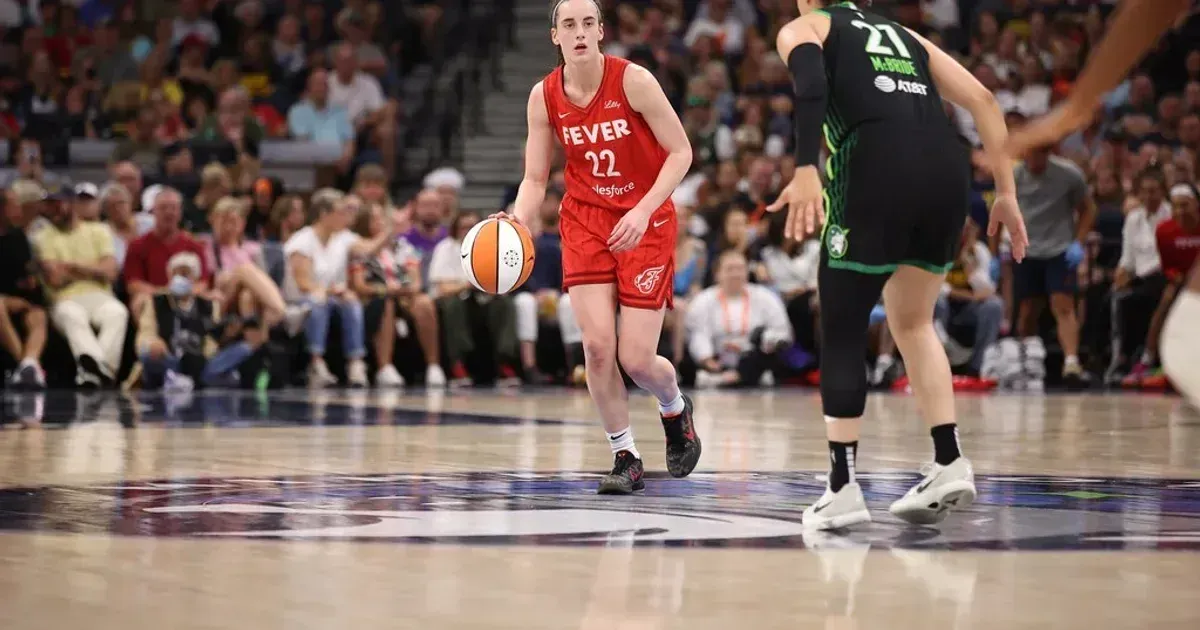
Caitlin Clark's preseason leg sleeve drew attention at Indiana Fever practice, adding a health subplot to a season already shaped by expectations. The concern surfaced as the 2026 WNBA GM Survey showed a changed executive view of the Fever guard, with Paige Bueckers leading one of the league's most watched future-franchise questions.
The two developments should not be collapsed into one alarm. On May 6, 2026, the leg sleeve was a training-camp issue that Clark had addressed as part of managing her body before the season. The survey is a leaguewide perception snapshot, not a medical report or a prediction of how the Fever will play.
Leg Sleeve Question
Newsweek reported that Clark addressed the sleeve after an injury scare during Fever preseason work. The important detail is that no final injury ruling has been attached to the equipment. In a league that has become more careful about workload, visible support gear can draw instant attention even when teams are simply managing risk.
That context matters because Clark's value to Indiana is not limited to scoring. She organizes the offense, drives ticket and television interest, and gives the Fever a clear late-game identity. Any sign of physical caution around her naturally becomes a team story before it becomes a league story.
The Fever have little reason to force urgency in early May. Preseason is the right window for conservative training decisions, especially for a high-usage guard who faces constant ball pressure and contact. If the sleeve remains precautionary, the story will fade quickly. If limitations continue, Indiana's depth and spacing plans will become more important.
Clark's previous injury history is why even a precaution attracts coverage. Indiana's offense is designed around her range, passing angles and ability to bend defenses before a play fully develops. A limited Clark changes the geometry of every possession. That does not make the sleeve proof of a major setback, but it explains why the team will be cautious with public messaging.
GM Survey Shift
The official WNBA survey showed how quickly executive perception can move. When general managers were asked which player they would sign first to start a franchise, Bueckers led with 33 percent, while Clark tied A'ja Wilson at 20 percent. Last year, Clark led that question at 50 percent.
Clark also slipped in several skill categories. Chelsea Gray led the best point guard vote at 73 percent, with Clark second at 20 percent. Gray also dominated the best passer category at 93 percent, while Clark received 7 percent. For MVP, Clark was listed only among players also receiving votes as A'ja Wilson led the field.
Those numbers are not a rejection of Clark. They show that general managers are balancing her offensive gravity against other players' experience, two-way value and championship resumes. Bueckers' rise also reflects how quickly a new elite guard can change the league's long-term conversation.
The survey methodology matters here. General managers cannot vote for their own team or personnel, and percentages are based on the pool of respondents for each question. That makes the results useful as a temperature check, not as a definitive ranking. A small voting pool can move sharply when a few executives change their view.
Fever Stakes
For Indiana, the practical question is not whether Clark wins a survey. It is whether she is healthy enough to raise the Fever's offensive floor while the roster around her matures. Executive polling can change by the month; availability and playoff performance change the franchise.
The survey drop may even lower the noise around her. Clark entered the league under unusually heavy attention, and every ranking became a referendum on whether she was overrated or underappreciated. A more measured preseason assessment gives her room to answer with efficiency, decision-making and team results.
The Fever will still be judged through Clark because she remains the organizing force of their project. The leg sleeve makes her health the immediate concern, while the GM survey shows the league is no longer treating her trajectory as automatic. That combination creates pressure, but it is also a clearer standard: stay available, make Indiana better and let the rankings chase the season.
That is the most useful way to read the week. The sleeve is a reminder that her body has to survive the schedule. The survey is a reminder that the league keeps moving even around its biggest draw. Clark's response can only come on the floor, where perception is usually rewritten faster than it is printed. For the Fever, that makes May less about defending Clark's reputation than managing the conditions for her next step. The survey gives rivals a headline, and the sleeve gives trainers a priority. Indiana's answer has to be practical: keep her available, reduce the easy defensive reads and let the season supply the argument. Everything else is preseason noise.