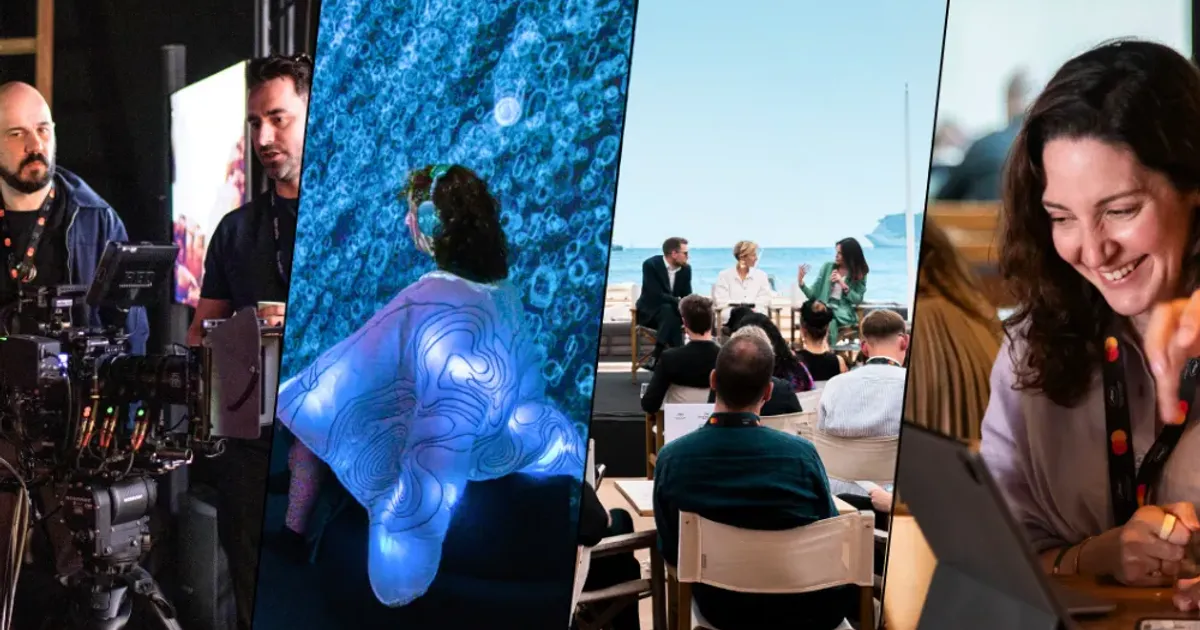
Marche du Film's first Creator Economy Summit was a signal that Cannes no longer sees digital creators as festival-side traffic. The May 17 forum at Plage des Palmes sat inside a wider Cannes Next program that ran from May 12 to 20, with AI, virtual production, immersive work and creator-led business models pushed closer to the center of the market.
The summit matters because the old film-market map is being redrawn from several directions at once. Creators bring audience relationships before a project is financed. Platforms shape discovery before a distributor buys rights. AI tools are entering development, localization, VFX and marketing. Virtual production is moving from studio-scale spectacle toward more accessible production planning. Cannes is not endorsing every part of that change. It is admitting that serious film business now has to negotiate with it.
The Summit Put Creators Inside the Market
The official Marche du Film description framed the Creator Economy Summit as a brand-new forum bridging traditional cinema and the creator economy. The wording is important. The summit was not only about inviting influencers to a red carpet or asking creators to promote finished films. It was about the commercial machinery behind digital-first audiences: financing, distribution, rights, platform strategy and how a creator's direct fan relationship can become part of a screen project.
Traditional producers have something creators often need: legal structure, budgeting discipline, international sales experience and the ability to turn a concept into a durable asset. Creators have something film companies increasingly struggle to buy: attention that already exists. The useful business question is not which side is more authentic. It is whether those assets can be combined without reducing creators to marketing channels or producers to back-office service providers.
Audience Ownership Is the New Rights Argument
The hardest negotiations will be about ownership. A creator may control the audience relationship, a producer may shape the underlying work, a financier may carry development risk and a platform may control discovery. If those roles are not defined early, the creator economy can reproduce old exploitation with newer language.
Film markets know how to price territories, windows and library value. They are less fluent in measuring a creator's community, data access or platform dependence. A large following is not the same as a paying audience, and a viral clip is not the same as a feature-film business. Cannes can be useful if it forces those distinctions into contracts rather than letting excitement carry deals past the difficult parts.
AI Moved From Side Panel to Industry Fault Line
The AI for Talent programming returned in a year when artificial intelligence was one of Cannes' most divisive subjects. AP and the Guardian described a festival conversation split between filmmakers who see AI as another production tool and critics who fear job loss, authorship confusion and synthetic work that weakens trust. Steven Soderbergh's AI-assisted John Lennon documentary and Darren Aronofsky's public defense of AI as an additive tool became part of the wider debate.
AI therefore cannot be treated as a neutral efficiency pitch. It touches consent, compensation, disclosure, performance rights and the value of human craft. Localization, restoration, previsualization and budgeting may benefit from AI tools. Replacing writers, performers or designers without clear rules is a different matter. Cannes is the right place for the argument because the market is where artistic language becomes contract language.
Virtual Production Is Becoming a Market Question
Virtual production also belongs in this conversation because it changes how projects are costed and sold. LED volumes, real-time environments and remote collaboration can reduce travel, help independent producers pre-plan scenes and give financiers a more concrete view of complicated worlds before shooting begins.
The risk is visual sameness. A tool that promises control can also flatten taste if everyone buys the same digital surfaces and the same lighting logic. For Cannes, the better use of virtual production is not to make every film look expensive. It is to help producers decide when the tool protects the story, the budget or the schedule. If it becomes a showroom gimmick, filmmakers will feel the technology before they feel the film.
Cannes Is Defending Its Role as a Deal Filter
Marche du Film has long mattered because it compresses financing, sales, distribution, festivals, talent and territorial buyers into one week of pressure. The creator economy threatens the market model only if deals move outside the rooms where professional standards are set. By bringing creators, AI companies, investors and producers into the market, Cannes is trying to remain the place where new power is tested rather than merely observed.
Bringing new participants inside does not mean every creator project deserves a film deal or every AI demo deserves artistic respect. It means the market has to decide which new models can survive rights scrutiny, financing discipline and audience fatigue. Cannes' advantage is not novelty. It is the ability to make novelty face people who know how quickly hype can lose money.
The New Economy Still Needs Old Discipline
The creator summit, AI panels and virtual production focus all point in the same direction: cinema business is expanding beyond the old studio-sales-agent-broadcaster chain. But the standards cannot disappear just because the tools and audiences have changed. Rights still need clarity. Labor still needs protection. Budgets still need honesty. Viewers still need work that feels made, not assembled from trend reports.
Cannes is choosing to host that collision instead of pretending it is temporary. Hosting the collision is the right instinct. The market will remain relevant only if it can welcome creators, test AI claims and price production innovation without forgetting why films need more than attention. Platform power can open doors. It cannot replace taste, trust or the contract discipline that keeps a screen project from becoming a short-lived content event.