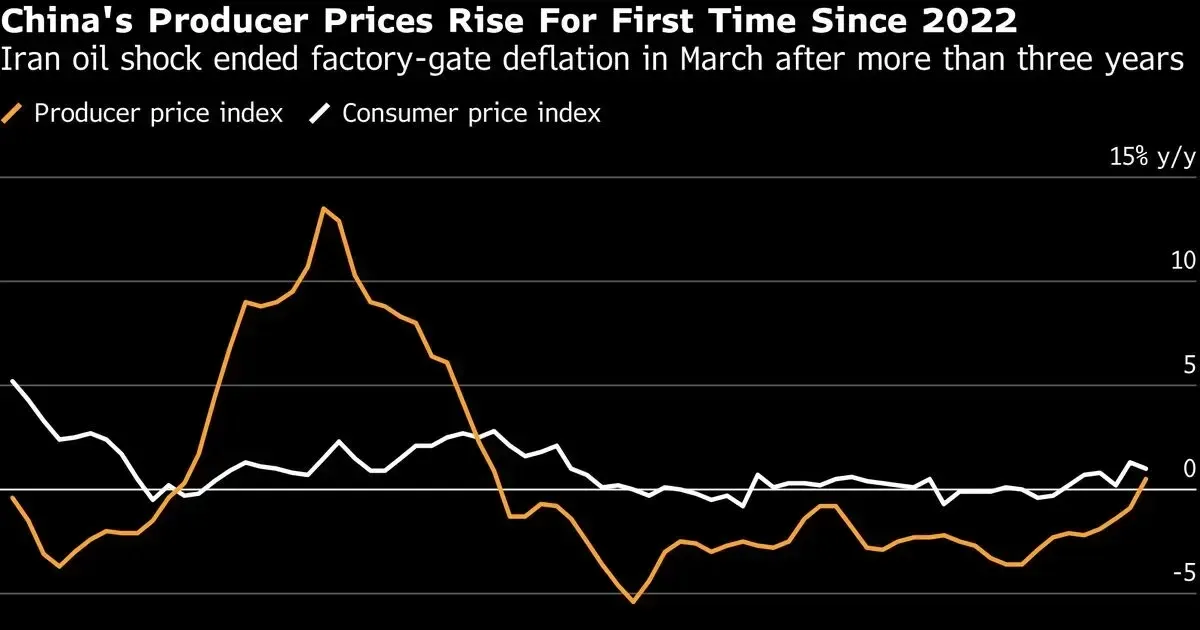
China's factory prices have moved out of a long deflationary stretch, but the shift looks more like an energy shock than a clean demand recovery. Importers had relied on Chinese weakness to cushion goods prices, and that cushion now looks thinner. The change became a warning for buyers that shipping, oil and factory costs can move together. Data from the National Bureau of Statistics showed on April 10, 2026, that producer prices had turned positive after 41 months of decline.
The immediate driver was higher oil and shipping costs tied to Middle East instability. Chinese manufacturers use imported energy across chemicals, plastics, metals and logistics. When those costs rise together, factories either raise prices or absorb margin damage that many cannot afford.
Energy Costs Reverse the Price Trend
China had spent more than three years dealing with weak factory pricing, industrial overcapacity and subdued domestic demand. A positive producer price reading can help corporate balance sheets, but the source matters. Cost-push inflation caused by fuel is very different from inflation created by stronger consumer spending.
Bloomberg Economics analysts noted that China's exit from factory deflation was tied largely to the energy shock rather than a broad domestic rebound.
Refineries, chemical producers and exporters were among the first to adjust. Freight rates also rose as vessels avoided higher-risk routes, adding another layer of cost before finished goods reached foreign buyers. That combination makes the change visible beyond China.
Purchasing managers outside China will have to decide whether the shift is a temporary surcharge or the beginning of a new pricing floor for manufactured goods.
Global Importers Lose a Cushion
For years, low Chinese factory prices helped Western retailers and central banks. Cheap imported goods softened inflation pressure in categories such as electronics, apparel, plastics and household products. If producer prices stay positive, that cushion weakens.
The risk is not that China's economy has suddenly overheated. The risk is that external energy volatility is now moving through the world's largest manufacturing base. Beijing can cut rates or support credit, but it cannot fully control oil markets or shipping insurance.
The result is an uncomfortable signal for the global economy. A Chinese factory sector still burdened by overcapacity is no longer automatically exporting lower prices. If energy remains expensive, importers will face higher landed costs even without a strong Chinese consumer recovery.
Factory managers will now have to decide how much of the energy shock can be passed on. Large exporters with long-term contracts may have some pricing power, especially in specialized components or machinery. Smaller producers selling into crowded consumer categories have less room. If they raise prices too quickly, foreign buyers can delay orders or search for alternatives in Vietnam, India or Mexico. If they do not raise prices, margins shrink and debt pressure returns.
That is why the producer-price reversal is not automatically good news for Beijing. It eases one symptom of industrial weakness while introducing a different kind of instability. Policymakers wanted reflation driven by household demand, services activity and healthier private investment. Instead, they received imported inflation from oil, freight and geopolitical risk. The number is positive, but the quality of the price increase remains fragile.
Foreign central banks will watch the next several readings closely. A single positive month can be dismissed as a shock, but a sustained run would complicate rate-cut expectations in the United States and Europe. Retailers can delay some price increases by using inventory already in warehouses, but replacement orders will reflect higher Chinese factory costs if the trend persists. That lag is important: the inflation effect may appear on store shelves months after it first appears in producer-price data. Companies outside China will respond by reconsidering sourcing assumptions that were built during the deflationary period. Some may diversify suppliers, but scale is difficult to replace quickly. That gives Chinese producers room to pass through part of the cost shock, especially in categories where alternative capacity is limited or quality requirements are high. The political challenge for Beijing is explaining that distinction without undermining confidence. Officials can point to a positive PPI reading, but businesses know whether orders are improving or only becoming more expensive to fulfill. If volumes remain weak while costs rise, the factory sector will face a squeeze rather than a recovery. That squeeze would leave policymakers with a less flattering story than the headline suggests: prices are rising, but not because factories are suddenly selling into a healthier domestic economy.