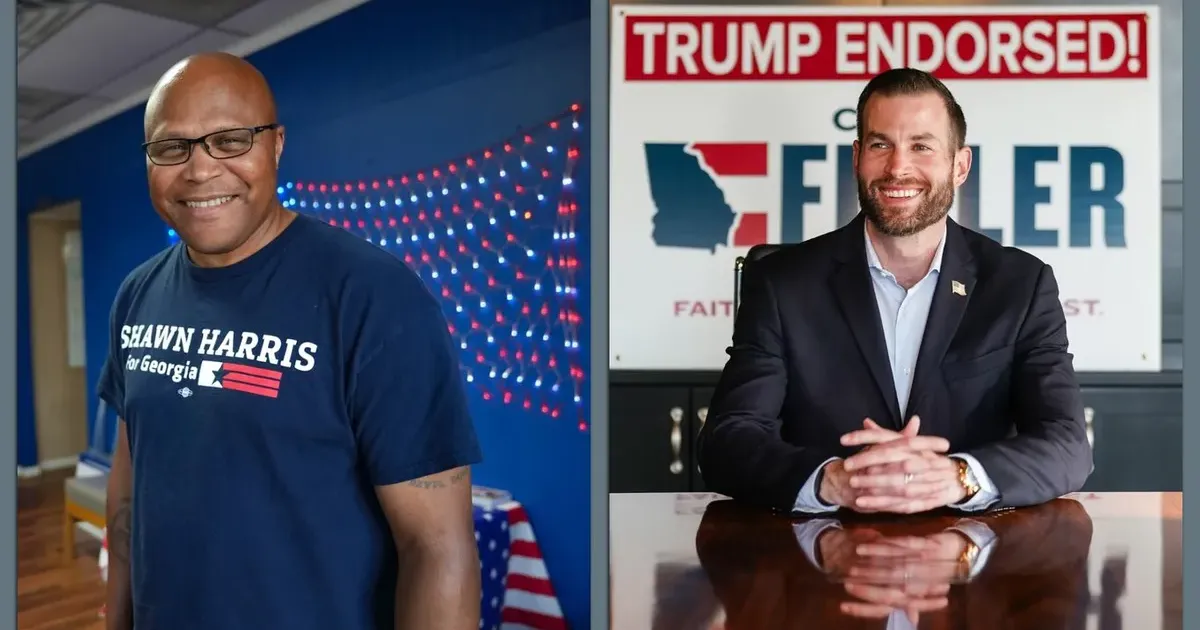
The Georgia runoff between Clay Fuller and Shawn Harris has turned the race to replace Marjorie Taylor Greene into a test of party loyalty, local service and national attention.
Political Tensions Rise in Georgia's 14th District
Rome, Georgia, serves as the epicentre of a political storm that few observers predicted just twelve months ago. Voters in this staunchly conservative corner of the state have narrowed the field to two candidates for the upcoming special election runoff. The runoff will pit Clay Fuller, a Trump-endorsed former prosecutor, against retired Army Brigadier General Shawn Harris. This contest, scheduled for April 7, 2026, aims to fill the seat vacated by former Representative Marjorie Taylor Greene. Her sudden departure from the House of Representatives in November 2025 sent tremors through the Republican establishment and the MAGA base alike. Marjorie Taylor Greene resigned her seat subsequent to a high-profile and surprisingly personal falling out with the former president. While she once stood as one of his most aggressive defenders on the House floor, internal friction eventually boiled over into public condemnation. Reports surfaced that the White House had even contacted the Secret Service regarding her behavior, though specific details of those communications remain closely guarded by administration officials. Her exit created an immediate power vacuum in a district that has long been a fortress for the Republican Party.
Clay Fuller, a former prosecutor who earned the explicit endorsement of Donald Trump, will face off against retired Army Brigadier General Shawn Harris.
Clay Fuller emerged from a crowded primary field by positioning himself as the true successor to the Trump legacy without the legislative baggage that defined Greene's final months. His campaign focuses on traditional conservative pillars including border security and fiscal restraint. Trump's endorsement provided the necessary momentum to carry Fuller into the runoff, yet he must now contend with a Democratic challenger who is better funded than any previous opponent in this district's history.
The Financial Surge of Shawn Harris
Shawn Harris is a significant departure from the typical Democratic candidate in northwest Georgia. He previously challenged Greene in 2024, suffering a defeat that many local analysts considered inevitable given the district's demographic makeup. But the 2026 special election cycle has seen a massive influx of capital into his campaign coffers. Harris has successfully raised more than $4 million, leveraging national frustration with Republican infighting to attract donors from across the country. Large-scale television buys and a sophisticated digital ground game have already begun to saturate the district, targeting moderate voters who may be weary of constant political volatility.
Money does not always translate to votes in deep-red Georgia, but the scale of Harris's war chest has forced the GOP to redirect resources they would rather use elsewhere. National Democratic organizations see an opening to flip a seat that was once considered impossible to reach. If Harris succeeds, it would represent a historic shift in the regional political map. His strategy involves highlighting his military background to appeal to veterans and rural voters who value service over partisan rhetoric. He frequently mentions his time in the Army as a contrast to the perceived chaos of the modern legislative process.
Republicans, however, remain confident that the district's foundational leanings will protect Fuller. They argue that Harris is an outsider funded by coastal elites who do not understand the values of Floyd or Whitfield counties. Fuller has leaned into this narrative, framing the runoff as a choice between local sovereignty and a national Democratic agenda. He spent the primary season visiting small towns, shaking hands at diners, and reinforcing his ties to the community. Such efforts are designed to ensure the base remains motivated for a special election where turnout is typically lower than in general cycles.
House Dynamics and the Majority at Risk
Speaker Mike Johnson finds himself in a precarious position as he manages a House majority that continues to shrink. The math in Washington grew even more complicated this week when Representative Kevin Kiley of California announced his decision to leave the Republican Party. Kiley now sits as an Independent, leaving the GOP with a razor-thin margin for passing any significant legislation. Every seat now carries the pressure of the entire party's legislative agenda. Losing the Georgia 14th would not just be a symbolic blow, it would physically diminish Johnson's ability to govern.
Internal GOP squabbles have made the Speaker's job nearly impossible during recent months. Conservative hardliners continue to demand concessions on spending, while moderates fear that extreme positions will cost them their seats in the upcoming midterms. The vacancy left by Greene was supposed to be a simple hold for the party. Instead, it has become a costly battleground that requires constant attention from leadership. Johnson has reached out to donors to ensure Fuller has the support needed to counter the Harris fundraising machine, but the pressure is mounting.
One might wonder if the Trump endorsement still carries the same weight it did in 2020 or 2022. While it remains a golden ticket in a Republican primary, its impact in a general runoff against a well-funded, military-aligned Democrat is being tested. Fuller has stayed disciplined, avoiding the more controversial rhetoric that eventually alienated Greene from the Mar-a-Lago inner circle. He presents a more polished version of the America First platform, aiming to satisfy the base while not frightening off the few remaining swing voters in the district.
Georgia law requires a runoff when no candidate secures more than 50 percent of the vote in the initial special election. This two-step process often leads to exhaustion among the electorate, yet both campaigns are treating the next few weeks as a sprint. Ground operations are being scaled up. Volunteers are knocking on doors in Dalton and Rome, urging residents to return to the polls for the third time in a year. The Harris campaign believes that a higher-than-average turnout among suburban women and minority voters could bridge the gap.
Fuller's team is focusing on a different metric. They need to ensure that the Trump-loyalist core does not stay home because their favorite firebrand, Greene, is no longer on the ballot. There is a palpable sense of unease among some local activists who felt Greene was unfairly pushed out by the party establishment. Fuller must convince these voters that he is their champion, even if his style is more measured. Failure to consolidate this group could lead to a disastrous result for the national party.
Voters in the 14th District are facing a barrage of advertisements that frame the election in existential terms. Harris ads focus on healthcare and veterans' benefits, while Fuller ads focus on the threat of a Democrat-controlled House. The contrast is sharp. One candidate offers a return to traditional military service and bipartisan cooperation, while the other promises a continuation of the Trump-aligned policies that have dominated the district for years. The outcome will provide a clear look at whether the MAGA movement can maintain its grip on rural America without its most famous, and controversial, protagonists.
Runoff Pressure
Legacy is a fragile currency in the modern Republican Party. By discarding Marjorie Taylor Greene, Donald Trump performed a surgical extraction of a liability, but he also left behind a gaping wound in Georgia's 14th District. Clay Fuller now walks into a trap of the party's own making. He is expected to win a seat that has become a national laughingstock, all while facing a Democrat who is armed with a military pedigree and a four-million-dollar war chest. It is a stunning display of strategic negligence that the GOP allowed this race to become competitive at all. Shawn Harris is not a typical sacrificial lamb, he is a seasoned operative who knows exactly how to exploit the fractures in a divided party. If Speaker Mike Johnson loses this seat, his speakership will likely end with it. We are not seeing a simple special election, we are seeing the consequences of a party that prioritizes internal purges over external victories. The runoff on April 7 will show if Republican voters are loyal to the brand or to the specific brand of chaos that Greene represented. If they stay home, the GOP loses a firewall. If Harris wins, the political earthquake will be felt all the way to the 2026 midterms.