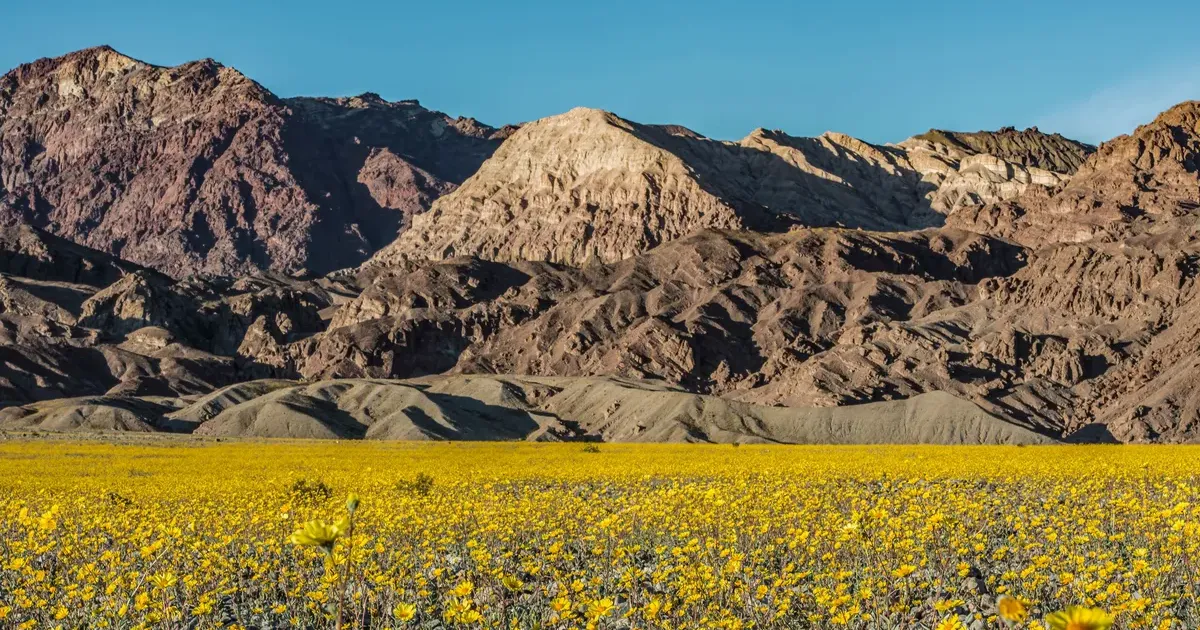
Death Valley’s superbloom has returned with rare force, covering the desert floor for the first time since 2016. The bloom drew fresh attention on March 11, 2026, as visitors weighed a rare landscape against the need for restraint.
Rare Rain Turns Into a Visitor Test
Badwater Basin sits 282 feet below sea level, a scorched expanse where salt flats typically crackle under a relentless sun. March 2026 has rewritten the visual identity of this terminal sink. Instead of the blinding white of salt crust, visitors now find a swaying sea of Desert Gold, a resilient wildflower that has waited ten years for this specific climatic alignment. This explosion of life is a biological lottery that only pays out once a decade. Rare storms saturated the valley floor during the preceding autumn and winter.
Death Valley National Park usually receives fewer than two inches of rain annually, but recent weather patterns delivered nearly double that amount in a single season. Seeds that have lain dormant in the parched earth since the last major event in 2016 began to stir as moisture reached deep into the alluvial fans. Biologists describe these seeds as survivors of a brutal environment, capable of waiting decades for a few weeks of moisture. Nature rarely works on a human schedule. Yellow Desert Gold dominates the lower elevations, while delicate Purple Phacelia and the elusive Desert Five-Spot cling to the rocky slopes of the Panamint Range.
Park rangers have already noted a surge in insect activity, specifically from the white-lined sphinx moth and various species of native bees that emerge to capitalize on the brief nectar bounty. Such a sudden abundance of resources creates a frantic pace of life in an area defined by its usual stillness.
How to See the Bloom Without Damaging It
Crowds have begun to descend upon the park in numbers that threaten to overwhelm local infrastructure. Park officials issued warnings this week regarding off-trail hiking, noting that a single footprint can crush dozens of seedlings and compact the soil for years. Rangers at the Furnace Creek Visitor Center report that parking lots reach capacity by 9:00 a.m., a phenomenon usually reserved for peak holiday weekends. Traffic now snakes along Highway 190 as photographers compete for the perfect shot of the yellow carpets against the backdrop of the Black Mountains. Preserving this ephemeral display requires more than luck.
Historical records show that superblooms occurred in 2005 and 2016, each triggered by significant El Nino weather patterns. The 2026 event appears to follow a similar trajectory of atmospheric river events that bypassed coastal cities to dump moisture directly into the rain shadow of the Sierra Nevada. Botanists suggest the timing of the rain is as critical as the volume. Early autumn rain is necessary to wash away the natural growth inhibitors on the seed coats, while subsequent winter showers must keep the ground moist enough for the roots to take hold before the spring heat arrives. Park Service resources are stretched thin.
Maintenance crews have been diverted from road repairs to manage the influx of tourists, many of whom are ill-prepared for the desert environment.
A Beautiful Warning in the Sand
Is a desert that refuses to stay dead actually a miracle, or is it a warning about the erratic energy stored in our atmosphere? We watch these superblooms with a sense of wonder, yet we ignore the reality that these events are becoming harder to predict as global weather patterns lose their historic rhythm. To view Death Valley's sudden greenery as a simple tourist attraction is an exercise in profound superficiality. It is a desperate gasp from an ecosystem that is increasingly pushed to the edge by extreme temperature swings and unpredictable precipitation cycles. We celebrate the beauty while ignoring the fact that the intervals between these blooms are growing longer and the conditions required for them are becoming more volatile. The National Park Service finds itself in an impossible position, tasked with protecting an environment that is being trampled by the very people who claim to admire it. If we cannot learn to appreciate the desert without leaving a trail of crushed seedlings and litter in our wake, then perhaps these seeds should have stayed dormant. The survival of this rare biological event depends on human restraint, a resource that is currently in much shorter supply than desert rain.