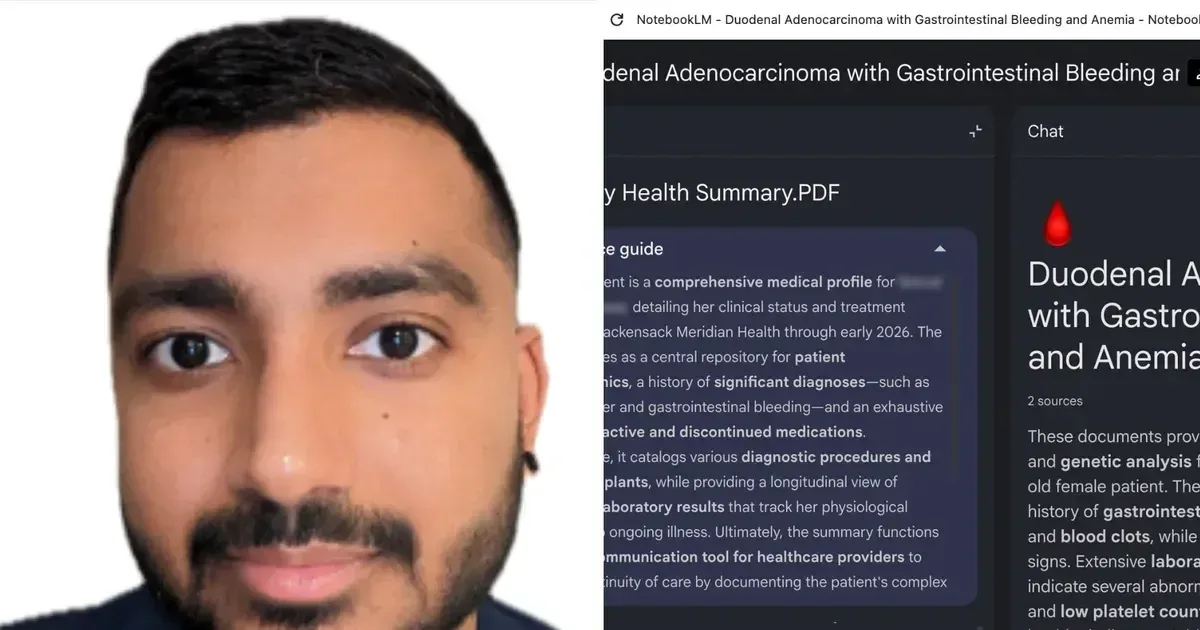
Pratik Desai says generative AI helped him organize medical records while his mother was being treated for stage 4 duodenal adenocarcinoma. His account shows how a caregiver tried to navigate a complicated hospital stay. It does not establish that a consumer AI system can audit cancer treatment.
Business Insider published Desai's story as an edited first-person interview. He said his mother was diagnosed in November 2025 and spent 67 of her final 76 days in hospital. He exported records from the Epic patient portal, added symptom notes and used Google's NotebookLM and Anthropic's Claude to summarize information and prepare questions for clinicians.
Desai reported finding inconsistencies in CT reports and said the workflow alerted him to patterns that prompted medical attention. Those are his recollections. The publication did not include the records, an independent hospital review or a study comparing the tools' answers with oncologists' decisions. In cancer care, a confident error can carry a high cost.
The Workflow Organized Records and Questions
Desai did not describe a purpose-built medical device. He assembled a personal workflow from general-purpose AI products. NotebookLM held selected documents, while Claude helped explain terminology, identify questions and suggest when to ask for another opinion. He also researched hospitals and found a physician connection who helped arrange an appointment.
That use can reduce a practical burden. Cancer care can generate pathology and imaging reports, medication lists, laboratory results, discharge instructions and notes from several specialists. A searchable summary may help a caregiver find a date, notice different wording or arrive at a consultation with focused questions.
It is still different from clinical verification. The tools worked from information Desai supplied, including text exported from the portal. The account does not show an AI model reading the underlying CT images, measuring a tumor or validating a chemotherapy dose. A summary can reproduce an error in a record, omit a qualifier or connect medically unrelated events.
Desai acknowledged another limit: his mother's file grew to about 1,600 pages, exceeding what he could comfortably place in one model context. He called the workflow imperfect. Dividing a record across model sessions can make it harder to preserve chronology, distinguish preliminary from final reports or recognize that a medication was stopped.
The Reported Alerts Remain Anecdotal
Desai said the workflow helped identify two occasions when internal bleeding followed a similar pattern and one episode in which symptoms raised concern about a pulmonary embolism. In the embolism episode, he contacted a physician in his family, who told him to take his mother to hospital. The AI output did not diagnose the condition or replace clinical evaluation.
That sequence warns against presenting the story as proof of autonomous monitoring. Symptoms that may indicate an emergency require prompt assessment through established clinical or emergency channels. A chatbot can give false reassurance, create an unnecessary alarm or miss information that changes the urgency.
The reported radiology discrepancies also require careful language. Desai said he found instances in which the wrong cancer appeared in a report and that clinicians corrected errors after he raised questions. Business Insider provided no independent account from the care team and did not establish whether the issue affected treatment. A caregiver reported using AI to flag text for discussion; the software neither proved medical negligence nor documented averted harm.
One family's experience cannot provide a sensitivity rate, false-alarm rate or safety profile. It cannot show whether the same workflow would help people with different cancers, records, language skills or access to clinicians. Those questions require prospective evaluation with defined tasks and outcomes.
Consumer Chatbots Are Not Cleared Cancer Auditors
The World Health Organization warns that large generative models can produce false, inaccurate, biased or incomplete health statements. Fluent language can encourage automation bias, in which a patient or professional overlooks an error because the answer sounds authoritative. WHO also identifies privacy and cybersecurity concerns when sensitive health information is supplied to an AI service.
People considering a record-summary tool should check how the service stores, uses and deletes uploaded data. A convenient interface should not be assumed to provide the same privacy controls, access logging or clinical accountability as a hospital system. Identifying details unnecessary for the task should not be uploaded.
Regulatory boundaries turn on intended use. The US Food and Drug Administration's 2026 clinical decision support guidance says software intended for patients or caregivers does not qualify for the statutory exclusion limited to recommendations for health professionals. Specific diagnostic or treatment directives and time-critical alerts can also place a function within medical-device oversight. A general chatbot used informally by a family is not equivalent to an AI-enabled medical device reviewed for a defined purpose.
Even clinicians do not treat AI output as a verdict. The National Cancer Institute described research in which cancer specialists considered AI recommendations case by case and rejected suggestions that could cause toxicity or put organs at risk. That independent professional judgment is far removed from asking a consumer system to decide whether a treatment plan is correct.
The Useful Role Is Narrower Than an Audit
Desai's account points to real needs: portable records, plain-language explanations, clearer handoffs and time for clinicians to answer caregiver questions. Generative AI may help a family build a timeline, translate unfamiliar terms into questions or compare two report versions. Each output still has to be checked against the original document and discussed with the treating team.
The boundary should be explicit. A caregiver should not use a model's answer to start, stop or change medication, alter a dose, delay urgent care or overrule a clinician. If a summary appears to reveal a contradiction, the next step is to locate the underlying record and ask the responsible professional to reconcile it.
Calling this workflow an audit gives anecdote the authority of a validated safety system. It has no demonstrated error rate, assured access to the complete chart or accountable clinician at the point of output. Its strongest use is clerical and preparatory: making an overwhelming record easier to navigate and helping a family ask better questions.
Desai's experience should encourage health systems to make records more usable and communication more responsive. It should not transfer oncology quality control to grieving families armed with consumer chatbots. A tool that helps someone find the right question can be valuable. A tool presented as the answer is a different and unproven proposition.