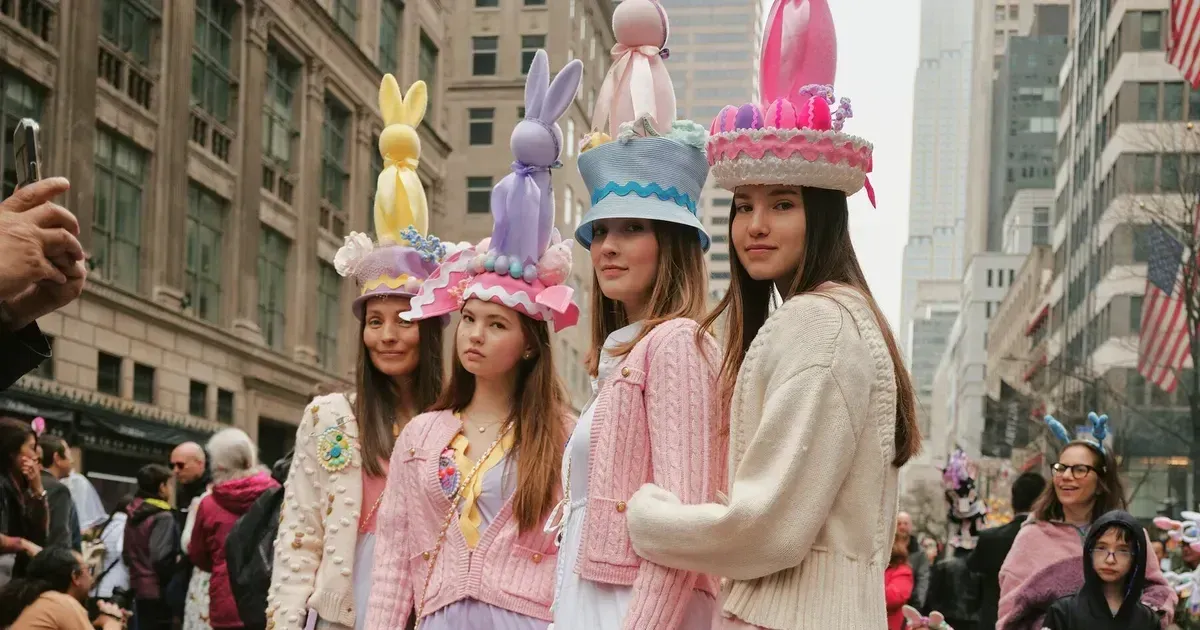
Fifth Avenue turned into a promenade of elaborate hats, vintage outfits and spring crowds for New York City's Easter Parade and Bonnet Festival. The informal event filled the Midtown corridor between churches, sidewalks and retail storefronts. There were no floats to anchor the spectacle. The street itself became the stage. On April 5, 2026, gray skies did little to stop participants from using the holiday tradition as a public display of craft, costume and neighborhood theater.
Manhattan residents have participated in this informal procession since the late nineteenth century. Historically, the event began as a display of wealth by upper-class families who attended services at the leading churches along the avenue. These individuals would walk from their places of worship to enjoy the spring weather, effectively turning the sidewalk into a fashion runway. The practice gained enormous cultural recognition following the release of the 1948 musical film starring Judy Garland and Fred Astaire. Today, the demographic of the promenade has shifted from the social elite to a diverse collection of artists, milliners, and families.
Historical Evolution of the Fifth Avenue Easter Promenade
St. Patrick's Cathedral is the primary focal point for the morning activities. Crowds typically thicken around the cathedral steps as the 10:00 AM start time approaches. While the original iteration focused on the latest European fashions, the modern version encourages avant-garde and satirical designs. Some participants spend several months engineering hats that incorporate live birds, motorized elements, or scale models of the New York City skyline. These structures often exceed three feet in diameter, requiring serious physical stamina from the wearer.
Millinery traditions have survived in the city largely through the persistence of this specific festival. Handcrafted lace, hand-dyed silk, and antique feathers appear on bonnets that contrast with the mass-produced apparel usually found in nearby storefronts. One group of designers from the Garment District debuted a collection of hats made entirely from recycled plastic bottles and discarded metro cards. This artistic push reflects a broader move toward sustainable fashion within the local creative community. Records from the New York Historical Society indicate that the complexity of these designs has increased steadily since the early 2000s.
Artistic Engineering of Modern Easter Bonnets
Technical skill is a requirement for the more ambitious participants. Many of the larger bonnets use lightweight carbon fiber or 3D-printed frames to support heavy floral arrangements and architectural components. A particular hat featured a rotating carousel powered by a small solar panel concealed within the brim. Such complex details draw professional photographers from across the globe to capture the ephemeral art. The festival remains one of the few occasions where amateur craftspeople share the stage with professional designers from the Broadway theater district.
“April showers brought silk flowers on Sunday,” according to observations recorded along the Fifth Avenue festival route.
Fifth Avenue merchants traditionally adjust their operations to accommodate the large influx of pedestrians. Some luxury retailers decorate their windows with floral motifs that echo the themes of the parade. Despite the closure of several blocks to vehicle traffic, the foot traffic often generates a surge in sales for local cafes and souvenir shops. A 2025 study by the Midtown Business Association found that holiday weekend visitors contribute an estimated $3.2 billion to the local economy annually. This financial impact highlights the continued relevance of the promenade to the city's commercial health.
Security Logistics for the Manhattan Easter Festival
Police officers from the NYPD maintain a meaningful presence throughout the designated blocks. Security protocols involve metal barricades to manage the flow of traffic at major intersections such as 50th Street and 57th Street. Because the event has no centralized organizer, the municipal government manages the logistics of sanitation and crowd control directly. These efforts ensure that the promenade stays within the public right-of-way without disrupting the functionality of the Midtown business district. The department deployed approximately 400 officers to monitor the 2026 proceedings.
Pet owners also use the festival to display coordinated costumes for their animals. Small dogs often appear in miniature bonnets or floral vests, traveling in strollers decorated to match their owners' outfits. This specific subset of the festival has grown in popularity, leading to several unofficial competitions hosted by local animal shelters. The presence of these pets adds a layer of unpredictable movement to the otherwise slow-moving crowd. Most pet-related activities concentrate near the southern edge of Central Park.
Midtown retailers also benefit from the foot traffic, but the event is still primarily a civic ritual built around costume, street theater and seasonal spectacle.
Tourism officials noted a high concentration of international visitors during the 2026 event. Travel data suggested that hotel occupancy in Midtown reached 92 percent over the holiday weekend. While some attendees come for the religious services at St. Patrick’s Cathedral, a larger percentage travels specifically for the aesthetic experience of the Bonnet Festival. The shift toward experiential tourism has prompted the city to maintain the parade even during years with inclement weather. The promenade concluded at 4:00 PM when the streets were reopened to standard vehicle traffic.
Designers often use the event to make subtle social or political observations. One participant wore a bonnet constructed from miniature scaffolding and orange traffic cones, a direct reference to the perpetual construction projects across the five boroughs. Another group chose to honor the history of the suffragette movement by wearing purple and gold ribbons alongside their floral arrangements. These thematic choices elevate the event beyond a simple fashion show. Every year, the festival provides a snapshot of the current cultural concerns of the city residents.
Fifth Avenue Street Ritual
Why does a city defined by cutthroat competition and enormous real estate prices pause its commercial grind for a display of oversized headgear? The Fifth Avenue Easter Parade exists as a rare, non-monetized anomaly in the Manhattan landscape. It is an act of aesthetic defiance against the sterile glass towers and the digital-first economy that threatens to erase physical community spaces. While the city government and local business associations celebrate the $3.2 billion in secondary revenue, the participants are engaged in something far more primal. They are reclaiming the street as a stage for folk art, a practice that has become increasingly difficult at a time of permit-heavy regulations and corporate-sponsored activations.
Critics might dismiss the Bonnet Festival as a frivolous vanity project for the eccentric. That perspective misses the strategic value of public whimsy. In a metropolis where every square inch of sidewalk is designed for movement or commerce, the Easter promenade forces a collective deceleration. The physical requirements of wearing a three-foot-wide hat or navigating a dense crowd in vintage silk require a slower pace. This forced mindfulness creates a social friction that is actually productive, encouraging spontaneous interactions that the digital world cannot replicate. It is the only day of the year when a billionaire and a starving artist are equally likely to be stopped by a tourist for a photograph based solely on their choice of millinery.
The future of the parade depends on its ability to remain unorganized. Once a corporate entity or a central planning committee takes control, the authentic eccentricity that defines the day will vanish. The NYPD may manage the perimeter, but the content remains gloriously anarchic. The lack of structure is its greatest protection against the gentrification of the imagination. As long as New Yorkers are willing to spend six months building a hat for a four-hour walk in the rain, the soul of the city persists. Eccentricity always wins.