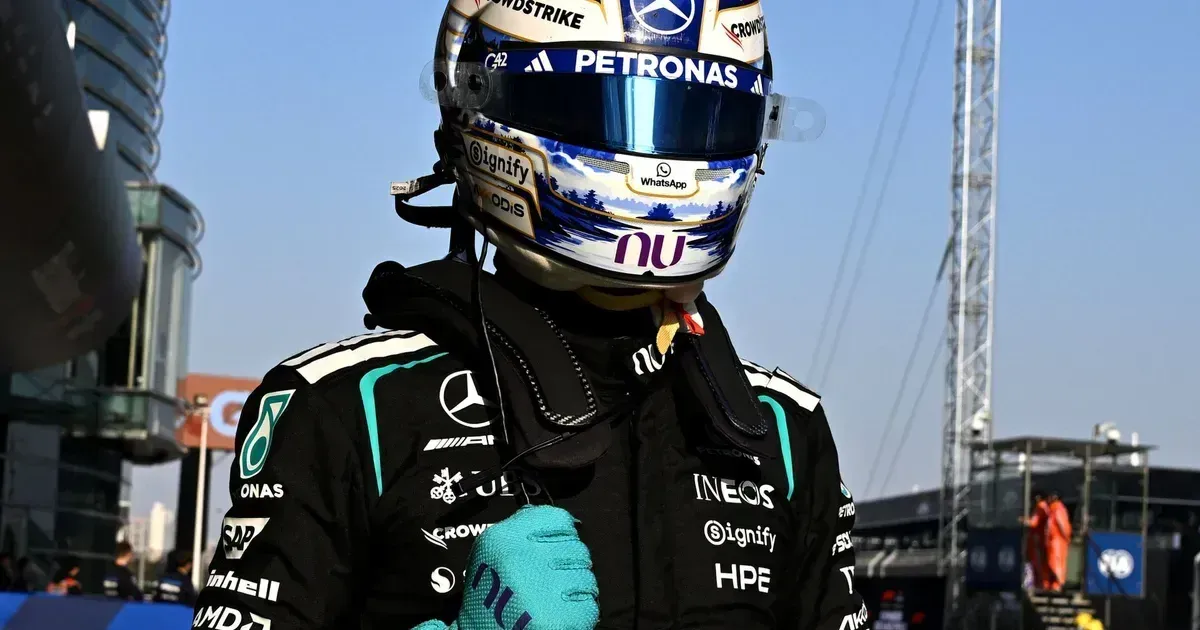
Russell Sets the Sprint Benchmark
Shanghai International Circuit witnessed a demonstration of mechanical and strategic precision. George Russell claimed the top spot for Saturday's sprint race, leading a Mercedes front-row lockout that suggests the German manufacturer has truly mastered the 2026 technical regulations. The report was published on March 13, 2026. Russell beat teammate Kimi Antonelli by a margin of 0.184 seconds, a gap that looks small on paper but is a significant chasm in the high-stakes world of modern Formula 1 qualifying.
Conditions at the circuit remained dry and cool, allowing the W17 chassis to exploit its superior aerodynamic efficiency through the long, sweeping curves of the middle sector. Russell arrived in China leading the championship standings and his performance today solidified his status as the man to beat. His mastery of the soft-compound tires was evident as he managed to find extra grip in the final sector where others struggled with overheating. The Briton delivered a clean, mistake-free lap that left little room for his younger teammate to respond.
Mercedes engineers seem to have found a sweet spot in their suspension setup that handles the notorious bumps of the Shanghai track better than any of their rivals. This outcome validates the extensive research conducted at Brackley over the winter months. Kimi Antonelli secured the second position on the grid despite a session marred by controversy and high-speed tension. The Italian teenager continues to justify his promotion to the senior team with raw pace that frequently rivals Russell.
His final run was nearly enough to challenge for the lead, but a slight wobble at Turn 14 cost him precious hundredths of a second. Still, his presence on the front row ensures that Mercedes will have total control over the start of the sprint race. The team appears to be operating on a different level compared to the rest of the field, a situation that brings back memories of their dominant run during the early turbo-hybrid era. Lando Norris fell short of the front row, finishing third after a frustrating final session.
The McLaren driver complained loudly over the team radio about being blocked during his flying lap, pointing directly at Antonelli as the culprit. McLaren management immediately lobbied the FIA stewards to investigate the incident, hoping for a grid penalty that would promote Norris to the front row. They argued that Antonelli was cruising on the racing line while Norris was at full speed, forcing the McLaren into an evasive maneuver that ruined the tire temperature for the rest of the lap. Stewards summoned both drivers to the race control office shortly after the checkered flag fell.
Mercedes Controls the Margins
Official documents later confirmed that Antonelli would escape punishment and retain his second-place start. Evidence from the onboard cameras and telemetry data showed that while the Mercedes was moving slowly, Antonelli had checked his mirrors and stayed as far to the edge of the track as the asphalt allowed. The stewards determined that the incident did not meet the threshold for unnecessary impeding, a decision that left Norris and McLaren officials visibly agitated in the paddock. This verdict from the stewards set a precedent for the weekend regarding the narrow margins allowed during qualifying sessions on this particular track.
However, the lack of a penalty does little to soothe the growing rivalry between the two teams. Red Bull Racing continues to struggle with the transition to the new engine formula. Max Verstappen could only manage fifth place, trailing the Mercedes duo by nearly half a second. The reigning champion expressed frustration with the battery deployment of his power unit, which seemed to run out of energy before reaching the end of the long back straight.
Red Bull's partnership with Ford is facing its first major test as they try to match the thermal efficiency of the Mercedes-Benz HPP unit. Engineers in Milton Keynes are working around the clock to find a solution, yet the gap remains wide enough to suggest a difficult weekend ahead for the Milton Keynes-based outfit. Ferrari remains a wildcard in the championship hunt with Charles Leclerc qualifying fourth. The Italian team has shown flashes of brilliance but lacks the consistency over a single lap to truly threaten Russell.
Leclerc was nearly two-tenths slower than Antonelli, citing a lack of front-end grip in the low-speed hairpins. Ferrari chose a higher-downforce setup compared to Mercedes, which might pay dividends during the full-length grand prix on Sunday but left them vulnerable in the sprint qualifying shootout. Their strategy relies on superior tire management during the race, though starting behind two Mercedes cars makes a victory unlikely without a chaotic start. The 2026 technical overhaul has clearly favored those who invested heavily in electric motor integration.
Formula 1 shifted to a nearly 50/50 power split between the internal combustion engine and the electric battery system this year. Mercedes appears to have built a system that recovers energy more efficiently under braking, allowing their drivers to use full boost for a longer duration of the lap. This data provided the necessary evidence for rivals to understand why the silver cars are pulling away on the straights. While some fans hoped for a more level playing field, the reality of the engineering gap is becoming impossible to ignore as the season progresses.
Shanghai Tests the New Order
Security at the Shanghai International Circuit was tightened on Friday as local fans turned out in record numbers to see the first grand prix in China under the new regulations. The atmosphere was electric, though the lack of a Chinese driver on the front of the grid dampened some of the local enthusiasm. Zhou Guanyu, the home favorite, struggled with balance issues and will start the sprint from the back half of the pack. His performance highlighted the difficulties of the Haas car in high-speed corners, a stark contrast to the poise and balance of the leading Mercedes cars.
The gap between the front and back of the grid remains a point of contention for those hoping for more parity in the sport. Formula 1's return to China marks a key moment for the sport's global expansion strategy. The circuit had been absent from the calendar for several years, and the return to this specific track layout has tested the adaptability of the 2026 cars. Unlike the street circuits of Saudi Arabia or Australia, Shanghai is a purpose-built facility with high lateral loads that chew through tires.
Teams had very little historical data to rely on for the new car dimensions and tire compounds. That trend of silver-on-silver competition suggests that while the cars have changed, the hierarchy of engineering excellence has remained largely static. The sprint format rewards exactly this kind of qualifying precision. A clean start from the front row can control tire temperature, traffic and battery deployment before rivals have time to settle into race rhythm. Norris and McLaren will still see opportunity if Mercedes mismanages the opening laps. Shanghai's long back straight can punish even a small energy deficit when cars are running in dirty air.