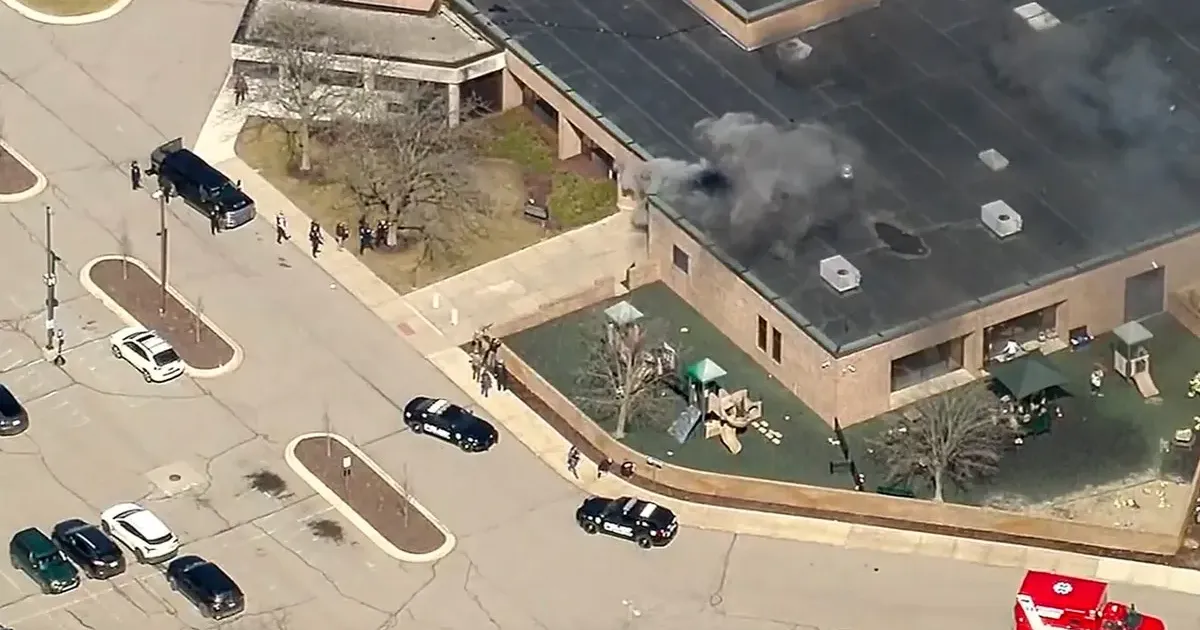
Black smoke billowed from the roof of Temple Israel on Thursday afternoon as tactical teams swarmed the West Bloomfield campus. Local residents watched in horror as flames licked at the structure of one of the largest Reform Jewish congregations in the country. The violence shattered a quiet Thursday for the Michigan Jewish community and triggered a massive federal and state law enforcement mobilization. Emergency calls began flooding dispatch centers at approximately 12:30 p.m. local time on March 12, 2026. Callers described a terrifying sequence of events that started with the high-speed impact of a vehicle against the synagogue's exterior. The first response focused on safety, and the Temple Israel attack quickly became a federal security case.
Witnesses reported a suspect intentionally rammed a vehicle into the house of worship before emerging with a firearm. Initial reports from the scene indicated that the individual opened fire shortly after the car came to a halt. Officers from several jurisdictions rushed to the 5700 block of Walnut Lake Road to contain the threat. Michigan State Police confirmed an active shooting situation was underway and urged members of the public to avoid the area entirely. This violence shattered a quiet Thursday for the Detroit suburbs as families waited for news of those inside the building.
Firefighters struggled to approach the structure to douse the growing blaze. Plumes of thick, dark smoke could be seen for miles across Oakland County. The intersection of the crash and the subsequent fire created a complex tactical environment for first responders who had to neutralize a shooter while managing a structural fire. It was not immediately clear if any congregants or staff members suffered injuries during the initial ramming or the ensuing gunfire. Security personnel at the temple often maintain a presence during business hours, but the scale of this assault appeared to overwhelm standard protocols.
Federal Authorities Take the Lead
FBI Director Kash Patel confirmed within the hour that federal agents were on the ground in Michigan to assist local partners. Patel noted that his personnel are actively responding to what he termed an apparent vehicle ramming and active shooter situation.
"An apparent vehicle ramming and active shooter situation."
The involvement of the bureau suggests authorities are investigating the possibility of a hate crime or a domestic terrorism link. Patel and his team are working closely with the Michigan State Police to secure the perimeter and process the scene for evidence. The swift federal response underscores the severity of the threat facing religious institutions in 2026.
Evidence collection will likely take days. Ballistics experts and arson investigators must wait for the structure to be declared safe before entering the charred remains of the sanctuary. Michigan State Police troopers have already begun increasing their presence at other places of worship throughout the district as a precautionary measure. There is no evidence yet of a broader conspiracy, yet the nature of the attack has put the entire region on high alert. Law enforcement agencies in nearby Ann Arbor also announced they would increase patrols at local schools and religious centers to provide a sense of security.
The suspect's identity and motive remain under investigation. Police have not released details regarding whether the individual was taken into custody or killed during the confrontation. This specific Reform Jewish house of worship has a long history in the community and serves thousands of families. Seeing it targeted in such a brazen, multi-pronged attack has sent a wave of anxiety through the Oakland County Jewish population.
Community on Lockdown
Schools in the Bloomfield Hills district entered a secure mode shortly after the first reports of gunfire. Administrators took this action out of an abundance of caution, though they clarified that no direct threats had been made against any educational facilities. Parents were notified via emergency alerts as the situation at Temple Israel continued to evolve. The secure mode prevents any unauthorized entry or exit, ensuring students remain inside until police give the all-clear. Such measures have become standard after suburban violence, but they do little to soothe the nerves of a community under siege.
Governor Gretchen Whitmer took to social media to express her concern and monitor the unfolding crisis. She described the reports as heartbreaking and emphasized that Michigan's Jewish community must be allowed to practice their faith in peace. Whitmer confirmed she is in constant communication with state police to receive real-time updates on the investigation. Her statement condemned antisemitism and violence, asserting that such acts have no place in the state. Still, the physical damage to the temple and the psychological impact on the congregation will take far longer to repair than a press release can address. Local leadership in West Bloomfield and surrounding townships are grappling with the reality of the assault. The Oakland County Sheriff's Office has been coordinating with federal partners to manage the massive influx of emergency vehicles and media personnel. Walnut Lake Road remained closed for several hours as investigators mapped the trajectory of the vehicle and the shell casings found near the entrance. The sanctuary was still burning.
A Pattern of Vulnerability
Security at synagogues has increased dramatically over the last decade, but the Temple Israel incident reveals the limits of physical barriers. Ramming a vehicle into a building bypasses many standard gate-and-guard protocols used by modern houses of worship. This incident reflects the evolving tactics used by those seeking to cause mass casualties in soft-target environments. Law enforcement experts will likely analyze the failure of the perimeter to prevent the vehicle from reaching the building's core. The situation leaves little room for simple answers.
Regional leaders are now calling for a thorough review of security grants for religious non-profits. While many institutions have received funding for cameras and reinforced doors, the threat of a high-speed vehicle ramming presents a different set of challenges. Some advocates suggest that bollards and heavy landscaping may be necessary for every religious site in the state. That conversation will likely dominate the political discourse in Lansing for the remainder of the year. For witnesses who saw the car hit the temple walls, safety became something that would have to be rebuilt, not assumed.
Religious life in Michigan continues to face significant headwinds. The West Bloomfield area is home to a dense population of Jewish residents who have built a strong network of schools, community centers, and synagogues. The attack strikes at the heart of that infrastructure. Until a suspect is clearly identified and a motive established, the community will remain in a state of hyper-vigilance. Police have asked for any witnesses with video footage of the Walnut Lake Road area between 12:00 p.m. and 1:00 p.m. to come forward and assist in the timeline reconstruction.