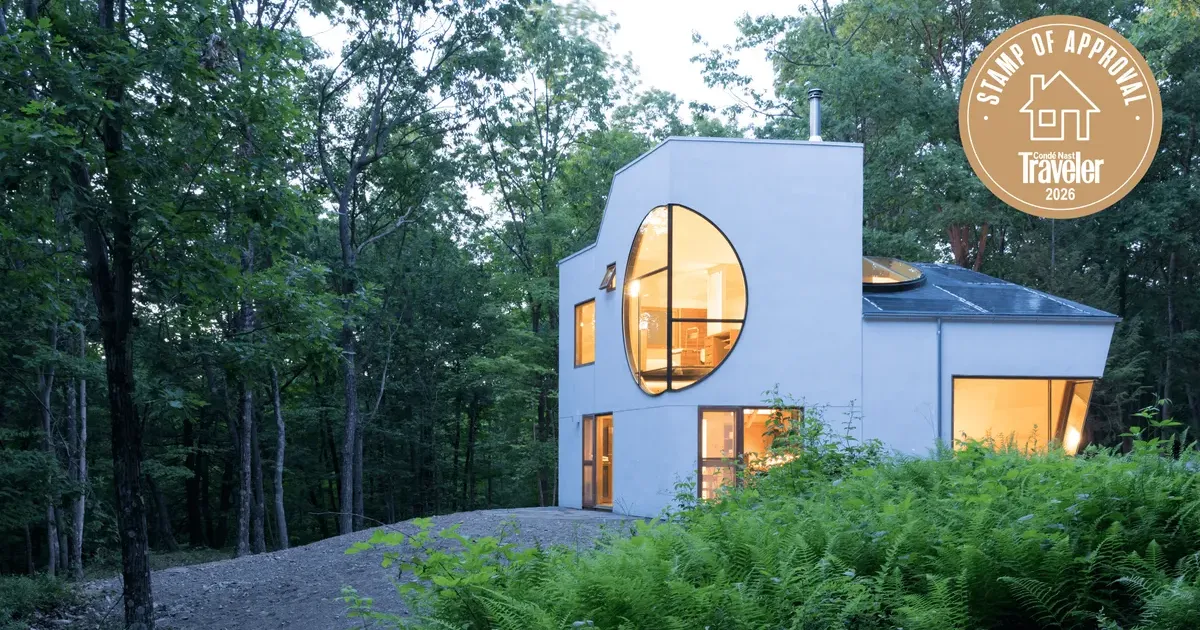
March 22, 2026, finds the Ex of In House in Rhinebeck, New York, attracting a new wave of architectural enthusiasts who bypass traditional luxury hotels. Steven Holl Architects designed this experimental structure to explore what the firm calls spatial energy through intersecting spheres and trapezoids. Property owners listed the site on Airbnb to monetize a project that began as a purely intellectual exercise in three-dimensional geometry.

Rhinebeck sits roughly two hours north of Manhattan and has long provided a canvas for experimental retreats. High-end travelers now focus on these unique structures over standard upstate farmhouses or Victorian inns. Demand for experiential lodging in the Hudson Valley grew by 14% over the last fiscal year.

Visitors pay upwards of $950 per night to inhabit a space that lacks traditional right-angled rooms. Every interior surface slopes or curves, forcing occupants to reconsider how they move through a domestic environment. Most guests describe the sensation as living inside a sculpture rather than a residence.

Hudson Valley Architectural Evolution and Land Use

Development in the Hudson Valley historically favored the preservation of Gilded Age mansions or the rustic charm of Catskill mountain cabins. Local zoning boards in Dutchess County shifted their focus over the last decade to allow for high-concept dwellings that minimize physical footprints. The Ex of In House occupies a 28-acre site known as the T2 Reserve, which is protected by a conservation easement to prevent future subdivision.

Environmental activists and architects reached a consensus on this site to demonstrate that residential density can be traded for architectural density. Construction focused on a compressed floor plan of 918 square feet while utilizing the full vertical height of the wooded lot. Cross-laminated timber and thin-film solar panels provide the primary structural and energetic framework.

But the aesthetic choices remain the primary draw for the modern traveler. Spherical intersections create voids in the corners of the house, which might appear as a loss of usable space to a traditional developer. To the guest, these voids offer framed views of the surrounding oak and maple trees that change with the passing of each hour.

Geometric Design Challenges Traditional Residential Norms

Architects rarely see their theoretical manifestos turned into profitable short-term rentals. This specific project evolved from a research program titled Seven Houses, which questioned the necessity of the suburban box. Instead of separate bedrooms and living rooms, the interior utilizes levels that flow into one another without doors or partitions.

The house is a manifestation of an investigation into the intersection of spheres and cubes, creating a space that is as much about what is not there as what is.

Heating and cooling such a fragmented interior space requires a sophisticated geothermal system. Pipes buried deep in the Hudson Valley shale regulate the temperature of the structure regardless of the harsh New York winters. Sensors monitor the occupancy levels to adjust airflow into the various geometric pockets of the house.

Yet the lack of privacy in the 918-square-foot structure limits its appeal to a specific subset of the traveling public. Families with children often find the open voids and steep transitions between levels impractical for daily life. Solo travelers and couples remain the primary demographic for the property.

Airbnb Market Shifts Toward Experiential Short-Term Stays

Data from the travel sector indicates a saturation in the luxury rental market for properties that only offer high-end finishes. Travelers now seek out dwellings that offer an intellectual or artistic challenge to their standard routines. Airbnb capitalized on this by creating a dedicated category for iconic or quirky structures to help users filter for architectural significance.

Booking rates for the Ex of In House often remain high through the off-season months of January and February. Travelers seem willing to trade the amenities of a five-star resort for the chance to experience a specific architectural theory in person. Occupancy remains at a steady 82% throughout the calendar year.

In fact, the success of this listing has prompted other Hudson Valley landowners to commission similar experimental designs. Local construction firms report a 25% increase in requests for non-traditional materials like charred cedar and recycled polycarbonate. Smaller footprints allow for faster permitting processes in towns like Rhinebeck and Red Hook.

Ecological Preservation in Modern Hudson Valley Construction

Preservation of the 28-acre T2 Reserve ensures that the geometric structure remains isolated from modern suburban sprawl. Geologists and arborists worked alongside the construction crew to ensure that the heavy machinery did not disrupt the root systems of the ancient trees. The house sits on a series of thin pilotis to further reduce its impact on the forest floor.

Rhinebeck residents often express a mixture of curiosity and pride regarding the international attention the house receives. Architecture students from nearby Bard College frequently request tours of the site to study the intersection of light and form. Most of these tours occur during the gaps between guest stays to maintain the privacy of the paying visitors.

Still, the cost of maintaining such a complex structure is significant. Specialized window cleaners must be hired to navigate the spherical glass sections that define the house. The property manager noted that maintenance costs for the geometric windows alone exceed $4,000 annually.

Energy independence is still a core feature of the Rhinebeck site. Thin-film solar cells integrated into the roof provide enough power to run the entire house and an electric vehicle charging station for guests. Excess energy is fed back into the local grid, making the structure a net-positive contributor to the county power supply.

Even so, the primary value for the owner lies in the brand equity of the Steven Holl name. Properties associated with Pritzker Prize-level architects command a premium that is insulated from general market fluctuations. This specific rental is a case study for the financial viability of high-art architecture in the digital economy.

The Elite Tribune Perspective

How much of our private life are we willing to surrender for the sake of a well-selected Instagram post? The Ex of In House is not a home in any functional sense, but rather a high-priced stage for the performance of taste. By turning a serious architectural experiment into a high-turnover rental unit, the owners have effectively created a museum where you can sleep in the exhibits for a thousand dollars a night.

This commodification of intellectual design strip-mines the actual purpose of architectural theory, which should be the improvement of human habitation rather than the creation of a backdrop for the bored elite. While the engineering is impressive, the reality of living in a house without doors or privacy is a novelty that wears thin within forty-eight hours. We should be skeptical of any design movement that focuses on geometric purity over the basic human need for a quiet, enclosed space to exist.

The Hudson Valley is increasingly becoming a theme park for New York City professionals who want to feel deep while staying in a shallow, albeit beautiful, glass box. True innovation should be measured by how many people can live comfortably in a space, not by how many likes a photo of its trapezoidal windows can generate on a social media platform.