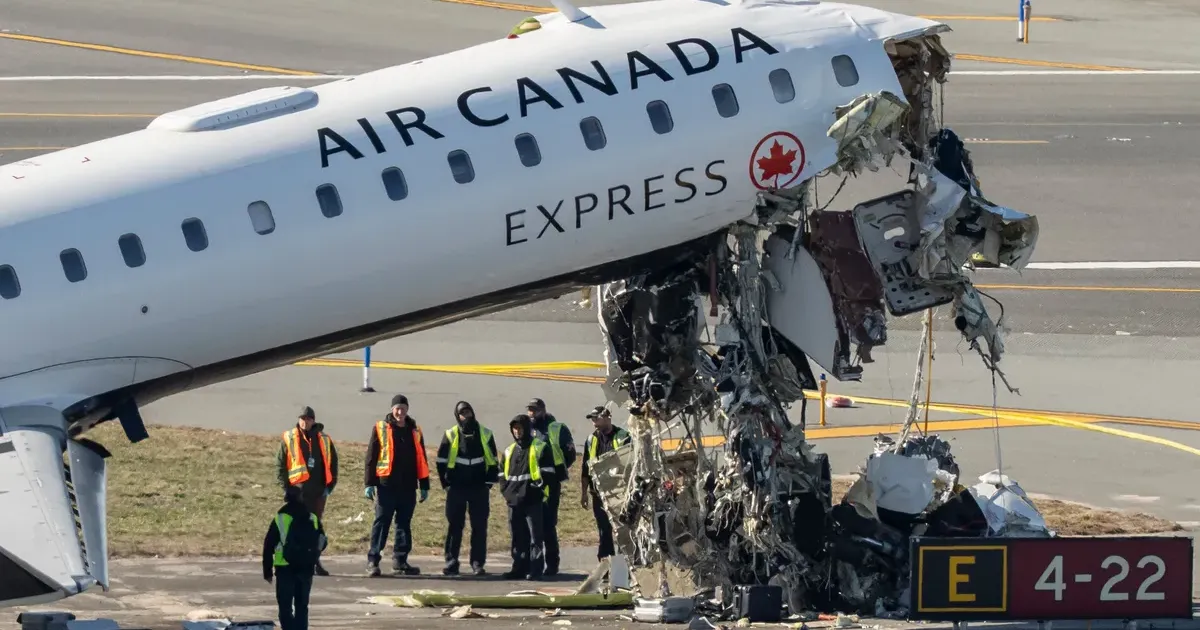
National Transportation Safety Board investigators confirmed on March 25, 2026, that a series of catastrophic tower errors led to the fatal collision between an Air Canada jet and an emergency vehicle at LaGuardia Airport. Audio retrieved from the cockpit voice recorder indicates that the flight crew received explicit landing clearance even though a fire truck remained stationed on the active runway. Tower officials failed to identify the conflicting permissions until the moment of impact.
Initial findings suggest that the ground and tower control frequencies were being managed with a degree of overlap that blurred the lines of responsibility for runway safety. The collision resulted in several fatalities and has triggered an immediate review of staffing protocols at one of the busiest airports in the United States.
Tower transcripts analyzed by the safety board show a breakdown in the standard protocols used to track vehicle movements on the airfield. In fact, the controller on duty had authorized the emergency vehicle to enter the runway for a routine inspection just minutes before the jet began its final approach. Radio logs indicate that the controller never issued a hold order for the truck despite the encroaching aircraft. Separately, the National Transportation Safety Board is scrutinizing why the airport’s ground-radar warning system did not alert the tower to the presence of the vehicle in the path of the landing jet.
Records show the collision occurred at a high speed, leaving the pilots with no time to perform a go-around maneuver or divert their course.
LaGuardia Runway Management and Fatal Oversight
Communication between the tower and the cockpit reveals that the pilots were unaware of any obstruction on the landing strip. But the data from the flight recorder suggests the crew noticed the vehicle lights only seconds before the collision. Evidence from the scene indicates the fire truck was positioned near the midpoint of the runway where visibility can be compromised by terminal architecture and ambient light. Investigators found that the controller had not updated the airport’s digital tracking board to show the runway was occupied.
Air traffic control manuals require that any vehicle occupying an active landing strip be tracked with a physical or digital marker to prevent exactly this type of oversight. This oversight allowed the landing sequence to continue unabated.
Safety experts point to the unique constraints of the airfield as a contributing factor. For one, the intersecting runway layout at the airport requires precise timing and constant monitoring to avoid incursions. The lack of clear separation between ground vehicle operations and aircraft movements creates a high-pressure environment for even the most experienced personnel. Preliminary reports indicate that the controller failed to verify the runway status before issuing the final clearance to the Air Canada crew. This breach of protocol is now the primary focus of the federal investigation. One controller was responsible for both ground traffic and incoming flights at the time of the accident.
Air Traffic Control Staffing Shortages and Fatigue
National Transportation Safety Board member Michael Graham expressed concern regarding the workload placed on the individuals operating the midnight shift. Meanwhile, the investigation has uncovered that the air traffic controller in charge was performing administrative tasks in addition to managing the active airspace. The board has raised questions about the Federal Aviation Administration policy that allows a single individual to manage multiple complex roles during low-traffic hours. Busy airports like the one in Queens require a full complement of staff regardless of the time of day or the number of scheduled flights. According to internal FAA documents, the tower was operating with only two controllers at the time of the fatal collision.
Fatigue is not merely a biological state but a regulatory failure.
Controllers working the overnight shifts often deal with irregular sleep patterns and long hours of isolation in the tower cab. Yet, the expectation for flawless execution remains constant across all shifts. In this instance, the controller had been on duty for several hours and was nearing the end of a rotation that included extra clerical duties. To that end, the safety board is examining the shift schedules for the month leading up to the crash to determine if chronic exhaustion played a role in the decision-making process. Internal emails from the facility suggest that staffing levels have been a point of contention between the local union and the federal government for years. Budgetary constraints often dictate these staffing levels.
The NTSB has concerns about air traffic controllers who work the midnight shift taking on extra work in an airspace as busy as LaGuardia’s, especially when managing the movement of both aircraft and ground vehicles.
Federal investigators are now interviewing the surviving controller to understand the sequence of events that led to the clearance. That said, the individual has reportedly pointed to a lack of support staff during the early morning hours. By contrast, the FAA maintains that the staffing levels on the night of the crash met the minimum requirements for the projected traffic volume. The union representing the controllers has long argued that the minimum requirements are insufficient for an airport with the topographical and operational complexities found in New York. The disparity between regulatory standards and operational reality is a key focus of the current inquiry. One controller was effectively acting as his own supervisor.
Air Canada Jet Cockpit Voice Recorder Findings
Analysis of the audio from the jet confirms that the flight crew was following standard operating procedures throughout the descent. For instance, the captain checked the runway status twice before crossing the threshold. And yet, the confirmation of a clear runway from the tower gave the pilots the confidence to proceed with the landing. The cockpit voice recorder captured the sound of the landing gear making contact with the pavement just moments before the impact. Silence fell over the tower frequency in the seconds before the impact.
The sudden appearance of the emergency vehicle in the landing lights left the crew with no options for evasion. Flight data shows that the brakes were applied, but the distance was too short to prevent the disaster.
Survivors from the aircraft described a large jolt followed by a fire that erupted near the wing section. In particular, the impact shredded the fuel lines and caused a localized inferno that fire crews at the airport had to contain. Emergency response teams arrived at the scene within minutes, though the damage to the fire truck and the jet was already extensive. The investigation has revealed that the fire truck was on the runway to inspect a reported debris issue from a previous departure. Ironically, the mission to ensure runway safety was what ultimately led to the fatal collision.
National Transportation Safety Board teams remain on the ground collecting physical evidence from the wreckage. Debris was scattered across a wide area.
Regulatory changes are expected to follow the conclusion of the fact-finding phase of the investigation. In turn, the FAA has already issued a temporary directive requiring a minimum of three controllers in the tower during any operation involving ground vehicles on active runways. The cost of the damage is estimated to exceed $50 million when considering the loss of the aircraft and the litigation that is likely to follow. Security camera footage from the terminal is being synchronized with the audio logs to create a second-by-second reconstruction of the crash. This process will help investigators understand why visual cues from the tower did not stop the clearance. The final report is expected within twelve months.
The Elite Tribune Perspective
Why are we still allowing the Federal Aviation Administration to treat midnight shifts as a dumping ground for administrative labor? The catastrophe at the airport was not an act of God or a mechanical failure. It was the predictable result of a bureaucratic culture that focuses on lean staffing over the lives of passengers and ground crews. History provides a gruesome map of what happens when aviation authorities ignore the limits of human cognition. We saw it at Tenerife and we saw it again here.
The pretense that two controllers can safely manage a high-stakes environment while simultaneously filing paperwork is a lie that has now been exposed by the death of several people. For years, the FAA has skirted the issue of controller fatigue by citing technical minimums that have no basis in the reality of modern aviation. If the agency continues to value budget-slashing over the fundamental requirement of situational awareness, these collisions will transition from rare anomalies to regular occurrences. It is time for a scorched-earth audit of tower staffing across every major hub in the country.
The blood on the runway is the price of federal negligence. We must demand that safety protocols are insulated from the fluctuations of the federal budget or admit that we are willing to gamble with human life for the sake of efficiency.