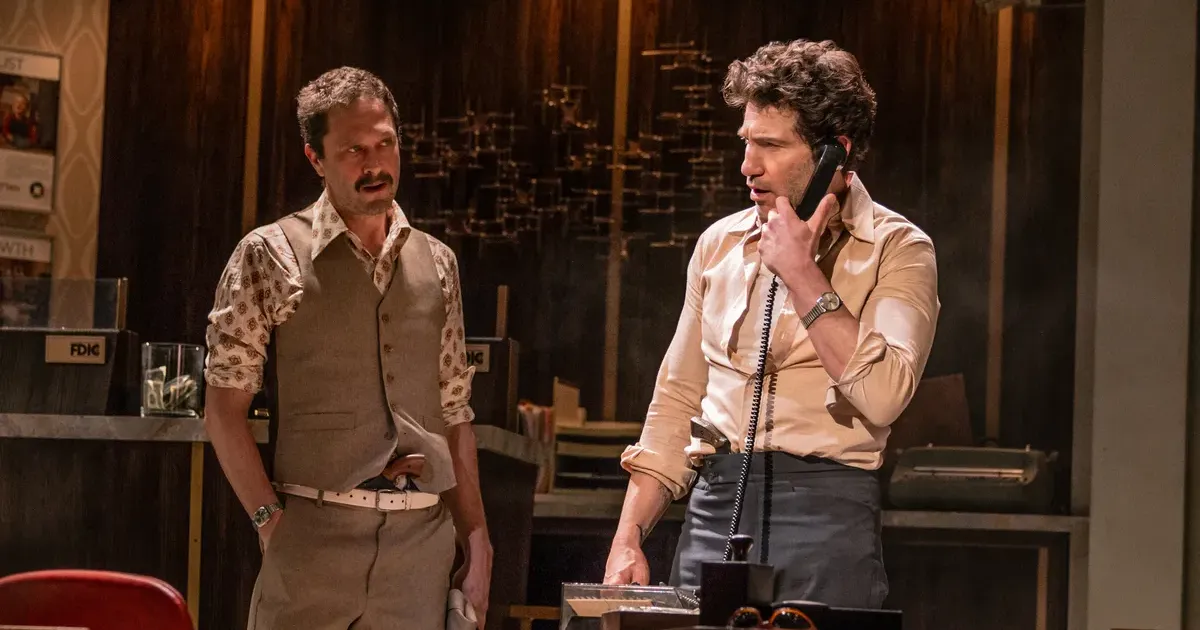
Jon Bernthal stepped onto the stage of the Belasco Theatre to inhabit the desperate skin of Sonny Wortzik in a revival that critics are already calling a tonal failure. Performance expectations were high for this adaptation of the 1975 Sidney Lumet film, which originally featured Al Pacino in a career-defining role. Early reviews from the opening night performance suggest a production struggling to find its footing between gritty realism and a bizarrely comedic atmosphere. While Variety praised certain elements of the stagecraft, other major outlets described the experience as underbaked and ultimately disastrous. The Jon Bernthal Leads Disjointed Dog Day Afternoon Play report carried a March 31, 2026 time marker for readers following the latest account.
Production tensions seem evident in the final product as the creative team attempts to translate the claustrophobic energy of a 1970s bank heist into a multi-act theatrical event.
Critics noted an immediate disconnect between the source material and the execution on the Broadway stage. Sidney Lumet directed the original film with a fluorescent, documentary-style grit that made the audience feel trapped inside the First Brooklyn Savings Bank. Director Rupert Goold, according to reports from The Hollywood Reporter, appears to have missed that mark entirely. Confusion surrounds the production credits, as Variety listed Mauk Kaufman as the director, suggesting potential back-of-house instability or late-stage leadership changes. Such discrepancies in production reporting often point to a chaotic rehearsal process that bleeds into the final performance. Audiences expected a tense psychological drama but instead received something that veered dangerously close to a sitcom setup.
Casting Chemistry and the Bernthal Factor
Jon Bernthal brings a physical intensity to the role of Sonny that contrasts sharply with the frantic, neurotically thin energy Al Pacino displayed decades ago. Reporters from The New York Times observed that Bernthal seems adrift in the script, his natural charisma stifled by a narrative that refuses to commit to a single mood. Ebon Moss-Bachrach, reuniting with his former co-star, plays Sal with a paranoid stupor that feels more like a character study in a different play.
Chemistry between the two leads remains one of the few bright spots, yet even their connection cannot save a production that undermines its own stakes with ill-timed levity. Their shared history in gritty television dramas promised a level of intensity that the script simply does not support.
Repartee between the bank robbers and the tellers has become a primary point of contention for seasoned theater critics. Variety compared the dialogue to a version of the television shows Cheers, noting that the hostages and captors fall into an increasingly companionable back-and-forth. Jessica Hecht, playing head teller Colleen, delivers an abrasive performance that evokes the style of Anne Meara. While her timing is precise, the comedic punch she provides serves to erode the life-or-death tension essential to the plot. Each teller is slotted into a role that feels more like a comedic ensemble than a group of terrified civilians facing a volatile criminal with a gun.
Staging Tensions at the Belasco Theatre
Technical execution of the heist relies on a canny piece of stagecraft that manages to keep the flow taut, even when the script falters. Moveable set pieces and lighting shifts attempt to mimic the cinematic cuts of the original film. However, the haunting power of the movie relied on its realism, a quality that is difficult to replicate in the artifice of a Broadway theater. The New York Times pointed out that the raucous nature of this adaptation stifles the very tension it needs to survive.
Lighting cues and set transitions happen with professional efficiency, but they cannot compensate for a story that has lost its internal clock. Moments that should feel like an agonizing wait for a getaway car instead feel like setups for the next round of banter.
The movie had moments of discordant comedy, but Sidney Lumet staged it in his hair-trigger fluorescent vérité style. On stage, the comedy gets ratcheted up, especially when Sonny is dueling with Colleen, the head teller, played by Jessica Hecht with an abrasive punch.
Stagecraft alone cannot sustain a narrative that requires the audience to believe in the imminent danger of the situation. Financial stakes for a production of this magnitude are notable, especially with a cast featuring two of the most sought-after actors in modern television. Ticket prices for the premium seats at the Belasco Theatre reflect the star power on stage, making the mixed critical reception a potential hurdle for long-term box office viability. Broadway audiences often forgive tonal inconsistencies if the spectacle is sufficient, but this play sits in an uncomfortable middle ground. It lacks the explosive action of a blockbuster and the emotional weight of a prestige drama.
Sitcom Repartee Erodes Cinematic Grit
Repetition of comedic beats has led some reviewers to label the production as a misguided attempt to modernize a classic. Ebon Moss-Bachrach provides a performance that some critics found haunting, yet his character is frequently interrupted by the witty observations of the bank staff. This structural choice shifts the focus away from the tragedy of Sonny and Sal, turning the bank into a stage for social commentary that feels forced. The Hollywood Reporter was particularly scathing, labeling the entire effort a disaster that fails to capture the soul of the 1975 film.
Directors usually aim to bring something new to a revival, but Goold or Kaufman seems to have brought only confusion. Tension evaporates every time a hostage cracks a joke that lands with the precision of a scripted punchline.
Authenticity is the primary victim in this transition from screen to stage. Lumet captured a specific moment in New York history characterized by decay, desperation, and a growing media circus. Production designers at the Belasco have recreated the bank with impressive detail, yet the actors behave as if they are in a different era entirely. Modern audiences might find the 1970s social dynamics difficult to grasp without the grounding of the film's gritty aesthetic. By leaning into comedy, the production ignores the socioeconomic despair that drove the real-life events upon which the story is based. The result is a hollowed-out version of a masterpiece that prioritizes audience laughter over thematic depth.
Stage Adaptation Test remains one useful lens for the next phase.
The production now has to prove that audience energy can coexist with the darker pressure of the source material. Bernthal gives the play force, but the adaptation will be judged by whether it adds theatrical shape rather than only familiar lines.