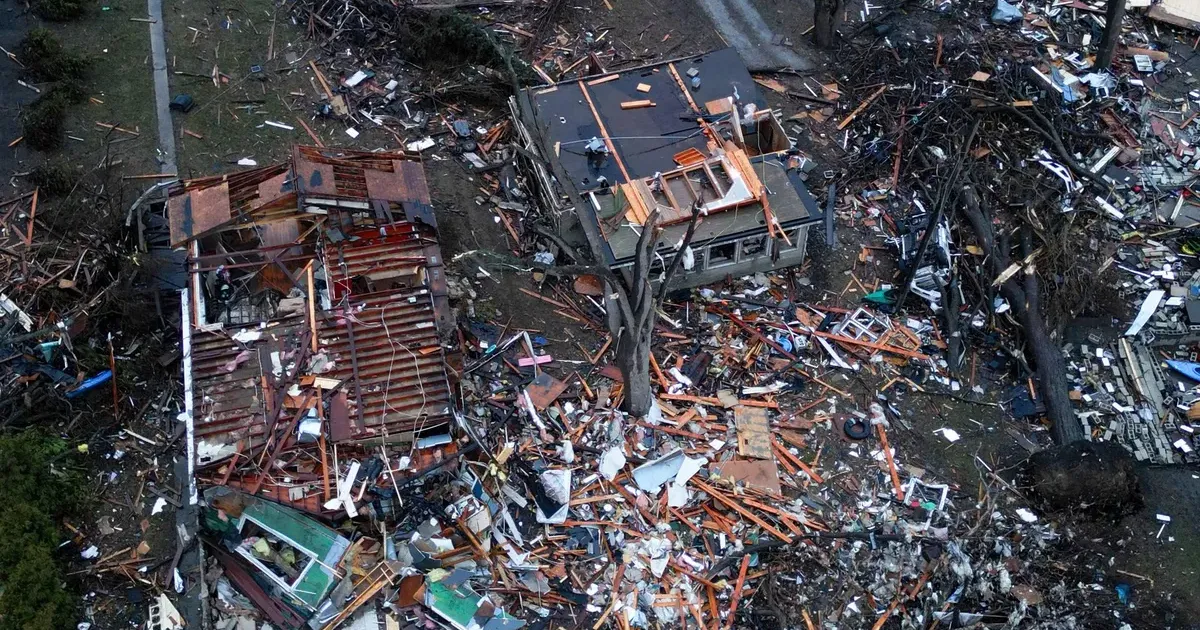
Indiana and Illinois moved from spring weather warnings to deadly tornado damage as the week’s extreme weather pattern hardened. The storm damage became national on March 11, 2026
Tornadoes Tear Through the Heartland
The outbreak began with a deceptive stillness in Kankakee, Illinois. By dusk, the atmosphere had curdled into a violent engine of destruction, leveling structures and upending lives across a wide swath of the Midwest. Emergency responders spent the late hours of Wednesday pulling survivors from the rubble of what were once thriving businesses and residential blocks. These localized horrors represent only one chapter of a larger, more menacing weather system currently bisecting the United States. Two residents in northwest Indiana lost their lives when a massive tornado touched down with little warning. Wind deaths in the Midwest collided with flood fears in the West. Local authorities confirmed the fatalities late Wednesday evening, though they withheld identities pending notification of kin. Survivors described a sound like a freight train passing through their bedrooms, followed by the immediate disintegration of roofs and walls. In Kankakee, the devastation took on a jagged, industrial character. Buildings once housing light manufacturing and retail were reduced to twisted skeletons of rebar and brick. The Sky News US bureau reported that the sheer force of the winds left entire neighborhoods unrecognizable, forcing first responders to use GPS coordinates simply to navigate familiar streets.
Meteorologists now warn that this Midwest violence is a precursor to a secondary, perhaps more statistically improbable, event on the West Coast. Predictions from Newsweek suggest that one Western state is currently bracing for a precipitation bomb.
Infrastructure Math Fails the New Weather
Current models indicate that nearly an entire year worth of rain could fall in a narrow five-day window, a scenario that threatens to redefine the region's flood maps. Such a volume of water defies standard municipal drainage capacity, raising the specter of catastrophic mudslides and urban inundation. Flash floods, tornadoes, and high-elevation snow are all manifesting from the same volatile atmospheric corridor. While the Midwest grapples with the immediate trauma of wind damage, the West faces a slow-motion disaster as moisture-heavy clouds stall over mountain ranges. This convergence of extremes underscores a growing volatility in the North American jet stream.
Forecasters at the National Weather Service have pointed to a rare alignment of tropical moisture plumes and Arctic air masses, a combination that creates a self-sustaining cycle of severe weather. Engineers are quietly sounding alarms about the age of American dams and levees. If a year of rain truly descends in less than a week, the pressure on these structures will exceed their design specifications by orders of magnitude. Most suburban drainage systems were built to handle the one-hundred-year flood, yet 2026 is already presenting weather patterns that occur once in a millennium. Because of these outdated standards, cities that once felt safe from the elements are finding themselves on the front lines of a new environmental reality.
The math simply does not add up for local taxpayers. Insurance markets are reacting with cold efficiency to the destruction in Illinois and Indiana.
Federal Response Splits Across Disasters
Several major carriers have already signaled plans to restrict new policies in counties deemed high-risk for convective storms. For the residents of Kankakee, the loss of property is compounded by the terrifying realization that rebuilding may be financially impossible. Without the safety net of affordable insurance, the economic recovery of these small towns could take decades rather than years. Bloomberg analysts suggest that the cumulative cost of this week's storm system could easily top 15 billion dollars, a figure that includes both immediate damage and long-term business disruption. Federal agencies are struggling to keep pace with the geographic breadth of the crisis.
While FEMA personnel are being deployed to the tornado tracks in Indiana, hydrologists are being rushed to the West to monitor rising reservoir levels. These competing priorities strain a disaster response system already burdened by a series of smaller, persistent events earlier this winter. Some critics argue that the federal government remains too focused on reactive measures instead of investing in the hardened infrastructure required to withstand such barrages. Local leadership in Illinois has declared a state of emergency. Gov.
J.B. Pritzker issued a statement late Wednesday promising that the state will provide every available resource to the recovery effort in Kankakee and surrounding areas.
Why Rebuilding the Old Map Is Reckless
Modern society clings to the delusion that our technological sophistication grants us immunity from the whims of the atmosphere. We build glass towers in tornado alleys and pave over the natural floodplains of the West, then express genuine shock when the sky retaliates with predictable fury. The tragedy in Indiana and the impending deluge in the West are not anomalies. They are the logical outcomes of a civilization that has prioritized short-term expansion over geological common sense. We have treated the environment as a static backdrop for our commerce, failing to realize that the backdrop is actually the lead actor in the drama of human survival.
Government officials will offer thoughts and prayers to the people of Kankakee, but they will likely refuse to authorize the massive, expensive, and unpopular infrastructure overhauls necessary to prevent the next catastrophe. It is easier to write a check for a disaster than it is to admit our entire approach to urban planning is obsolete. Until we stop building for the climate of the twentieth century, we will continue to bury our neighbors in the twenty-first. We are not victims of the weather so much as we are victims of our own stubborn refusal to adapt to a planet that no longer resembles the maps of our youth.