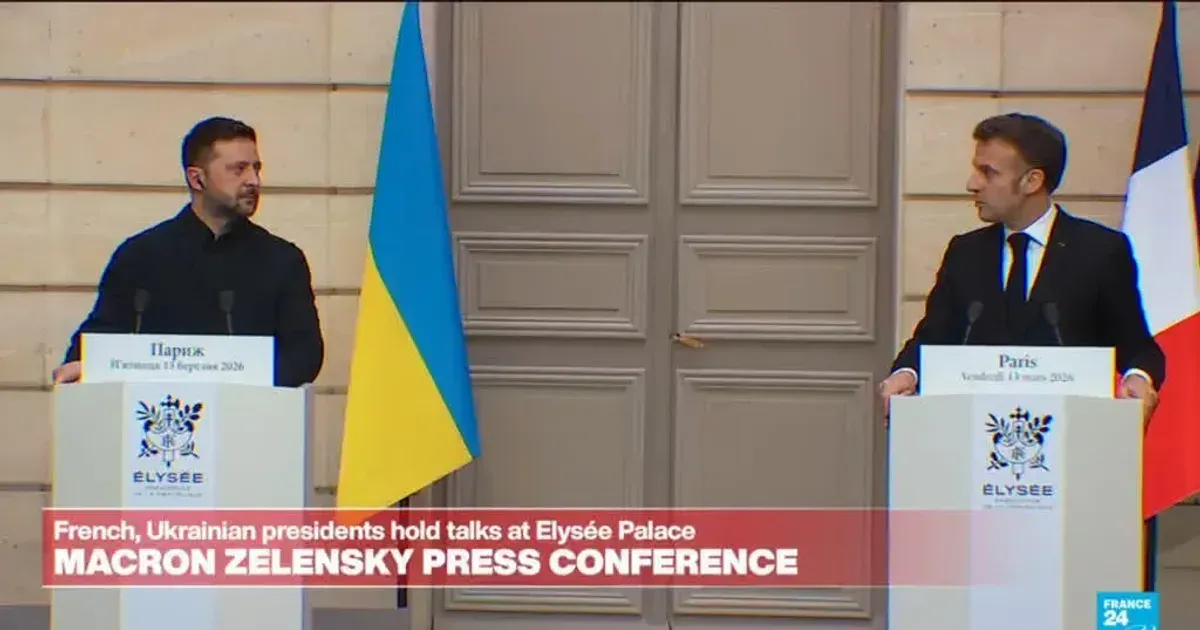
Elysée Palace grounds remained damp from an early spring rain as Volodymyr Zelensky arrived for a high-stakes meeting with Emmanuel Macron on Friday. The Ukrainian leader sought to shore up European commitments at a time when global attention appears diverted by escalating hostilities in the Middle East. Security was tight along the Rue du Faubourg Saint-Honoré while the two presidents retreated for two hours of private talks before addressing the international press. The remarks were reported on March 13, 2026. The diplomatic exchange hardened quickly. Energy markets provided a grim backdrop to the diplomatic theater unfolding in Paris. Crude oil prices have surged recently, driven by supply chain disruptions in the Persian Gulf and shifting trade routes. But the most significant blow to the Ukrainian diplomatic effort came from Washington rather than Moscow. The U.S. Department of the Treasury recently authorized a temporary lifting of sanctions on Russian oil exports, a move intended to stabilize global prices but one that has effectively increased the Kremlin's war chest.
Energy Markets and Russian Oil Sanctions
Macron focused his rhetoric on the glaring contradictions in Russian foreign policy. He pointed out that Moscow has frequently called for a ceasefire in the Middle East while simultaneously intensifying its bombardment of Ukrainian infrastructure. These calls for peace in one region ring hollow when contrasted with the scorched-earth tactics deployed in Eastern Europe. Russia seeks to portray itself as a mediator in the Levant while remaining the primary aggressor on the European continent.
Rising energy costs have granted Vladimir Putin renewed pressure over Western capitals. With the Middle East conflict tightening global supply, Russian barrels have become an unavoidable necessity for several emerging economies and, increasingly, for Western-aligned nations struggling with inflation. In fact, $11 billion in additional revenue is expected to flow into Russian coffers this quarter alone due to the temporary easing of American trade restrictions.
The war in the Middle East will not give Russia respite in its own conflict with Ukraine. It is strange to see Russia calling for a ceasefire in the Middle East when it obstinately refuses to accept one with Ukraine.Zelensky remained stoic during Macron's address, his signature olive-drab attire contrasting with the gilded interior of the French presidential palace. He focused his remarks on the practicalities of the front line rather than the abstractions of global oil prices. According to Ukrainian intelligence, Russian forces have used the distraction of the Middle East to reposition heavy artillery in the Donbas. Still, the Ukrainian president expressed gratitude for the continued delivery of French military hardware.
French Military Commitments to Ukraine
France remains one of the few European powers consistently increasing its defense production to meet Ukrainian demands. Macron reiterated that French support would remain resolute regardless of the geopolitical shifts occurring elsewhere. To that end, Paris has pledged another shipment of long-range missiles and additional Caesar self-propelled howitzers to be delivered by the end of the month.
Logistical challenges continue to hamper the rapid deployment of these assets. Shipping routes through the Mediterranean have become increasingly complex due to naval skirmishes and heightened insurance premiums. Meanwhile, the French defense industry is operating at maximum capacity, with shift workers in cities like Bourges and Saint-Etienne working around the clock to assemble the munitions required for a prolonged war of attrition.
By contrast, some European neighbors have shown signs of fatigue. Internal polling in several EU member states suggests that the public is becoming more concerned with domestic heating costs than with the territorial integrity of Ukraine. Macron addressed this sentiment indirectly by framing the defense of Kyiv as the defense of European sovereignty. Any concession to Russia in the east would inevitably lead to a more volatile security environment for the entire European Union.
Diplomatic Tensions at the Elysée Palace
The meeting also served as a venue to address the recent diplomatic friction between Paris and Washington over the oil sanctions issue. French officials have privately expressed frustration that the United States acted unilaterally to ease pressure on the Kremlin. This decision has complicated the EU strategy of total economic isolation of the Russian state. Still, the Biden administration has argued that preventing a global recession is paramount to maintaining any level of support for Ukraine in the long term. Russia has seized this opportunity to drive a wedge between the Atlantic allies. Pro-Kremlin media outlets have spent weeks highlighting the discrepancy between American rhetoric and American economic policy. For instance, while the White House continues to condemn Russian war crimes, the lifting of oil sanctions provides the very funds that finance the Russian military machine. Macron's public rebuke of Russian hypocrisy was clearly also a signal to his allies in the West.
Data from maritime tracking services shows that a fleet of tankers is already moving to exploit the new trade window. In particular, shipments of Russian Urals crude have increased sharply toward ports in India and China, where refining capacity has been expanded to handle the influx. These economic realities make the task of the Ukrainian president sharply harder as he lobbies for more aggressive measures against the Putin regime. Conflict in the Middle East has fundamentally altered the calculus of the war in Ukraine. Tehran, a key ally of Moscow, has diverted some of its drone shipments to support local proxies in the Levant. But this shift has not resulted in a meaningful decrease in the number of Shahed-style drones falling on Ukrainian cities. In fact, Russia has successfully localized the production of these unmanned aerial vehicles at a massive factory in the Tatarstan region.
Military analysts suggest that the two conflicts are now deeply intertwined through a complex web of arms deals and intelligence sharing. Russia provides satellite imagery to its partners in the Middle East in exchange for continued diplomatic cover at the United Nations. At the same time, the French navy has had to redeploy assets from the North Sea to the Eastern Mediterranean to protect shipping lanes. This redistribution of resources is precisely what the Kremlin hoped to achieve when it first aligned itself with disruptive forces in the Levant. Separately, the European Central Bank has warned that a prolonged period of high oil prices could trigger a new wave of stagflation. This economic pressure is the most potent weapon in Putin's arsenal. If the cost of living in Paris and Berlin continues to rise, the political will to send billions in aid to Kyiv may eventually evaporate. Macron's firm stance on Friday was an attempt to preempt that decline in resolve. Zelensky's visit concluded with a tour of a military training facility where Ukrainian soldiers are learning to operate French armored vehicles. The visual of the two leaders standing among the hardware was intended to project an image of unbreakable unity. To that end, the joint statement issued after the meeting emphasized that French military aid would continue as long as necessary. France has now committed €3 billion in direct military assistance for the 2026 fiscal year.
European Diplomacy Faces the Hard Test
Macron is right to call out Russian hypocrisy, but the harder question sits in Europe itself. A continent that condemns Moscow while relying on emergency oil arithmetic is still letting energy fear dictate moral clarity. Ukraine does not need another ornate press conference in Paris; it needs governments willing to absorb a political cost when prices rise.