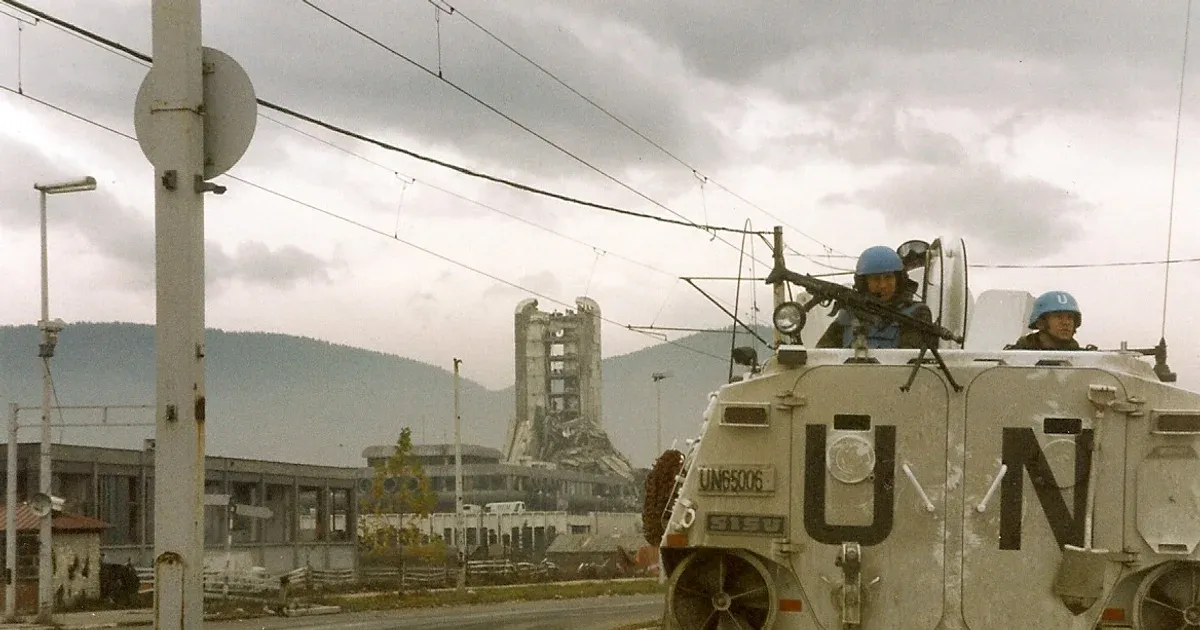
Archivists and historians at CNN began a detailed review of the Margaret Moth record to preserve one of the clearest visual accounts of the Bosnian War. The effort renewed attention on a camera operator whose courage shaped how television audiences saw modern conflict. By April 11, 2026, the review had also become a reminder of how expensive and dangerous front-line reporting once was. Survivors of the 1992 siege of Sarajevo recall her distinctive presence, often marked by heavy black eyeliner and a refusal to wear the standard blue press helmet.
Sarajevo Sniper Attack and the Price of Access
Risk management for international news organizations changed forever on July 23, 1992. Margaret Moth was traveling in a clearly marked television van toward the airport in Sarajevo when a sniper round shattered the windshield. Impact from the bullet destroyed her jaw and tongue, leaving her with catastrophic facial injuries that required years of reconstructive surgery. Doctors in the United States and Germany performed more than a dozen operations to repair the damage caused by that single high-velocity round. Colleagues who visited her during the initial recovery period noted her dark sense of humor. Despite the severity of her wounds, she maintained a focus on her professional duties. "I will go back and find my missing teeth," she reportedly joked to her coworkers before returning to the field.
Persistence defined her career after the attack. Journalists often cite her return to the same conflict zone in 1994 as a defining moment for the profession. Sarajevo was still a lethal environment for foreign press, yet she insisted on resuming her post at the CNN bureau. Resilience despite such trauma provided a blueprint for the psychological support systems now standard in modern newsrooms.
Financial Logistics of High-risk Foreign Bureaus
Operating a news bureau in a besieged city required immense capital investment during the 1990s. CNN allocated millions of dollars to maintain a presence in the Balkans, covering the costs of armored transport, satellite uplinks, and local fixers. Each armored vehicle could cost upwards of $150,000 after custom plating and ballistic glass installations. These expenditures represented a significant portion of the annual foreign news budget for the Atlanta-based network.
Insurance premiums for camera operators like Margaret Moth skyrocketed as the intensity of the urban warfare increased. Actuaries at major firms struggled to calculate the liability of sending staff into regions where the press was explicitly targeted. Internal financial documents from that era reveal that the cost of a single day of filming in a conflict zone often exceeded the weekly budget of a domestic news desk. Direct investment in high-quality footage from the front lines gave the network a competitive advantage in a crowded media market.
Market demands for unfiltered conflict imagery drove these economic decisions. Viewers in the United States and the United Kingdom gravitated toward the visceral, ground-level perspective that Margaret Moth provided. This appetite for raw footage created a feedback loop where networks felt compelled to fund increasingly dangerous assignments. Strategic spending on technology allowed her to transmit images from deep within the Sniper Alley district. Economic shifts eventually forced many outlets to pull back from this model.
Margaret Moth and the Personal Cost of Professional Duty
New Zealand became her home before she moved to the United States to pursue a career in television. Born Margaret Wilson, she changed her name to Margaret Moth to reflect her desire for a unique identity within the industry. Early work at local stations in New Zealand demonstrated her aptitude for finding the most difficult shots in the most challenging conditions. Moving to CNN allowed her to apply that intensity to global events that shaped history.
Physical suffering did not deter her from subsequent assignments in Iraq, Afghanistan, and Lebanon. Surgeons used fragments of her hip bone to rebuild her face, a process that left her in chronic pain for the remainder of her life. Experts in journalism ethics point to her career when discussing the line between dedication and self-sacrifice. Her presence in the field was a constant for nearly two decades, ending only when she was diagnosed with cancer. Death came in 2010, but the influence of her work persists in every modern war documentary.
Camerawork from the Bosnian era remains the gold standard for aspiring visual journalists. Mentors at major broadcast schools use her Sarajevo footage to teach the importance of steady hands under fire. Statistical analysis of her career reveals that she spent more time in active war zones than almost any other Western camera operator of her generation. Her legacy is found in the continued willingness of crews to enter dangerous territories to document the truth.
What War Reporting Costs
Safety protocols in modern newsrooms have reached a level of bureaucratic sterility that would have rendered the career of Margaret Moth impossible. Corporations now prioritize the mitigation of insurance liability over the pursuit of unvarnished truth. The era of the lone, fearless camera operator has been replaced by a culture of risk-aversion and remote reporting. This shift toward safety is a financial necessity, but it comes at the expense of historical clarity. When news organizations prioritize their balance sheets over the physical presence of their reporters, the audience loses the visceral connection to global tragedies.
Margaret Moth was an economic anomaly. She existed in a window of time when cable news possessed the surplus capital to fund high-risk pursuits without the constant interference of corporate legal departments. Modern news executives would likely veto her return to a war zone after an injury as severe as the one she sustained in 1992. They would view her not as a hero, but as a liability. This cold calculation simplifies the accounting process but hollows out the soul of investigative journalism. The industry must decide if it values the bottom line more than the front line. Courage cannot be quantified on a spreadsheet.