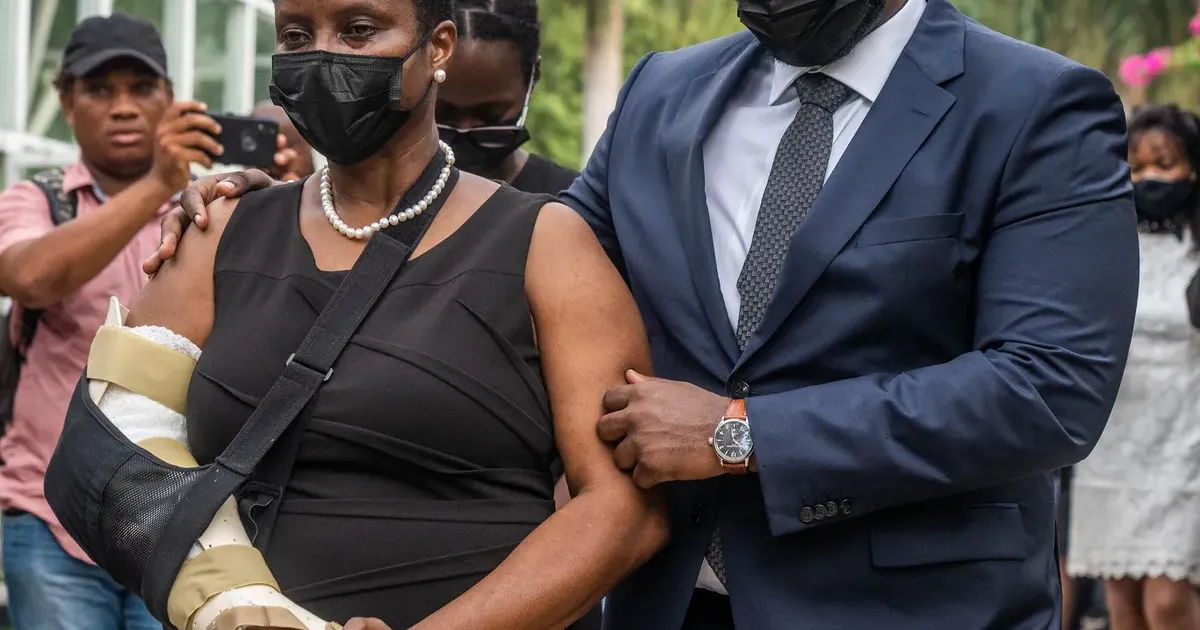
Martine Moise’s account of her husband’s final moments has brought Haiti’s unresolved assassination trauma back into focus. The testimony returned to court attention on March 12, 2026
A Widow Reconstructs the Attack
Martine Moise sat before the court, her voice steady but her words heavy with the memory of a night that broke a nation. Sunlight filtered through the dusty windows of the makeshift courtroom as she recounted the early morning hours of the assassination. Gunfire shattered the silence of the presidential residence in Pelerin 5. She recalled the intruders moving with military precision, their footsteps echoing across the tiled floors. They did not speak the Haitian Creole or French common to the streets of Port-au-Prince. Instead, the air filled with rapid Spanish commands, a detail that has become the linchpin of the government's case against a group of foreign mercenaries. Spanish-speaking voices rose above the sound of shattering glass and heavy boots. Prosecutors in the ongoing trial argue that these linguistic details confirm the presence of foreign assassins. Records from the Haitian National Police and international investigators point toward a group of former Colombian soldiers. These men entered the country through the Dominican Republic under the guise of providing security services. Christian Emmanuel Sanon, a Haitian-American pastor, remains a central figure in the investigation. His ambitions for the presidency drove the plot, according to witness statements and electronic records seized by federal agents, as Haiti's search for accountability remained painfully incomplete. The math doesn't add up. Witnesses have consistently noted the foreign origins of the tactical team.
Foreign Links Shape the Case
Martine Moise told the court that the attackers spoke in a language she recognized as Spanish, which she did not understand fluently. This linguistic barrier added a layer of confusion to the terror. While some early reports suggested the attackers claimed to be part of a US Drug Enforcement Administration raid, the widow's testimony focuses on the specific dialect of the men inside the bedroom. Colombian officials later confirmed that many of the suspects had served in their nation's elite military units. Such training was evident in how they secured the perimeter and moved through the multi-story residence. Nobody came to help. Security details assigned to the President mysteriously vanished or failed to engage the intruders. Martine Moise described hiding under the bed while her husband faced the gunmen alone.
She felt the searing impact of bullets hitting her own body. Eleven rounds struck the President. He died where he stood, his body a map of a political conspiracy that spanned multiple borders. The widow testified that the attackers searched the room frantically for documents and cash.
They ignored her as she lay bleeding, focused instead on a specific objective that remains the subject of intense speculation. Florida-based firms became central to the web of financing discovered by the FBI.
Haiti Still Lacks Closure
CTU Security, a firm based in Doral, allegedly recruited the Colombian mercenaries. Antonio Intriago, the owner of the firm, faced charges related to the conspiracy in a Miami court. Federal agents seized documents and electronic devices that suggested a complex financial arrangement involving multiple shell companies. US authorities successfully prosecuted several individuals in Miami courts while the Haitian legal system struggled to maintain momentum.
Rodolphe Jaar, a dual Haitian-Chilean citizen, received a life sentence for his role in providing material support to the assassins. His cooperation with US investigators provided a roadmap of how the operation was staged from South Florida. Investigators found that the plotters had met several times in Florida and the Dominican Republic. They discussed various scenarios, ranging from a simple arrest of the President to a full-scale assassination.
The decision to move forward with the killing occurred just weeks before the July raid. Financial records indicate that thousands of dollars were funneled through bank accounts in the United States to pay for flights, lodging, and weapons. Such a large-scale operation required a level of logistical support that went far beyond the capabilities of a lone pastor or a small security firm. It remains unclear who provided the ultimate financial backing for the coup.
Haiti has not held an election since the assassination.
Justice Is Arriving in Fragments
Martine Moise testified about the final moments of Jovenel Moise. Her account renewed focus on foreign mercenaries, financing links and missing security protection. The broader Haitian justice process remains slow, fragmented and politically dangerous.
Her testimony provides firsthand detail in a case where evidence, jurisdiction and political pressure have repeatedly collided. The testimony is powerful because it narrows the night into human detail. It is also insufficient by itself. Haiti's crisis will not be solved by identifying the men who entered the room if the networks that enabled them remain protected by fear, money or political chaos.