NAEYC's centenary is both a milestone and an indictment. A century of professional standards has not solved the pay, access and childcare funding problems facing early educators. The anniversary gives advocates a public platform.
Michelle Kang and other top early learning advocates gathered on April 6, 2026, to mark the centennial of the National Association for the Education of Young Children. Established in 1926, the group initially focused on the growing nursery school movement. Members originally operated under the name National Association for Nursery Education before adopting the current acronym to reflect a broader scope of early childhood development.
Institutional Milestones and the Head Start Legacy
Success for the association often involved bridging the divide between academic research and classroom practice. Beyond these legislative wins, the group established the first nationwide accreditation system to standardize quality in early learning centers. Programs seeking this status must undergo rigorous evaluations of teacher-child interactions, curriculum depth, and physical safety protocols. Professional standards evolved sharply through the creation of the Child Development Associate credential. Known as the CDA, this certification provides a pathway for educators to demonstrate competency without requiring a four-year university degree. State governments frequently use these standards to determine eligibility for public subsidies.
Credentialing Systems and National Accreditation Benchmarks
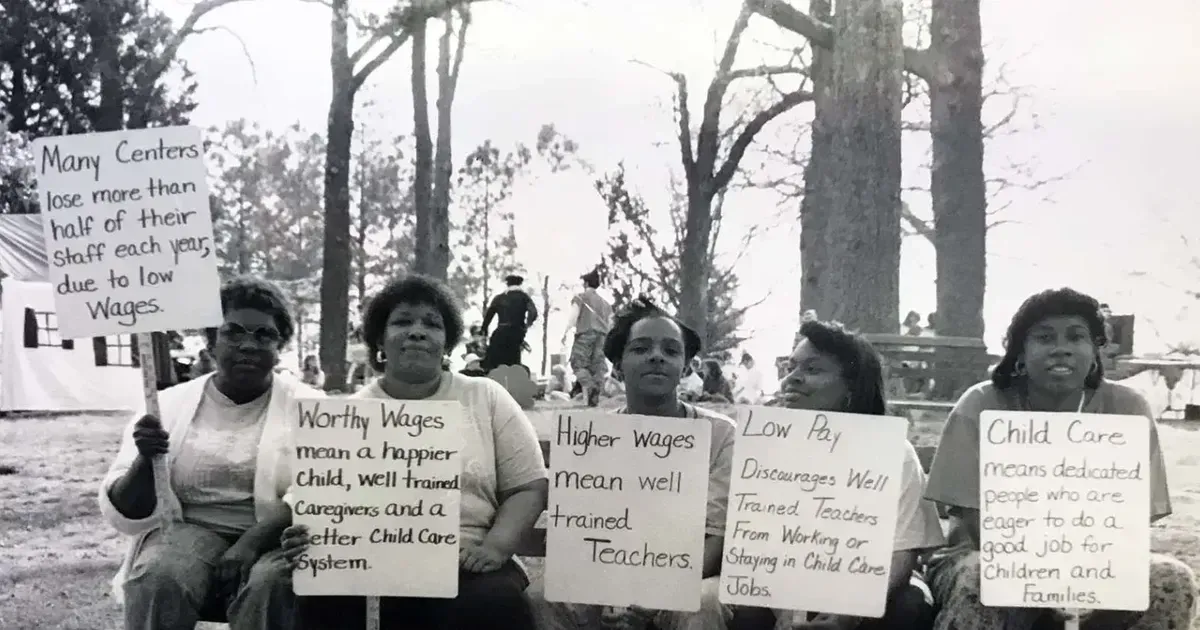
Within the workforce, however, a sense of stagnation persists regarding compensation and professional recognition. Early childhood educators frequently cite the 1992 Worthy Wage Day as a historical benchmark for labor advocacy. Organizers in Greensboro, North Carolina, led marches to highlight the gap between the importance of the work and the poverty-level pay scales. Political discourse surrounding early childhood development often centers on the efficacy of government-backed support systems and provider standards.
Poverty-level wages continue to plague the sector despite rising educational requirements for staff. Bureau of Labor Statistics data shows that childcare workers earn far less than their peers in the K-12 system. Many teachers in the early childhood sector rely on public assistance programs to supplement their income. Today, the organization functions as the primary professional body for the American childcare workforce. Michelle Kang, serving as CEO, describes the 100th anniversary as a deliberate period for centering educator perspectives.
“The national nonprofit plans to honor the occasion with an intentional year of celebration, reflection and doing what we have always done: center the voices of educators,” Michelle Kang said.
Historically, this body helped shape the federal Head Start program during the expansion of the American social safety net. Records from the 1960s show the association provided technical expertise to the Lyndon B. Johnson administration to ensure developmental standards were integrated into poverty-reduction efforts. Federal funding for Head Start reached nearly 12 billion dollars in 2024.
National data indicates that hundreds of thousands of educators currently hold active credentials through these association-led programs. Michelle Kang maintains that the focus must stay on the individuals performing the labor. Affiliates now operate in nearly every state to provide localized support for teachers facing shifting regulatory environments.
Economic barriers prevent many qualified individuals from remaining in the profession for more than five years. Turnover rates in early learning centers often exceed 30 percent annually in several high-cost urban markets. This instability directly affects the continuity of care for children during their most sensitive developmental windows.
Economic Stagnation and the Child Care Wage Gap
Decades of advocacy have yet to produce a unified federal solution for childcare funding. Instead of a centralized system, the United States relies on a patchwork of state grants, private tuition, and limited federal vouchers. Legislative efforts to pass universal childcare bills have stalled in Congress due to concerns over long-term fiscal commitments.
Federal investments in the Child Care and Development Block Grant provide essential support to low-income families, but the reach is limited. Eligibility rules vary by state, leaving many middle-class families to spend over 20 percent of their household income on care. Such costs frequently drive parents, predominantly women, out of the labor force.
Local affiliates of the association report that the supply of licensed spots continues to fall short of demand in many regions. This disparity creates childcare deserts where families have no access to accredited programs within a 30-mile radius. Rural communities face the most severe shortages of qualified staff and facilities.
Early Education Funding Gap
Longevity is a poor substitute for structural power in the American political economy. While the National Association for the Education of Young Children has spent a century refining pedagogy and professionalizing the workforce, the organization has failed to solve the fundamental math of childcare. The sector remains a secondary priority for lawmakers who view early learning as a private family responsibility rather than a public utility.
The current model of early education relies on the suppressed wages of a largely female workforce to remain solvent. Accreditation and high-level credentials mean little if the people holding them cannot afford basic housing. Unless the association pivots from academic advocacy to aggressive labor organizing, another century will pass with teachers marching for a worthy wage while the systemic architecture stays broken. Pragmatism dictates that the association must stop asking for a seat at the table and start demanding the keys to the treasury. Can a professional body born in the era of nursery schools evolve into a modern political force?