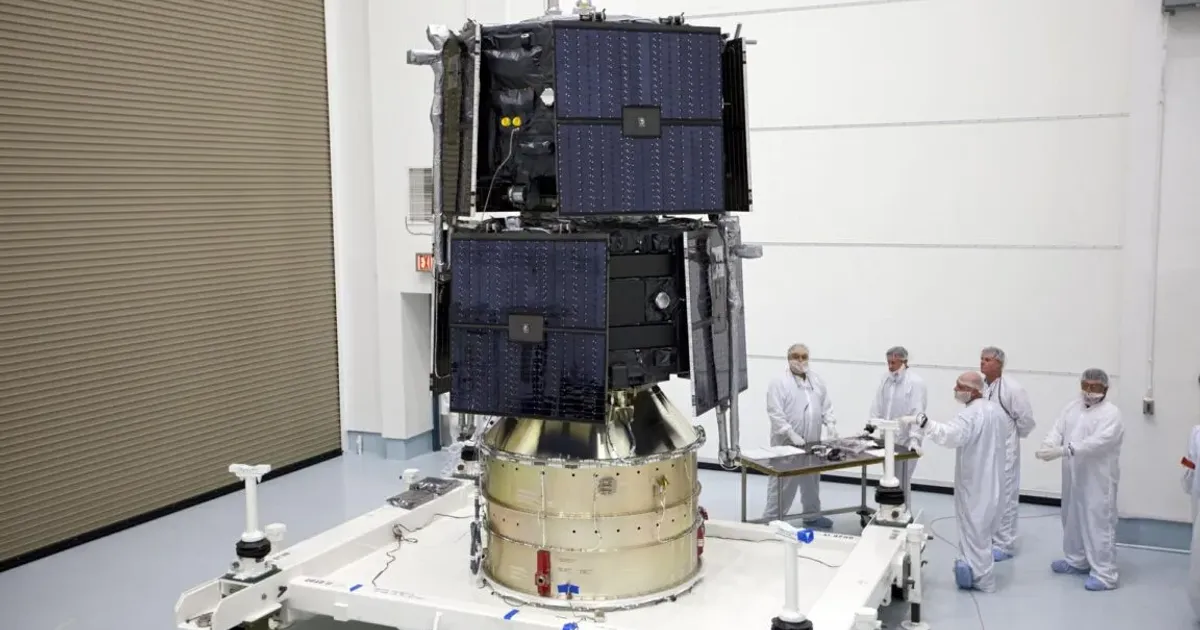
March 11, 2026, marks the final descent of a decade-old scientific sentinel into the scorching friction of Earth’s atmosphere. NASA engineers confirmed this week that one of the Van Allen Probes, a 1,323-pound spacecraft designed to withstand the harshest radiation environments, will make an uncontrolled reentry. Most of the structure will vaporize into incandescent gas during the plunge. Some fragments, however, are expected to survive the journey and strike the surface of the planet.
Gravity is claiming the remainder of a mission that revolutionized our understanding of space weather. While many satellites burn up completely or are steered into the uninhabited reaches of the South Pacific, this specific craft lacks the propulsion necessary for a guided disposal. It remains a tumbling mass of titanium and aluminum, governed only by the chaotic drag of the upper atmosphere.
Risk levels associated with the event have forced NASA to take an unusual administrative step. Official safety protocols typically mandate that any satellite returning to Earth must pose a casualty risk to the public of less than 1 in 10,000. Calculations for this reentry place the risk at 1 in 4,200. This calculation exceeds the standard safety threshold by more than double, prompting the agency to issue a formal safety waiver to allow the event to proceed without intervention.
The math simply does not favor the public.
Legacy of the Radiation Belt Explorers
Launched in late August 2012, the Van Allen Probes were a pair of identical spacecraft built and operated by the Johns Hopkins Applied Physics Laboratory. They spent years diving through the inner and outer Van Allen radiation belts, regions of high-energy charged particles trapped by Earth’s magnetic field. These belts act as a barrier and a threat, capable of frying the electronics of GPS satellites and endangering astronauts on the International Space Station. Scientists used the probes to map the belts in three dimensions, discovering a third, temporary radiation ring that appeared and disappeared based on solar activity.Data gathered by these twin sensors helped power-grid operators and satellite manufacturers prepare for solar storms. Reliability was the hallmark of the mission. Both probes operated far beyond their expected lifespans, surviving the intense bombardment of the very particles they were sent to study. In 2019, the mission officially ended when the satellites exhausted their fuel reserves. NASA chose to lower their orbits at that time, ensuring they would eventually burn up rather than remaining as permanent hazards in high-traffic orbital lanes.
Anatomy of a Safety Waiver
NASA Procedural Requirements 8715.6 serves as the primary governing document for limiting orbital debris. It explicitly states that the probability of a casualty from a returning spacecraft should not exceed 0.0001. When a mission fails to meet this requirement, the Associate Administrator of the Science Mission Directorate must sign a waiver acknowledging the elevated danger. Internal records suggest the decision to approve the waiver for the Van Allen Probe was based on the lack of viable alternatives. Because the satellite has no remaining fuel, ground controllers cannot adjust its trajectory or force a steeper, safer entry angle.Experts at the Orbital Debris Program Office at Johnson Space Center performed the modeling that led to the 1 in 4,200 figure. Their simulations account for the population density of the regions the satellite might overfly and the durability of the components within the 600-kilogram frame. Titanium tanks and hardened camera housings are the most likely candidates for surviving the 3,000-degree heat of reentry. These pieces can hit the ground at terminal velocity, carrying enough kinetic energy to cause significant damage or injury.
Bureaucracy often wins where physics fails.
Agency spokespeople maintain that the risk to any specific individual is astronomically low. Still, the statistical reality of a 1 in 4,200 chance is departure from the conservative safety culture NASA adopted in the wake of previous space disasters. Critics within the space safety community argue that granting waivers for known risks creates a precedent that could be exploited as orbital traffic increases. They point to a recent study indicating that uncontrolled reentries of objects weighing more than 500 kilograms occur several times a month, though few involve the specific regulatory bypass seen here.
Global Roulette of Orbital Debris
Predicting exactly where the debris will land is impossible until the final hours of the descent. The Van Allen Probe travels at approximately 17,500 miles per hour, meaning a one-minute error in calculating the burn-up time translates to an impact point nearly 300 miles away. Most of the Earth is covered by water or uninhabited wilderness, which serves as the primary defense against satellite-related casualties. Probability suggests the titanium fragments will sink into an ocean or vanish into a forest, but the satellite’s orbital inclination covers a wide swath of populated latitudes.Materials used in the construction of the Van Allen Probes were chosen for their ability to withstand the extreme environment of the radiation belts. This same durability makes them a liability during reentry. Carbon-fiber-reinforced polymers and specialized metal alloys do not always succumb to the plasma shield that forms around a falling object. If a propellant tank or a structural bracket survives, it will likely strike the Earth within a debris corridor stretching hundreds of kilometers.
Spacecraft reentries have rarely resulted in documented injuries, yet the volume of hardware in low Earth orbit is growing at an exponential rate. Governments are currently struggling to update treaties that were written when only two nations were capable of reaching the stars. Today, private corporations and dozens of national space agencies are adding to the congestion. This specific NASA waiver highlights the tension between the desire to explore and the responsibility to protect the people living under the flight paths.
Engineers at the Applied Physics Laboratory will monitor the decay of the probe’s orbit until the very last signal is lost. Once the satellite enters the thicker layers of the atmosphere, it will begin to tumble and break apart. Observers on the ground might see a brilliant streak of light, a man-made meteor signaling the end of a storied scientific journey. For NASA, the event is a calculated gamble, a necessary conclusion to a mission that has already provided its weight in scientific gold.
The Elite Tribune Perspective
Does a one-in-four-thousand chance of killing someone sound like a safety standard, or a confession? NASA’s decision to sign off on this waiver is a cynical admission that their own regulations are merely suggestions when they become inconvenient. We are told the risk is low, yet the agency’s own rules exist precisely because we decided decades ago that 'low' was not good enough. By doubling the acceptable casualty threshold, the space agency is participating in a dangerous game of orbital Russian roulette, gambling with the safety of random civilians to clear their books of an old satellite.Bureaucrats will hide behind the lack of fuel as if it were an act of God rather than a failure of long-term mission planning. If a private company attempted to drop a half-ton of titanium on an unpredictable global path, the outcry would be deafening. Because this is a NASA mission with a pedigree of scientific achievement, we are expected to shrug at the deviation. We must demand better than a culture of waivers. If the physics of reentry cannot be controlled, the mission design must change, or we risk a future where falling debris is just another weather report we are told to ignore.