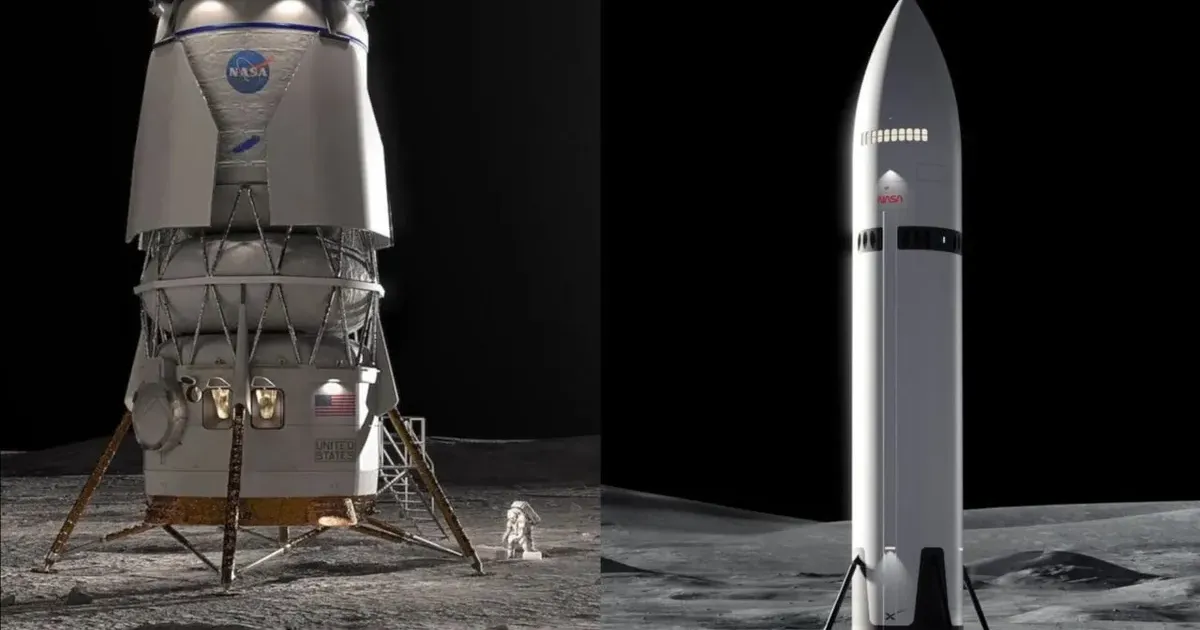
NASA’s watchdog warning about Artemis landers puts the moon program’s rescue assumptions under sharper scrutiny. The warning became sharper on March 11, 2026, as Artemis planning again ran into the hard calendar of contractor readiness.
Artemis Depends on Contractor Timing
Cape Canaveral serves as the backdrop for a growing crisis of confidence as federal investigators cast doubt on the vehicles meant to return Americans to the lunar surface. A scathing internal report from the NASA Office of Inspector General suggests that the Human Landing System program, currently split between Elon Musk's SpaceX and Jeff Bezos's Blue Origin, faces systemic risks that could leave crews stranded in lunar orbit or on the surface itself. These warnings arrive as NASA pushes to meet aggressive deadlines for the Artemis III and IV missions, which are designed to establish a long-term human presence on the moon. Space travel remains a lethal gamble. Federal auditors pointed to a lack of transparency and insufficient testing protocols for the massive Starship and Blue Moon landers. NASA has invested billions into these commercial partnerships, yet the watchdog report highlights a terrifying reality: the agency lacks a backup plan if these private platforms fail during a mission. While SpaceX has conducted several high-altitude flights of its Starship prototype, the Inspector General notes that the technology required to transfer super-chilled propellant in zero gravity has never been successfully demonstrated at scale. Such a failure would leave a crew with no way to lift off from the moon once their mission concludes.
SpaceX engineers are currently racing to solve the problem of cryogenic fuel boil-off, a phenomenon where propellant evaporates during the long journey to the lunar south pole. NASA officials have expressed private frustration with the pace of development, even as public statements remain optimistic.
Refueling Complexity Raises Safety Questions
Musk's company must execute dozens of refueling launches just to get a single lander to the moon. This technological gap creates a precarious chain of events where one faulty valve or a miscalculation in fuel docking could end in a multi-billion dollar catastrophe. Blue Origin faces its own set of hurdles related to the sheer complexity of its Blue Moon lander. NASA auditors found that the oversight of these private contracts is sharply less rigorous than the procedures used during the Apollo era.
This decision to prioritize speed and cost over direct government control has created a culture where safety milestones are often secondary to corporate milestones. Bezos, who has long dreamed of moving heavy industry into space, finds himself under the same scrutiny as his terrestrial business interests. Amazon, the retail giant also founded by Bezos, continues to push its own automated transport agenda through its subsidiary Zoox. Recent announcements indicate that Zoox could soon integrate its fleet of autonomous robotaxis with the Uber platform, targeting cities like Las Vegas and Los Angeles for commercial rollout.
While the connection between a self-driving car in Nevada and a lunar lander may seem distant, the underlying software and sensor arrays share a common DNA of high-stakes automation. Safety advocates argue that if these companies struggle to navigate a predictable city street, trusting them with the vacuum of space is a leap of faith the taxpayer should not have to make.
Program Risk
Uber executives confirmed they are in discussions to allow riders to book a Zoox vehicle directly through their app, a move that would monetize years of development. For years, these rides have been offered for free to select passengers as a form of beta testing. Moving toward a paid model suggests a level of confidence in the hardware that federal space auditors do not yet share regarding the lunar landing craft. Yet, the history of autonomous vehicles is littered with technical retreats and unforeseen edge cases that have delayed full-scale adoption for a decade.
Trust is the most expensive commodity in the solar system. Safety concerns extend beyond just the landing phase to the actual life support systems housed within these commercial vessels. NASA's watchdog highlighted that the pressurized volume required for a multi-day stay on the moon is barely met by current designs. If a lander experiences a power failure or a breach in the hull, the current Artemis architecture provides zero redundancy.
Unlike the International Space Station, which features escape pods and multiple docking ports, the Human Landing System is a one-way ticket for the duration of the surface stay. Critics of the current NASA strategy point to the 2026 launch window as an arbitrary political deadline that ignores engineering reality.
NASA Outsourced the Hardest Part
Could the survival of the American space program really be contingent on the whims of two billionaires who treat the moon like a private sandbox? The latest watchdog report is an indictment of the reckless outsourcing of national prestige to corporations that prioritize stock prices over human life. We are essentially watching a repeat of the lead-up to the Challenger disaster, but this time the negligence is hidden behind the proprietary curtains of SpaceX and Blue Origin. The decision to hand over the keys to the lunar surface to men who are simultaneously trying to dominate the ride-sharing market through Uber and Zoox is a conflict of vision that should worry every taxpayer.
Capitalism is a magnificent engine for building a better smartphone, but it is a horrific framework for deep-space exploration where the profit motive encourages cutting corners on safety. NASA has become a hostage to its own contractors. The math doesn't add up when you consider the sheer number of refueling flights needed just to put boots on the ground. History will eventually record that we traded the meticulous safety culture of the 20th century for the flashy, hollow promises of tech moguls who are better at social media marketing than they are at building vacuum-tight life support systems. If an Artemis crew is lost, the blood will be on the hands of the bureaucrats who let these privateers write their own safety rules.