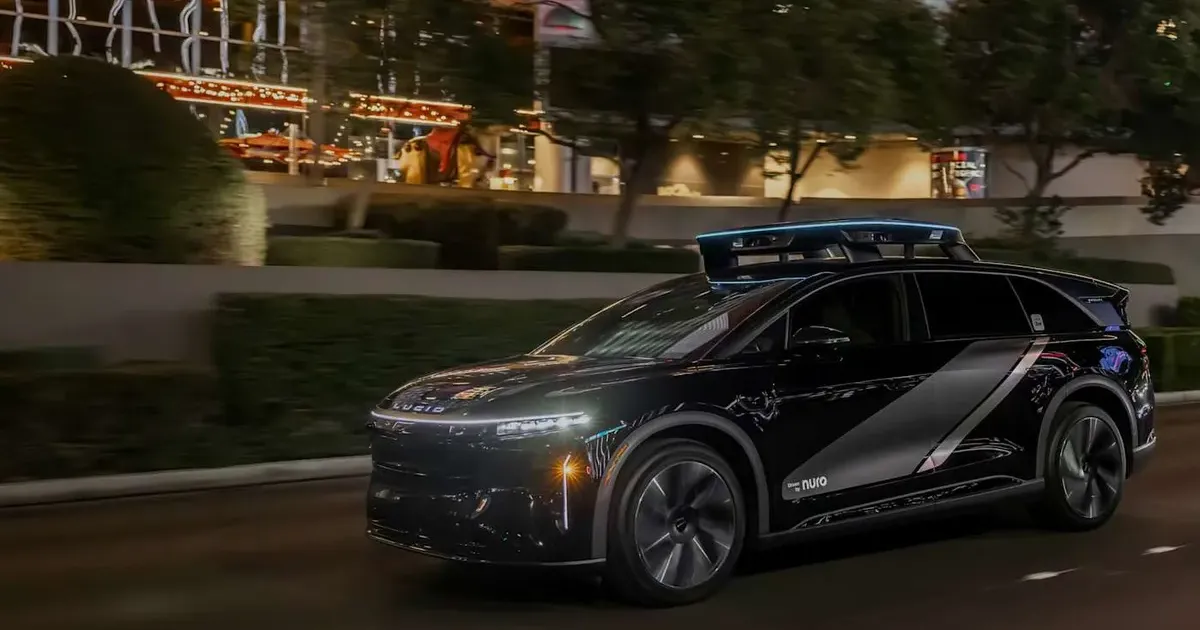
Nuro's Tokyo trials are less a publicity stunt than a stress test for whether autonomous driving software can adapt to a city that refuses to behave like a clean simulation. The trial is designed to answer practical questions before commercial promises. Regulators will be watching how the system behaves when the street stops matching the map. The company's first local test fleet drew attention on March 12, 2026, because Tokyo offers dense traffic, narrow streets, cyclists, delivery vehicles, pedestrians and left-hand driving patterns in the same operating environment. For an autonomous vehicle developer, that combination is valuable and unforgiving. A system that performs well in a wide suburban grid can still struggle when lanes are tight, curb space is crowded and human behavior changes by block.
Why Tokyo Is a Hard Test
Autonomous vehicles rely on perception, prediction and planning. Tokyo challenges all three because the vehicle has to identify objects, anticipate movement and choose safe maneuvers without assuming that traffic will be orderly. The city also tests the quality of high-definition maps. Construction, delivery stops, curbside activity and temporary restrictions can quickly make a static view of the road incomplete. Nuro's advantage is that it has spent years building low-speed autonomy for delivery use cases. Its challenge is proving that those systems can generalize beyond carefully selected US routes.
Safety Driver Requirement
Japan's regulatory approach remains cautious, and the use of human safety supervision reflects that posture. The point is not to declare full autonomy on day one, but to gather evidence that regulators and local partners can trust. That evidence will include disengagements, near misses, route reliability, response to vulnerable road users and how the system behaves when the map does not match reality. The Tokyo autonomous vehicle trial therefore becomes a data-gathering exercise as much as a technology demonstration. Success depends on boring consistency, not a dramatic one-day performance.
Commercial Path
If Nuro can prove safety in Tokyo, the company could strengthen its case for logistics partnerships in other dense Asian cities. Delivery automation is more plausible when routes are repeatable and vehicles operate at controlled speeds. But the economics remain difficult. Lidar, compute hardware, monitoring, insurance and local compliance costs can narrow the advantage that automation is supposed to create.
What It Means
Tokyo will not adapt itself to Nuro's software. Nuro has to show that its platform can respect local conditions, unusual street geometry and a regulatory culture that prizes caution. The trial's real value will come from what goes wrong. Every awkward merge, unexpected pedestrian movement or safety-driver intervention will tell the company whether its system is ready for cities that are messier than a test track.
Regulators Will Judge the Process
Japanese regulators will likely judge the trial by process as much as performance. They will want to know how Nuro reports disengagements, how quickly maps are updated, how safety drivers are trained and how the company communicates with local governments after unusual events. That makes the trial a relationship test. Autonomous vehicle companies need municipal trust because streets are public systems, not private laboratories. A single poorly explained incident can slow permits and make residents skeptical of the next phase. Tokyo also exposes the limits of importing a US playbook. Road culture, curb behavior, delivery patterns and expectations around pedestrian priority differ enough that a system trained elsewhere must show humility in deployment. The commercial promise remains meaningful. Low-speed delivery vehicles could reduce some labor pressure and improve logistics efficiency if they prove reliable. But that promise depends on the public believing the vehicles will not make dense streets feel more unpredictable.
Public Acceptance Is the Real Test
The public will not evaluate autonomy only through statistics. Residents will judge whether the vehicles hesitate at the wrong time, block narrow streets, behave politely near pedestrians and respond clearly when something unexpected happens. That social layer is often underestimated. A technically safe vehicle can still fail if people around it cannot understand what it is about to do.
Nuro will also need to prove that the technology can handle edge cases without becoming overly timid. A vehicle that stops too often may be safe in a narrow sense but still create frustration, congestion or risky behavior from human drivers trying to get around it. The company's data will be valuable only if it is specific. Regulators and partners need to know what caused interventions, which routes performed reliably, where perception struggled and whether problems were solved by software improvements or by avoiding difficult streets.
That distinction matters for the business model. A system that works only on carefully curated routes can still be useful, but it is a narrower product than a platform marketed as broadly adaptable urban autonomy.
Another issue is weather and lighting. Rain, glare, nighttime reflections and crowded intersections can change the difficulty of the same route. A credible trial has to show performance across ordinary variation, not only on the cleanest possible day.
That is where Tokyo can help Nuro. The city gives the company a dense catalogue of ordinary complications, from delivery stops to pedestrians stepping around construction barriers. Handling those details safely would be more persuasive than a long route in an easier setting.
Autonomy will advance only if companies can prove they understand the streets they enter. In Tokyo, that proof has to be earned one cautious route at a time.