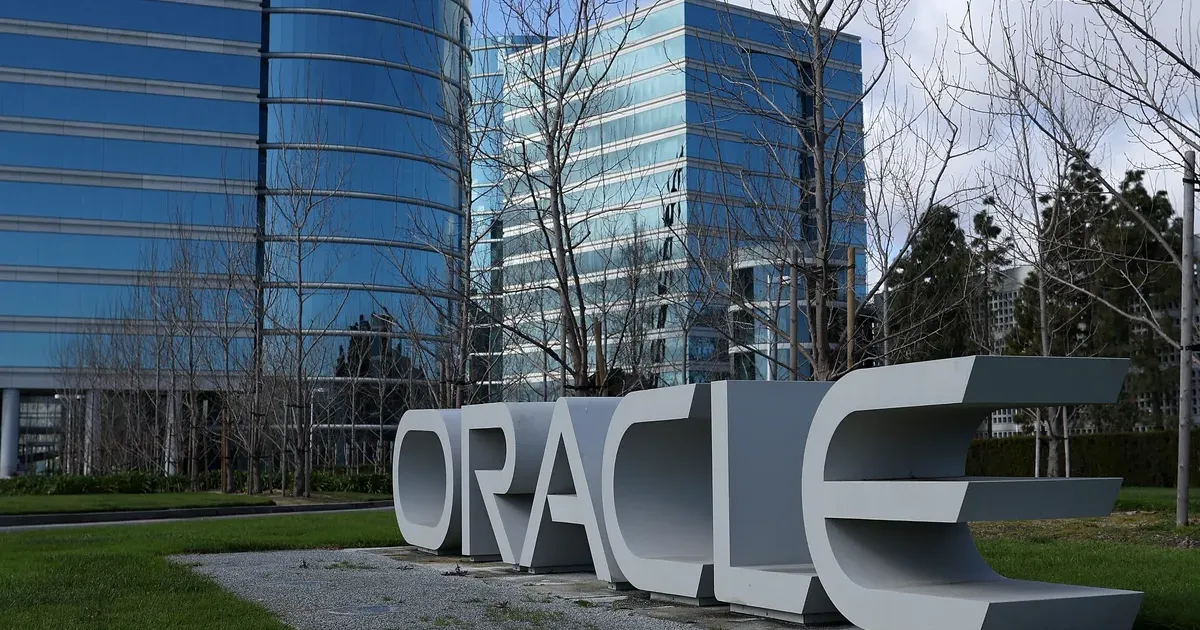
Oracle's earnings showed that demand for AI cloud infrastructure can still restore pricing power to older technology giants. The rally arrived on March 11, 2026.
Oracle Gives AI Bulls a Lifeline
Red screens turned green across trading floors in New York today. Oracle Corporation reported financial results that exceeded even the most optimistic projections from Wall Street. Revenue hit 17.19 billion dollars, supported by an earnings per share of 1.79 dollars. These figures surpassed the 16.9 billion dollars and 1.70 dollars per share analysts previously anticipated. Such a performance triggered a 14 percent surge in Oracle stock, pushing shares to 177.76 dollars by Wednesday morning. This quarter's success provided much-needed stability to a tech sector that had been reeling since late 2025. Investors had spent the first two months of 2026 questioning the massive capital expenditures required for artificial intelligence. A lackluster report in December 2025 sparked a widespread sell-off, creating fears that the AI buildout was an expensive bubble with no immediate return. Oracle's latest data suggests otherwise. The company raised its 2027 fiscal year guidance to 90 billion dollars, a bold statement of confidence in the longevity of the current cycle.
Investors were searching for proof that AI infrastructure could still produce real returns, and Oracle's quarter gave them a concrete answer.
Demand for cloud computing for AI training and inferencing continues to grow faster than supply, according to Oracle's official earnings statement. Clayton Magouyrk, serving as Oracle CEO, noted during the earnings call that the company's operating model is specifically optimized for profitability despite the high costs of infrastructure. Major consumers of AI cloud capacity have recently strengthened their financial positions, providing Oracle with a reliable pipeline of high-spending clients. Success in the cloud division appears to be a direct result of this disciplined scaling.
Self-Improving Models Change the Risk
While some competitors struggle with the sheer cost of data center expansion, Oracle claims its model ensures consistent margins. Analysts at several major firms raised their price targets within hours of the announcement. One research note highlighted that Oracle's ability to meet and likely exceed its 2027 revenue growth rate sets it apart from more volatile players in the space. The math suggests that the AI trade is far from exhausted. Morgan Stanley issued a far more ominous warning to its clients just as Oracle's stock price took flight.
Experts at the bank argue that the market is fundamentally unprepared for what they describe as a non-linear increase in large language model capabilities. These models are approaching a critical threshold where they can begin to self-improve, leading to an exponential leap in intelligence and utility. This technological feedback loop could begin to manifest as early as April or June of this year. If the bank's thesis is correct, the relative calm in the markets today is merely the eye of a hurricane. Industry titans have been quietly echoing these sentiments for weeks.
Sam Altman, speaking at the India AI Impact Summit in February, admitted that the takeoff of extremely capable models is happening faster than he originally anticipated. Jimmy Ba and other researchers have also alluded to a growth trajectory that defies traditional linear modeling. Morgan Stanley's note emphasized that current investment strategies do not account for the speed of this transition. Most portfolios are positioned for incremental change, not the radical disruption expected by mid-2026.
Infrastructure Wins While Services Wobble
The market is not prepared. Price deflation for services appears to be the most immediate risk for a wide variety of sectors. Morgan Stanley identified wealth management, insurance, shipping, gaming, property management, and software as the industries most vulnerable to this shift. As AI models become capable of performing complex cognitive tasks with minimal human intervention, the cost of these services will likely collapse. Firms that rely on high-margin professional services may find their business models obsolete within months rather than years.
Staffing reductions are expected to accelerate at firms that fail to integrate these self-improving models into their core operations. Earlier this year, several companies in the insurance and property management sectors saw their stock prices decline on the mere suggestion of AI-driven automation. Morgan Stanley advises investors to lean heavily into AI infrastructure and assets that the technology cannot easily replicate. Physical real estate, energy production, and the hardware that powers the models themselves are seen as the only safe havens in a world of rapidly devaluing human labor. This divergence between infrastructure providers like Oracle and service-based firms creates a complex environment for capital allocation.
While Oracle benefits from the gold rush by selling the shovels, the people digging the holes are about to be replaced by autonomous machinery. The tension between the hardware boom and the service-sector bust will likely define the second half of 2026.
Why Wall Street Is Cheering the Wrong Thing
History usually treats those who ignore exponential growth with brutal indifference. The celebration surrounding Oracle's earnings beat is a symptom of a desperate market looking for any excuse to ignore the looming structural collapse of the service economy. Wall Street is currently cheering for the companies that are building the gallows for their own clients. If Morgan Stanley is correct about the April-June window for non-linear AI improvement, we are currently living through the final weeks of a recognizable financial order. The transition from human-led services to self-improving algorithmic labor will not be a smooth transition for your portfolio or the social contract.
Oracle and its ilk are reporting record profits because they are the primary beneficiaries of a massive, one-time transfer of wealth from labor-intensive industries to capital-intensive infrastructure. Once the models begin to improve themselves, the need for further massive cloud expansion might even plateau as efficiency skyrockets. We are watching the peak of a construction boom that precedes a permanent vacancy in the office towers of the Western world. To bet on the service sector now is to bet against the most powerful technological force in human history. The smart money has already moved to the physical world of power grids and silicon, leaving the digital remnants to the dreamers and the doomed.