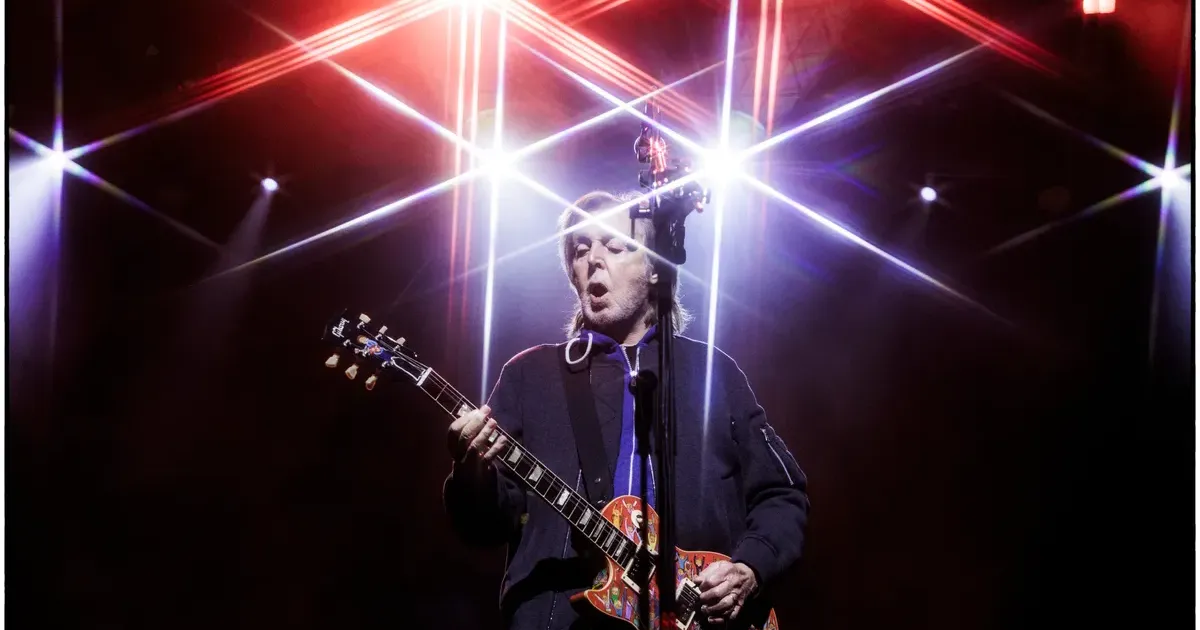
Paul McCartney’s Fonda Theatre show turned a Hollywood club into the kind of room that usually exists only in rock mythology. The performance had scarcity on its side from the first announcement. A club show by a stadium artist changes the value of every familiar song. That is why the room itself became part of the story. On March 28, 2026, he opened a rare two-night stand at the 1,200-capacity venue, bringing arena-sized songs into a space where fans could see expressions rather than screens. The result was not simply a smaller version of a stadium concert. It was a reminder of how different McCartney’s catalog feels when the distance between performer and audience collapses.
The show carried the industry term “underplay,” but that word sounds too technical for what happened. McCartney is a stadium artist choosing a club-sized stage, and that choice changes the emotional math. Songs that can become communal monuments outdoors became direct exchanges inside the Fonda. The audience did not just recognize the hits; it could hear the room breathe around them. That intimacy made the familiar material feel less sealed by history and more exposed to the present tense of performance. It also reminded the room that McCartney’s strongest asset is not nostalgia alone, but the ability to make a shared memory behave like a live event. That distinction is why the night felt reviewed rather than merely witnessed. The performance invited judgment on pacing, arrangement and presence, not just gratitude that a legend appeared in a famous Hollywood room, under real performance pressure in public tonight. Demand was predictably intense. Surprise announcements and strict entry checks made the concert feel partly like a public event and partly like a private gathering. Hollywood has seen countless secret shows, but few carry this level of generational weight. McCartney’s presence turned the venue into a meeting point for fans, musicians and industry figures who understood they were seeing a catalog at unusually close range.
The setting also changed the way anticipation worked. At a stadium, spectacle is assumed before the first note. At the Fonda, the suspense came from proximity: whether a song associated with mass singalongs would still feel alive when reduced to a few hundred bodies pressed toward a modest stage.
Fonda Theatre Turns McCartney Into a Club Act Again
The Fonda’s scale shaped the night from the beginning. Its balcony, floor and old-theater architecture gave McCartney room to play with class and proximity, joking about the “posh” seats while acknowledging the fans pressed close below. That kind of banter can disappear in massive venues. Here it helped make the room feel shared rather than managed.
Sound was central to the effect. A Hofner bass and familiar vocal phrasing can fill any stadium, but in a theater the details become sharper. The slight looseness of a transition, the warmth of a harmony and the audience’s immediate response all become part of the performance. McCartney has spent decades perfecting large-scale delivery; the Fonda asked him to make that precision feel spontaneous. The smaller setting also changed the way age was perceived. Instead of watching a legend preserved at a distance, the audience saw a working musician managing tempo, memory and showmanship in real time. That vulnerability made the night stronger. It gave the performance a human scale without reducing the scale of the songs.
Setlist Connects Beatles Memory to Wings Muscle
The setlist moved across the familiar territories: Beatles landmarks, Wings staples and solo material that tied the eras together. In a stadium, those transitions can feel like chapters in a heritage presentation. At the Fonda, they felt more like a musician opening drawers in a crowded room, pulling out pieces of a life that everyone already knew but heard differently at close range.
Beatles songs inevitably carried the loudest recognition, but the Wings material benefited most from the room. Those songs often sound built for big choruses and open-air release. Inside the theater, their craft came forward: bass lines, melodic turns and arrangements that can be swallowed by spectacle elsewhere. The club setting made the post-Beatles years feel less like an appendix and more like a continuation.
The performance also showed why McCartney’s catalog remains unusually flexible. It can bear nostalgia without depending entirely on nostalgia. Fans came for memory, but the show worked because the songs still functioned as live material. They had structure, hooks and muscle beyond their historical importance.
Hollywood Underplay Becomes a Status Event
The audience was part of the story. A McCartney underplay in Hollywood naturally attracts famous faces, executives and longtime collectors of impossible tickets. That can make a show feel self-conscious, but the Fonda’s compactness limited the distance between celebrity and ordinary fan. Everyone was in the same small container, waiting for the same chord changes. That shared scale is why club shows by legacy artists can feel more democratic than exclusive, even when tickets are nearly impossible to obtain. The room compresses status. A famous attendee may be present, but the performance is too close and too loud for detached observation.
For the music business, the event also illustrates the continuing power of scarcity. Streaming has made songs endlessly available, but access to a room like this remains finite. A small show by a global artist creates a kind of cultural premium that no algorithm can reproduce. It tells fans that presence still matters.
That scarcity explains the underplay strategy. Major artists use intimate venues to reset the relationship between catalog and audience. The gesture says that the songs are not only museum pieces for huge stages; they can still survive sweat, imperfect sightlines and the pressure of a room close enough to judge every moment.
The Lasting Value of a Small-Room McCartney Show
The deeper significance of the Fonda performance is that it resisted the usual inflation of legacy rock. McCartney did not need a larger screen, a bigger runway or a historical lecture to prove the size of the work. The small room did that by contrast. It made the songs feel larger because they had less machinery around them.
That is why underplays still matter. They strip away the assumption that scale equals importance. For an artist like McCartney, the catalog is already monumental. What a theater can provide is friction: the risk of proximity, the charm of direct address and the sense that a familiar song may take a slightly different shape because the room asks for it. The Fonda show will be remembered less for novelty than for compression. Six decades of pop history were forced into a room built for a fraction of the usual crowd. Instead of shrinking the music, that compression clarified it. McCartney sounded most powerful when Hollywood briefly stopped treating him like an institution and let him be a bandleader again.