Universities Feel the Pressure First
Denton, Texas, became the unlikely center of a national debate over artistic freedom when the University of North Texas abruptly shuttered an exhibition critical of American border enforcement. The gallery windows of the College of Visual Arts and Design were blocked from public view, hiding the works of Brooklyn artist Victor Quinonez. Titled Ni De Aqui, Ni De Alla, the show was intended to explore the complex identities of those living between cultures. It instead became a casualty of administrative anxiety.
Newly published text messages between university leaders reveal that the decision to cancel the show was driven by a specific fear of political retaliation from the state capital. On March 12, 2026, disputes in Texas and Sydney showed how quickly cultural institutions can become political battlegrounds. University President Harrison Keller and Provost Michael McPherson exchanged communications that suggest a coordinated effort to sanitize the gallery before it could attract the attention of conservative lawmakers in Austin. One week before the scheduled opening, McPherson asked Keller if certain controversial pieces could be removed to allow the rest of the show to proceed.
Keller thanked the provost for the assistance. The urgency behind these messages reflects a growing trend of state universities preemptively policing speech to avoid budget battles or legislative scrutiny. McPherson eventually apologized to colleagues, claiming the university had sought to get ahead of the controversy. This strategy did not satisfy students or faculty who discovered the exhibition space had been physically obscured.
Professor Nicole Foran reported that students were asking why the windows were blocked, yet leadership offered only vague instructions to front-desk workers. The administration instructed staff to tell the public the gallery was simply closed for the week. Behind the scenes, the provost expressed concern that photographs of the anti-ICE artwork would circulate on social media, making it harder to manage what she called barking from our friends in Austin. Such language highlights a shift in academic leadership where the protection of artistic expression is secondary to the management of political relationships.
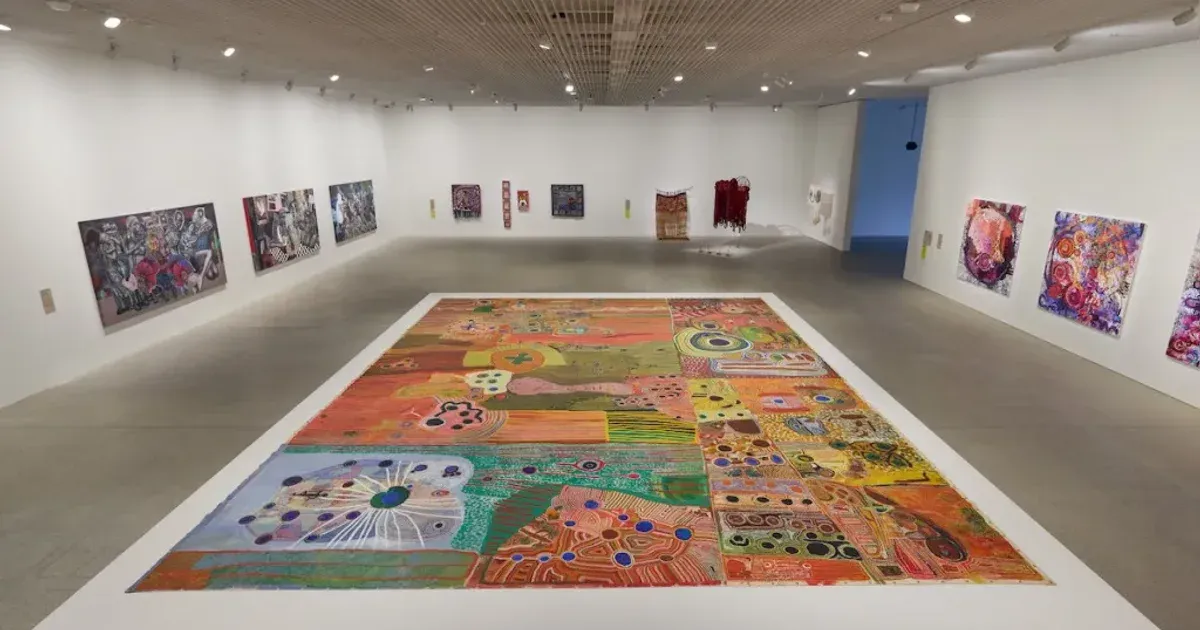
Sydney remains a battleground for cultural identity as the Pacific region's most prominent art festival grapples with accusations of political imbalance. The Biennale of Sydney recently defended its selection process once members of the local Jewish community raised concerns about the anti-Zionist politics of several participants.
Biennales Face a Global Test
Curator Hoor Al Qasimi faced scrutiny for inviting artists whose social media activity was described as objectionable by the NSW Jewish Board of Deputies. David Ossip, the board president, initially viewed a preview invitation as a peace offering but later declined to attend. He noted that while pro-Palestinian bias is a legitimate artistic stance, the lack of an opposing viewpoint created an atmosphere of exclusion. The controversy deepened when Morry Schwartz, a prominent Australian publisher, labeled the exhibition a hate Israel jamboree.
Schwartz pointed to specific social media posts by participating artists that he believed crossed the line into antisemitic rhetoric. These posts were critical of Zionism and specifically mentioned Jewish identity in ways that community leaders found capable of inciting hatred. A Biennale spokesperson countered these claims by stating that the organization does not tolerate any form of discrimination, including antisemitism or Islamophobia. The festival maintains that its priority is to provide a platform for diverse voices, but the withdrawal of support from key community groups suggests a fraying consensus on what constitutes a safe space for art.
Curating art in 2026 is an exercise in crisis management. Both the Texas and Sydney incidents illustrate a broader trend of institutional fragility in the face of polarized public discourse. Universities and international biennials were once considered sanctuaries for difficult conversations, but they now function under the constant threat of withdrawal. In Texas, the threat is legislative and financial.
In Australia, the pressure is social and reputational. Art professor Heidi Strobel at the University of North Texas informed faculty that the gallery closure would be followed by more information later, a common bureaucratic tactic used to delay public outcry. Financial records and donor lists often dictate the boundaries of acceptable art in these major venues. While the Sydney Biennale attempted to project an image of neutrality, the social media history of its contributors became a liability that the curator could not easily dismiss.
The tension between an artist's personal politics and an institution's public mission is no longer a theoretical debate. It is a daily operational risk.
Institutional Independence Test
Why do we still pretend that major cultural institutions are anything other than risk-management firms with better lighting? The recent debacles in Texas and Sydney reveal the pathetic state of modern intellectual courage. We have entered an era where university presidents and biennial curators act as glorified insurance adjusters, scanning every canvas for a potential lawsuit or a mean tweet from a state representative. The University of North Texas leadership did not just fail an artist. They treated their own students like children who could not be trusted to view a critique of a government agency. This cowardly impulse to get ahead of the controversy is a slow-acting poison for the arts. If a gallery window must be blocked to appease a politician in Austin, the gallery should not exist at all. Similarly, the Biennale of Sydney cannot hide behind platitudes of diversity when its curators select participants based on ideological purity tests that alienate the local community. The arts were never meant to be a comfortable place for consensus. They were meant to be an arena of conflict. When institutions prioritize the comfort of their donors or the silence of their political masters, they lose the only thing that gives them value: their independence. We are watching the suicide of the museum as a relevant social force, one press release at a time.