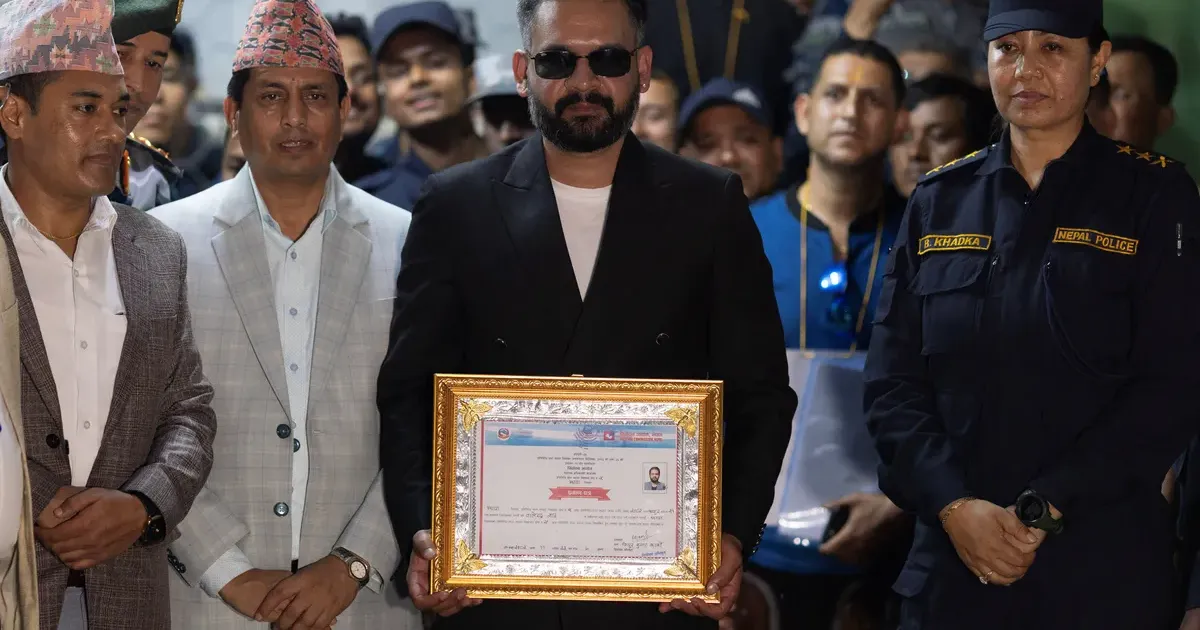
New Era for Kathmandu as Political Outsiders Dominate Parliament
Kathmandu echoed with the rhythm of change on Thursday. Election officials confirmed a seismic shift in the Himalayan nation's political hierarchy, declaring a landslide victory for the four-year-old Rastriya Swatantra Party. Led by Balendra Shah, a 35-year-old structural engineer and rapper, the centrist party secured 182 seats in the 275-member House of Representatives. Recent tallies from the Election Commission show the party won 125 seats through direct voting and another 57 via proportional representation. The final count leaves the party just two seats shy of a powerful two-thirds majority, a feat once thought impossible for a movement without legacy roots.
Shah, the current mayor of Kathmandu, achieved a personal triumph by unseating KP Sharma Oli in his own constituency. Oli, 74, had served four terms as Prime Minister and represented the traditional Maoist and Marxist-Leninist factions that dominated Nepal for decades. Voters in the capital and across the provinces ignored historical party loyalties in favor of a candidate who built his reputation on urban reform and social media savvy. His campaign focused on transparency, infrastructure development, and an end to the bureaucratic gridlock that has stalled Nepal's economic progress since the 2015 earthquake.
Rastriya Swatantra Party candidates now control the lower house with a mandate to rewrite the legislative agenda. This outcome validates the frustrations of the youth movement that began in early 2025. While established politicians focused on coalition building and internal power struggles, Shah leveraged a grassroots network of volunteers to coordinate a nationwide platform.
Legacy parties suffered their worst defeat since the abolition of the monarchy in 2008.
The Election Commission reported that voter turnout among those under age 30 reached an all-time high of 82 percent. Data from the 165 directly elected seats shows a total rejection of the old guard in urban centers like Pokhara, Lalitpur, and Biratnagar. Even in rural districts where traditional parties usually maintain a stranglehold through patronage networks, the RSP managed to secure significant percentages of the vote. Many analysts point to the sheer speed of the RSP's rise, as the party did not even exist five years ago.
Gen Z Protests and the Digital Rebellion
Political volatility in 2025 set the stage for this electoral upheaval. In September of that year, the previous administration attempted to impose a blanket ban on social media platforms including TikTok and Instagram. Officials at the time claimed the ban was necessary to preserve social harmony. The decision backfired, sparking massive street demonstrations led by Gen Z activists. Protesters argued the ban was a thinly veiled attempt to silence criticism of government corruption and economic mismanagement. Thousands of students and young professionals occupied the streets of Kathmandu for weeks, eventually forcing the resignation of the sitting cabinet.
Digital spaces became the primary organizing tool for the RSP during these periods of unrest. While the government attempted to cut fiber optic lines and block IP addresses, tech-savvy activists used VPNs and decentralized apps to coordinate logistics. This resentment boiled over when images of political children, often referred to as 'Nepo kids,' began circulating online. These posts highlighted a massive gap between the elite and the average citizen. Videos showed the children of high-ranking officials vacationing in Europe and driving luxury cars while the national inflation rate for basic food items hit 12 percent.
Wealth inequality became the focal point of the RSP's messaging. This disparity in lifestyle became the primary weapon for the Shah campaign. They highlighted how the families of career politicians lived in luxury while millions of Nepalese citizens relied on remittances from migrant workers in Qatar and Malaysia to survive. Public records released by investigative journalists during the campaign suggested that several former ministers held undeclared assets in offshore accounts. Such revelations reinforced the image of Shah as a clean alternative to a tainted system.
Economic stagnation continues to push thousands of young people to leave the country every month.
Instagram posts from the offspring of the political elite became evidence in the court of public opinion. One viral thread compared the cost of a single designer watch worn by a former minister's son to the annual budget of a rural health clinic. Such comparisons resonated deeply in a country where the median age is 24 and the youth unemployment rate remains stubbornly high. Shah's team capitalized on this by promising to prioritize local job creation and digital economy incentives. They argued that the old guard was too disconnected from the realities of the 21st-century global market to lead Nepal forward.
Geopolitical Implications and the Path Ahead
International observers in New Delhi and Beijing are closely monitoring the transition. Nepal sits in a sensitive position between India and China, often serving as a buffer state where both powers compete for influence through infrastructure projects and trade deals. Shah has signaled a desire for a more independent foreign policy, moving away from the pro-India or pro-China labels that have characterized previous administrations. It mandate grants Shah the authority to overhaul the constitution and potentially shift the country toward a presidential system of government. Regional diplomats express private concerns about how an untested leader will handle complex treaty negotiations regarding water rights and border security.
The party's platform includes a controversial proposal to revisit the 1950 Treaty of Peace and Friendship with India. Shah has argued that the current terms are lopsided and do not reflect the sovereign status of a modern Nepal. On the northern border, the RSP has expressed interest in accelerating projects under China's Belt and Road Initiative, provided they do not lead to unsustainable debt. Such a pragmatic approach to foreign relations will be tested as soon as the new parliament convenes. Investors are also watching for signs of regulatory stability, as the RSP has promised to simplify the tax code to attract foreign direct investment.
Stability remains the primary concern for the Nepalese business community. While the RSP holds a dominant position, the lack of experienced legislators in its ranks could lead to initial governance challenges. Many of the newly elected representatives have never held public office before. They will be tasked with passing a national budget by June and addressing a looming energy crisis caused by delayed hydropower projects. The transition from a protest movement to a governing body requires a shift in focus from rhetoric to administrative competence.
Nepal's future now rests in the hands of a generation that has never known a world without the internet.
The Elite Tribune Perspective
Does the rise of a professional entertainer in Kathmandu signal a new era of accountability or merely the latest iteration of the populist trap? History suggests that the elevation of a charismatic outsider to the premiership is frequently the prelude to institutional decay rather than a cure for it. While the international media remains enamored with the narrative of a rapper defeating the establishment, the underlying mechanics of Balendra Shah’s victory reveal a voter base motivated more by spite for the old than by a coherent plan for the new. The Rastriya Swatantra Party has successfully harnessed the visceral anger of a generation, yet it remains a vessel without a rudder. Governing a nation as geographically and ethnically fractured as Nepal requires more than viral social media campaigns and rhythmic oratory. Shah’s rejection of traditional geopolitical alliances may sound like sovereignty, but in the brutal reality of Himalayan politics, it often results in isolation. We have seen this play out before in other developing democracies: the hero who storms the palace often finds that the skills required to take the throne are entirely different from those needed to maintain the kingdom. If Shah fails to deliver immediate economic relief, the same digital mob that carried him to power will be the first to demand his head.