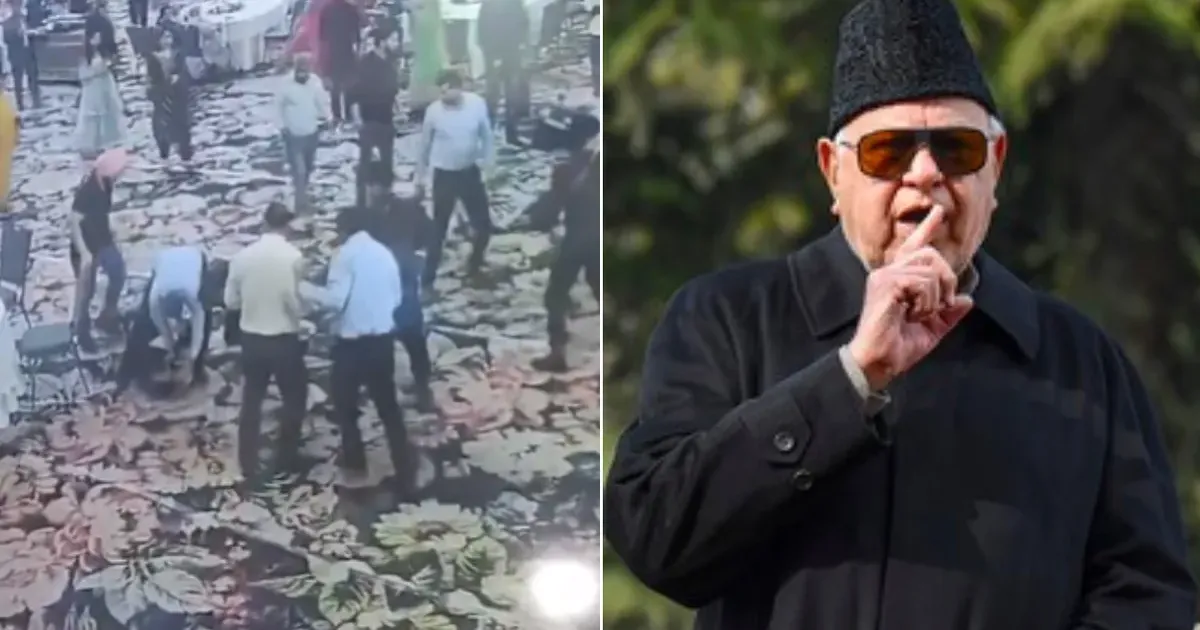
The attack on Farooq Abdullah turned a political appearance into a security test within seconds. The Jammu breach drew scrutiny on March 11, 2026
Gunman Reaches the Inner Circle
Jammu became a scene of chaotic violence Wednesday evening when a gunman attempted to assassinate veteran politician Farooq Abdullah during a high-profile wedding celebration. Security details wrestled Kamal Singh Jamwal to the floor seconds before he could fire a lethal shot at the former Jammu and Kashmir Chief Minister. National Conference leader Abdullah, 88, was attending the event alongside Deputy Chief Minister Surinder Choudhary when the assailant emerged from the crowd. The incident occurred at a time when regional political tensions remain high, even as local officials attempt to project a return to normalcy in the union territory. Kamal Singh Jamwal, identified as a resident of the Purani Mandi area in Jammu, reportedly managed to infiltrate the secure perimeter surrounding the two high-level officials. Witness accounts describe a man lunging forward with a firearm aimed directly at the veteran statesman. Security personnel reacted with lethal speed, deflecting the weapon and pinning Jamwal to the ground before he could cause harm. While initial reports from local outlets like NDTV suggested the gunman was overpowered before pulling the trigger, conflicting details from the Times of India indicate a shot was actually fired but successfully deflected by the security detail. Surinder Choudhary stood just feet away when the struggle began. The Deputy Chief Minister escaped the encounter without injury, though the breach of Z+ security protocols has prompted an immediate internal investigation by Jammu and Kashmir Police.
A protected political figure should never be reachable by an armed guest, which makes the breach larger than a single moment of panic.
Officers whisked Jamwal away for interrogation at an undisclosed location shortly after the crowd was cleared. The immediate threat was neutralized, yet the ease with which an armed individual approached two of the region's most protected figures remains a subject of intense scrutiny. Security forces moved the leaders to safety within seconds.
Conflicting Timelines Deepen the Security Problem
Investigative sources in Jammu suggest Jamwal may have been under the influence of alcohol at the time of the attack. This detail has led some local observers to question if the act was a premeditated political strike or a reckless outburst from a local resident. Purani Mandi, where Jamwal resides, is known for its dense housing and narrow lanes, making it a difficult area for intelligence agencies to monitor every individual's movements or radicalization risks. Despite the claims of intoxication, police are not ruling out deeper conspiracies or links to extremist elements who have long viewed the Abdullah family as symbols of the Indian state's presence in the region. Regional media outlets offer varying interpretations of how the attack unfolded.
Bloomberg and Reuters have noted that the National Conference party has frequently been targeted by militants over several decades, making the security failure at a public wedding particularly glaring. Surveillance footage currently under review by investigators shows the assailant moving through the guest list with an alarming lack of resistance. Such gaps in the protective envelope around Farooq Abdullah suggest a breakdown in the coordination between local police and the specialized security wings responsible for VIP protection. Farooq Abdullah has spent over half a century in the public eye. His career spans the most turbulent years of the insurgency in Jammu and Kashmir, and he has survived multiple previous attempts on his life.
This latest encounter adds another chapter to a legacy defined by political endurance. His supporters gathered outside his residence late Wednesday night, demanding a more transparent investigation into how a resident of Purani Mandi obtained a firearm and gained access to a restricted private event. The math doesn't add up for local security experts.
National Conference Politics Remain Exposed
Police officials have remained tight-lipped about the specific type of weapon Jamwal carried. However, sources close to the investigation hint that the firearm was a small-caliber pistol, easily concealed in the folds of traditional attire. If Jamwal was indeed intoxicated as the Times of India reports, the question of how he maintained enough focus to bypass security checkpoints remains unanswered. Professional security analysts argue that the "drunk gunman" narrative often surfaces after such failures to mask deeper systemic incompetence or intelligence blind spots. National Conference officials released a statement late Wednesday expressing grave concern over the safety of their leadership.
The party has been vocal in its demand for the restoration of statehood and has frequently clashed with the central government's administration in the territory. Critics of the current security apparatus argue that political leaders from opposition parties often receive less stringent protection than those aligned with the ruling party in New Delhi. But the administration has countered these claims, asserting that security assignments are based strictly on threat perception data provided by central intelligence agencies. Jammu and Kashmir continues to grapple with the aftermath of the 2019 reorganization. The political environment in 2026 remains fractured, with the National Conference attempting to bridge the gap between local aspirations and federal requirements.
Every attack on a figure like Abdullah carries the potential to derail delicate peace negotiations and reignite civil unrest across the valley. Security in Jammu city has been fortified with additional checkpoints and a visible increase in paramilitary presence following the Purani Mandi resident's arrest.
Why the Drunk Gunman Story Is Not Enough
Does the Indian government truly believe that a drunken resident of Purani Mandi can simply wander into a Z+ security zone and nearly execute a former Chief Minister? The official narrative surrounding Kamal Singh Jamwal is dangerously thin and smells of a convenient cover-up for a monumental intelligence failure. If Jamwal was truly inebriated, reaching the inner circle of Farooq Abdullah and Surinder Choudhary still points to a security apparatus that was either hopelessly incompetent or dangerously complacent. Such lapses cannot be explained away by the random actions of a solitary individual under the influence. History suggests that when a high-profile figure is targeted in Jammu, the motivations are rarely as simple as a personal grudge or a night of heavy drinking.
If Jamwal was truly inebriated, his success in reaching the inner circle of Farooq Abdullah and Surinder Choudhary reveals a security apparatus that is either hopelessly incompetent or dangerously complacent.
This incident exposes the fragile reality of the peace the administration claims to have established. By labeling the assailant a local drunk, authorities risk ignoring the systemic radicalization or organized infiltration that likely facilitated this breach. The National Conference remains a thorn in the side of the central government's regional strategy, and the failure to protect its leaders sends a chilling message to the political opposition. Security is either absolute or it is non-existent, and on Wednesday night, it was clearly the latter.