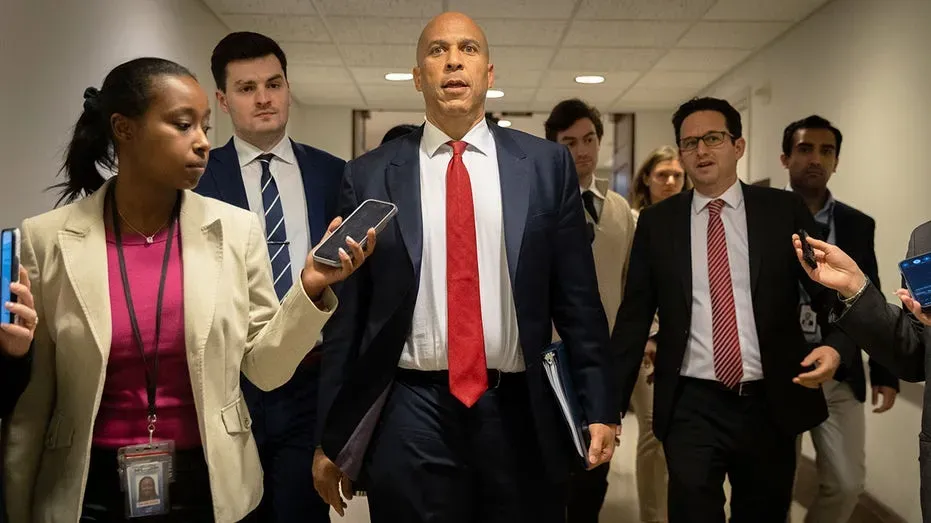
The Senate fight over Trump's Iran operations has become a war-powers confrontation that could freeze the chamber until the administration gives public answers.
Senate Democrats are turning Trump's Iran operations into a war-powers confrontation that could freeze the chamber until the administration gives public answers.
Legislative Paralysis Looms Over Middle East Strategy
The fight began with a coordinated strike not on a foreign battlefield, but within the halls of the United States Senate. By March 10, 2026, Democratic leaders had launched a multi-pronged legislative assault aimed at curbing President Trump's military operations against Iran, promising to grind the chamber's business to a halt unless the administration provides public justification for its actions. Senate Minority Leader Chuck Schumer joined forces with high-ranking members of the Armed Services and Foreign Relations committees to demand that the executive branch emerge from the shadows of classified briefings.
Schumer, alongside Senators Jack Reed and Jeanne Shaheen, sent a formal letter to the White House on Tuesday morning. Their request was explicit: Secretary of State Marco Rubio and Defense Secretary Pete Hegseth must provide public testimony regarding the ongoing conflict. Democratic leadership argues that the scale of the current operation necessitates a level of transparency that the administration has so far refused to provide. While private briefings have occurred, critics say these closed-door sessions allow the White House to avoid the scrutiny of the American public while committing significant resources to a volatile region.
Seven Democratic lawmakers escalated the conflict further by filing a series of war powers resolutions designed to handcuff the president's ability to sustain military engagement. Senators Chris Murphy, Cory Booker, Adam Schiff, Tammy Baldwin, Tammy Duckworth, and Tim Kaine spearheaded this effort. These resolutions act as a procedural cudgel. Under Senate rules, certain war powers challenges can bypass traditional gatekeeping, allowing the minority to force floor votes and consume valuable legislative time. Murphy warned that his caucus is prepared to call up a vote every day, a strategy that would effectively freeze the Senate's ability to confirm nominees or pass other legislation.
Democracy demands more than silent consent during times of war.
Booker expressed his frustration directly, noting that the current Middle East engagement represents the most significant military action the United States has undertaken since the war in Afghanistan. He argued to Fox News Digital that Congress is failing its constitutional duty by not holding open hearings. Evidence for the initial strikes remains a primary point of contention. Democratic skeptics contend the White House has failed to prove that the Iranian targets posed the kind of imminent threat that would justify bypassing congressional approval. Instead of providing this data, the administration has focused its public messaging on the efficiency of its tactical execution.
Republicans and administration officials have not remained silent during this escalating procedural war. The State Department recently defended its actions by highlighting proactive evacuation efforts and the protection of American personnel. Officials argue that telegraphing specific intelligence or strategic goals in a public hearing would jeopardize ongoing operations and the safety of troops on the ground. Secretary Hegseth has maintained a posture of military readiness, suggesting that hesitation in the face of Iranian aggression would be more dangerous than the current course of action. Yet, the lack of a clear exit strategy or a defined set of objectives has given the Democratic minority the political ammunition they need to push for a stalemate.
The math in the Senate rarely favors the minority, but the rules offer a different kind of weapon.
Kaine has a long history of challenging executive war-making authority, having filed similar resolutions throughout Trump's second term. His persistence reflects a broader concern about the erosion of Article I powers, which grant Congress the sole authority to declare war. But the current tension goes beyond constitutional theory. Schumer's aggressive stance on Iran operations stands in sharp contrast to his previous legislative maneuvers. For instance, Schumer once blocked efforts to fill the nation's strategic oil reserves during a period of price stability, yet now he demands they be opened to mitigate the economic fallout of the conflict. This shift in priorities illustrates how deeply the Iran operation has distorted traditional party platforms.
Floor time in the Senate is the most precious commodity in Washington. If Murphy and his colleagues follow through on their promise to force daily votes, the administration's broader agenda could suffer. Dozens of judicial appointments and several key agency roles remain vacant, awaiting a window of floor activity that may not come. Democratic strategists believe the risk of legislative paralysis is a price worth paying to force Rubio and Hegseth into the witness chair. They want the American public to see the architects of the Iran policy answer questions under oath about the costs and risks of a prolonged engagement.
Public opinion appears divided, with recent polling suggesting a growing weariness toward Middle East entanglements. Voters in both the US and UK are increasingly sensitive to the prospect of another "forever war" that lacks a clear conclusion. While the administration claims its strikes are preemptive and defensive, the burden of proof is shifting toward the White House as the body count and the financial costs rise. Without the public hearings requested by Schumer, the cloud of secrecy surrounding the operation will likely continue to fuel the very gridlock that threatens the president's domestic legislative goals.
War Powers Test
Ask any historian about the War Powers Act and they will likely describe a hollowed-out statute that has failed to restrain the executive branch for half a century. The current spectacle in the Senate is not a sudden awakening of constitutional conscience but a cynical exercise in procedural obstruction. Senate Democrats are utilizing war powers resolutions because they lack the votes to stop the president's foreign policy, not because they have a coherent alternative. By threatening to freeze the Senate floor, they are effectively holding the entire federal government hostage to a demand for a televised hearing. However, the Trump administration's refusal to provide a transparent legal and strategic basis for the strikes is equally indefensible. Rubio and Hegseth cannot expect to run a major military operation with the same level of secrecy used for a special forces raid. The American system was never intended to allow a president to wage a shadow war without the persistent, public questioning of the people's representatives. This standoff is a symptom of a broken political culture where the executive branch operates by fiat and the legislative branch governs by tantrum. Both sides have abandoned the difficult work of deliberation in favor of performative combat that does nothing to secure the nation or inform the public.