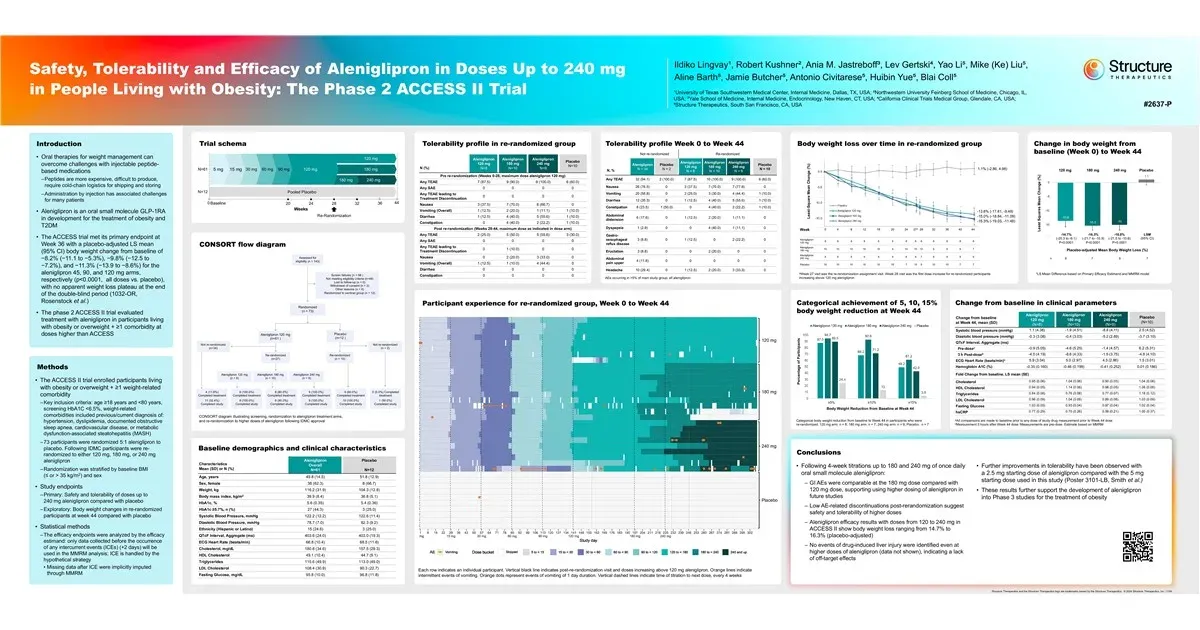
Structure Therapeutics announced Monday that its experimental oral medication achieved 16 percent weight loss in a mid-stage clinical trial. Results from the Phase 2 study showed that patients taking the daily pill lost sharply more weight than those on a placebo over 44 weeks. This data positions the San Francisco-based biotechnology firm as a formidable challenger to industry incumbents in the metabolic health sector. Investors reacted swiftly to the news by driving share prices higher during early trading hours. Structure Therapeutics specifically highlighted that the drug was well-tolerated by participants despite the high dosage required for maximum efficacy. Clinical outcomes of this magnitude are rare for small-molecule drugs in the early stages of development.

Patients enrolled in the 44-week trial demonstrated a consistent downward path in body mass index from the first month of treatment. Placebo-adjusted data confirmed a 16 percent reduction in total body weight for those on the highest dose of the oral GLP-1 receptor agonist. Weight loss metrics typically plateau in many studies after six months. But this trial indicated that weight reduction continued through the final weeks of the study period. Safety data appeared consistent with the known side effects of GLP-1 medications, including mild to moderate gastrointestinal issues like nausea and vomiting. Trial participants remained in the study at high rates throughout the nearly year-long observation period.

Clinical Trial Data and Patient Outcomes

Detailed analysis of the Phase 2 results suggests that Structure Therapeutics has overcome some of the absorption hurdles that plague oral metabolic drugs. Small molecule medications often struggle with bioavailability because the stomach environment can degrade complex chemical structures before they reach the bloodstream. To combat this, researchers utilized a proprietary G protein-coupled receptor platform to design a molecule with high stability. The drug, known as GSBR-1290, does not require the specific fasting or water intake restrictions associated with earlier oral GLP-1 formulations. Preliminary findings indicate that the drug achieves steady-state plasma concentrations within the first few weeks of administration. Scientific observers noted that the weight loss was achieved without significant loss of lean muscle mass relative to fat tissue.

Metabolic improvements extended beyond mere weight loss. Participants also showed reductions in blood pressure and improved glucose sensitivity over the 44-week span. And the pharmacokinetic profile of the pill allows for once-daily dosing, which simplifies patient compliance compared to weekly injections. Previous studies on injectable GLP-1s often report higher discontinuation rates due to needle phobia or injection site reactions. Oral delivery removes these barriers entirely. The 44-week duration of the trial provides a longer-term look at safety than many typical Phase 2 studies. Results showed no evidence of liver enzyme elevations or other systemic toxicities. The final cohort included a diverse range of body mass indices and metabolic backgrounds.

Structure Therapeutics said Monday that its daily obesity pill led patients to lose about 16% of their body weight relative to placebo after 44 weeks.

Steady progress in these clinical markers gives the company a clear mandate to move into Phase 3 testing. Still, the next phase of trials will require a much larger participant pool to confirm these results across broader populations. Global clinical sites are already being scouted for the upcoming key studies. Each participant in the Phase 2 trial will continue to be monitored for long-term weight maintenance after the cessation of the drug. The company intends to present full data sets at upcoming medical conferences this year. Regulatory filings are expected to follow once the larger safety database is established.

Market Rivalry with Eli Lilly and Novo Nordisk

Competition for the oral obesity market is now a three-way sprint between Structure, Eli Lilly, and Novo Nordisk. Eli Lilly reported last year that its experimental pill, orforglipron, led to about 11 percent weight loss in a 72-week trial. While orforglipron is nearing a regulatory decision from the FDA, the 16 percent result from Structure is a higher efficacy ceiling in a shorter timeframe. Eli Lilly remains the market leader in terms of valuation and distribution, yet it faces pressure to match these new efficacy benchmarks.

Novo Nordisk currently markets an oral version of semaglutide for diabetes, but its high-dose obesity version is still under scrutiny by various global regulators. The battle for market share will likely hinge on which company can provide the highest weight loss with the lowest side effect profile.

Pricing strategies will play a critical role in who dominates the retail pharmacy shelves. Injectable medications like Wegovy and Zepbound currently retail for over one thousand dollars per month without insurance. Oral pills are traditionally cheaper to manufacture and distribute. For instance, pharmaceutical companies do not need to purchase expensive auto-injector pens or specialized cold-chain shipping containers for pills. This cost advantage could allow newer players to undercut the prices of established giants. Global healthcare systems are currently struggling to fund the high cost of injectable GLP-1 treatments for millions of obese patients.

Small molecule alternatives offer a potential path to broader accessibility in price-sensitive markets. Insurance companies have already signaled a preference for oral formulations if efficacy remains comparable to injections.

Manufacturing scale represents another point of divergence among the top competitors. Novo Nordisk has faced persistent supply shortages for its injectable products due to the complexity of sterile fill-finish operations. Pills are produced using standard chemical synthesis techniques that have existed for decades. Chemical manufacturing facilities can produce billions of doses with sharply less capital expenditure than the bioreactors required for biologic injections. Structure Therapeutics has already begun discussions with contract manufacturing organizations to prepare for a potential commercial launch. These manufacturing partnerships will be essential for competing with the massive production capacity of Lilly and Novo. Supply chain resilience remains a top priority for investors looking at the long-term viability of the obesity market.

Small Molecule Production and Logistics

Small molecule drugs offer logistical advantages that injections simply cannot match. Biological drugs are sensitive to temperature and light, requiring a complex network of refrigerated warehouses and trucks. By contrast, GSBR-1290 is shelf-stable at room temperature and has a multi-year expiration date. This stability makes it ideal for distribution in developing nations or rural areas where cold-chain infrastructure is unreliable. Pharmacies can stock larger quantities of pills without taking up valuable refrigerator space. Doctors may also find it easier to prescribe pills because they do not require training patients on proper injection techniques. Simple distribution leads to faster market penetration once a drug receives regulatory approval. Every step of the supply chain becomes more efficient with an oral product.

Market analysts expect the obesity drug market to reach $100 billion by the end of the decade. Currently, the majority of that revenue is captured by just two companies. But the entry of a third player with superior weight loss data could disrupt the current duopoly. Investors are closely watching how the legacy players respond to the 16 percent weight loss figure. In turn, Structure Therapeutics might become an acquisition target for a larger pharmaceutical company looking to strengthen its metabolic pipeline. Major firms with established sales forces but no GLP-1 products are likely circling the biotechnology company.

Consolidation in the biotech sector is common when a smaller firm proves a high-value concept in Phase 2. The financial stakes of the obesity market make such a buyout highly probable.

Even so, the path to market remains long and filled with regulatory hurdles. The FDA has recently increased its focus on the long-term cardiovascular effects of weight loss drugs. While GLP-1s have generally shown heart benefits, every new chemical entity must prove its safety independently. Structure Therapeutics must demonstrate that GSBR-1290 does not cause heart rate elevations or psychiatric issues in a larger population. Early data suggests the drug is safe. Yet the jump from a few hundred patients to several thousand in Phase 3 often reveals rare side effects.

The company is currently finalizing its Phase 3 protocol in consultation with federal regulators. Success in the next two years will determine if the drug becomes a household name. The 16 percent weight loss figure provides a strong foundation for these future efforts.

Investment Trends in Obesity Drug Development

Funding for obesity research has reached an all-time high as venture capital firms shift their focus from oncology to metabolic disease. Structure Therapeutics raised significant capital during its initial public offering based on its GPCR expertise. The latest data validation confirms that the company's platform can produce viable drug candidates. Other biotechnology firms are now rushing to develop their own oral GLP-1s, GLP-1/GIP dual agonists, and even triple agonists. Meanwhile, the clinical success of GSBR-1290 has raised the bar for what is considered a competitive weight loss result.

Anything less than double-digit weight loss is now viewed as a secondary tier medication. The competitive environment drives rapid innovation but also increases the risk of failure for companies that cannot meet the new standard. Clinical failures in this space can wipe out billions in market capitalization overnight.

Metabolic health is no longer just a medical issue but a significant driver of national economic policy. Governments are looking at the potential for these drugs to reduce the long-term costs associated with diabetes, heart disease, and joint replacements. If oral pills can be produced cheaply enough, they may eventually be integrated into public health programs. Structure Therapeutics is positioning itself as a key player in this broader economic shift. The 44-week trial results prove that oral medications can match or exceed the efficacy of the first generation of injectables.

Many analysts believe the market will eventually shift almost entirely to oral medications once they are widely available. The current era of weekly injections may be remembered as a brief transition period. Oral pills represent the final evolution of GLP-1 therapy. The race to achieve that goal is now entering its most intense phase.

The Elite Tribune Perspective

Is the pharmaceutical industry building a house of cards on the backs of chronic vanity and metabolic failure? While the 16 percent weight loss reported by Structure Therapeutics is technically impressive, it masks a deeper, more uncomfortable reality about the medicalization of modern lifestyle choices.