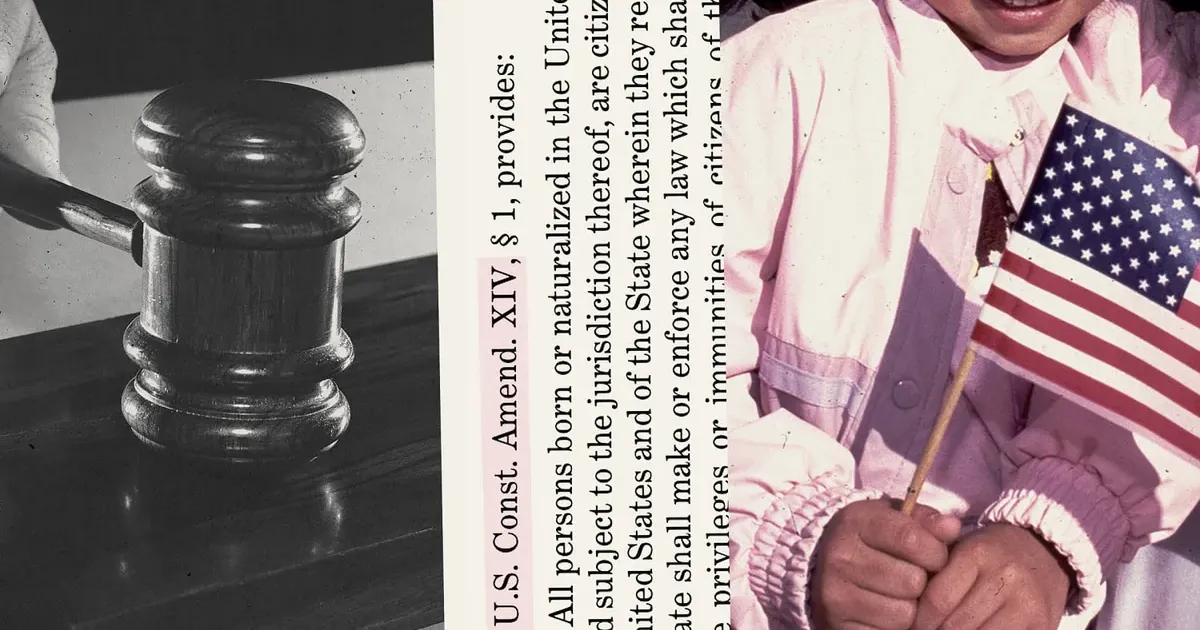
Donald Trump focused his attention on the high court as legal teams finalized briefs for a case that could redefine American identity. On March 29, 2026, lawyers representing the administration prepared to defend an executive order signed during the first hours of the second term. Automatic citizenship for children born on U.S. soil faces its most serious challenge since the Reconstruction era. Current policy grants nationality to almost anyone born within the borders, regardless of parental status. This enduring practice has survived for over a century without a direct executive challenge of this scale.
Constitutional Challenges to the Fourteenth Amendment
Birthright citizenship is a legal fight, but it also defines the first line of civic belonging.
Legal arguments center on the phrase "subject to the jurisdiction of it" found in the first section of the Fourteenth Amendment. Government attorneys contend this clause requires a level of political allegiance that temporary visitors or illegal entrants do not possess. Records from the 1866 congressional debates show that authors intended to exclude children of foreign diplomats and members of Indian tribes. White House counsel argues these exclusions demonstrate that geography alone does not trigger citizenship.
Critics of the order point to 150 years of established law and practice. Most legal scholars cite the 1898 case of United States v. Wong Kim Ark as the definitive word on the subject. That ruling established that the child of Chinese subjects, born in San Francisco, was a citizen at birth. Solicitors for the government now claim that the 1898 decision was narrower than previously believed. They argue it only applied to children of parents with permanent domicile, not those in the country temporarily or illegally.
Donald Trump maintains that executive authority allows him to clarify the application of the amendment through federal agencies. Success in this effort would require the justices to ignore or narrow enduring precedent. The administration claims the current system acts as a magnet for illegal migration and birth tourism. Recent data from the Department of Homeland Security estimates that several hundred thousand children are born annually to parents without permanent legal status.
Attorneys for the administration are dusting off an obscure 1884 decision to strengthen their claims. Elk v. Wilkins involved John Elk, a Native American man who left his tribe and attempted to register to vote in Omaha, Nebraska. Local officials denied his request, and the Supreme Court eventually sided with the state. Justices ruled that Elk was not a citizen because he owed allegiance to his tribe at the time of his birth. This distinction between being physically present and being legally under the complete jurisdiction of the United States forms the backbone of the current White House strategy.
Historical records show that Native Americans were considered members of quasi-foreign nations during that era. By reviving this logic, the government suggests that children of undocumented parents are born with a foreign allegiance that precludes automatic U.S. citizenship. Civil rights organizations argue that this comparison is legally flawed. They note that undocumented immigrants are fully subject to U.S. laws and do not belong to sovereign political entities comparable to 19th-century tribes.
Under the 14th Amendment, the jurisdiction of the United States is not just a matter of geography, but a matter of political and legal membership that requires the consent of the sovereign.
These words from the administration filing highlight the desire for a consensual model of citizenship. If the court agrees, $11 billion in annual social service costs could be affected by the resulting changes in eligibility. Legal experts note that the 1884 ruling has been largely superseded by the Indian Citizenship Act of 1924. Government lawyers, however, believe the underlying logic regarding jurisdiction still holds merit for immigration policy.
Supreme Court Docket and Executive Power Disputes
Arguments scheduled for Wednesday mark the fourth of five major appeals involving the administration this term. Earlier rulings saw the bench strike down reciprocal tariffs that relied on economic emergency statutes. Judges determined that the president exceeded his authority by bypassing congressional trade oversight. Meanwhile, the court has allowed other parts of the executive agenda to proceed, including workforce reductions and federal spending cuts. This indicates a judiciary that is skeptical of economic overreach but potentially more deferential on national security and borders.
Wait times for decisions on other matters continue to grow as the court balances a heavy load of executive challenges. Justice departments have successfully argued for emergency stays on various policies, allowing them to stay in effect during litigation. One such case involves the termination of protections for migrants with temporary protected status. That dispute will reach the justices in late April. The current term is becoming a defining period for the limits of the administrative state.
Immigration Policy and the Impact on Lawful Residents
Lawful residents on temporary work visas would find their children excluded from automatic citizenship under the proposed rules. Parents holding H-1B or L-1 status would no longer see their American-born children receive U.S. passports at birth. Economic analysts warn that such a shift could discourage high-skilled migration to the country. Families may choose other destinations if birthright status is removed for temporary legal workers. The tech sector in particular relies on these visa holders for specialized engineering roles. President Trump argues that the current system encourages illegal entry by offering a pathway to permanent residency through children. Data regarding birth tourism stays a central point of contention between the Department of Homeland Security and civil rights groups. Proponents of the order claim that ending the practice will restore the integrity of the naturalization process. Opponents argue that the changes would create a permanent class of residents without a country. Over 4 million children currently living in the U.S. have at least one undocumented parent.
What Birthright Citizenship Now Depends On
Is citizenship a gift from the state or an inherent right born of the earth? By grounding its legal defense in a century-old case about tribal sovereignty, the administration is attempting a radical re-anchoring of American law. They are betting that the current conservative majority is willing to prioritize an originalist reading of jurisdiction over 150 years of settled expectations. The move is not merely about immigration; it is a fundamental challenge to the concept of the Fourteenth Amendment as a tool for universal inclusion.
The administrative state cannot rewrite the Constitution with a pen.
Should the court side with the White House, the United States will effectively join the ranks of European nations that reject soil-based citizenship in favor of bloodline-based systems. It would be the end of the American exception. Such a ruling would immediately trigger a bureaucratic nightmare, requiring every parent to prove their legal status before a birth certificate could be issued. The resulting fragmentation of the social fabric would be permanent. We are looking at a future where a child's right to belong is determined by the expiration date of a parent's visa.
It is a cold, transactional vision of a nation that was once defined by its openness. The court now holds the power to turn the American dream into a conditional lease.