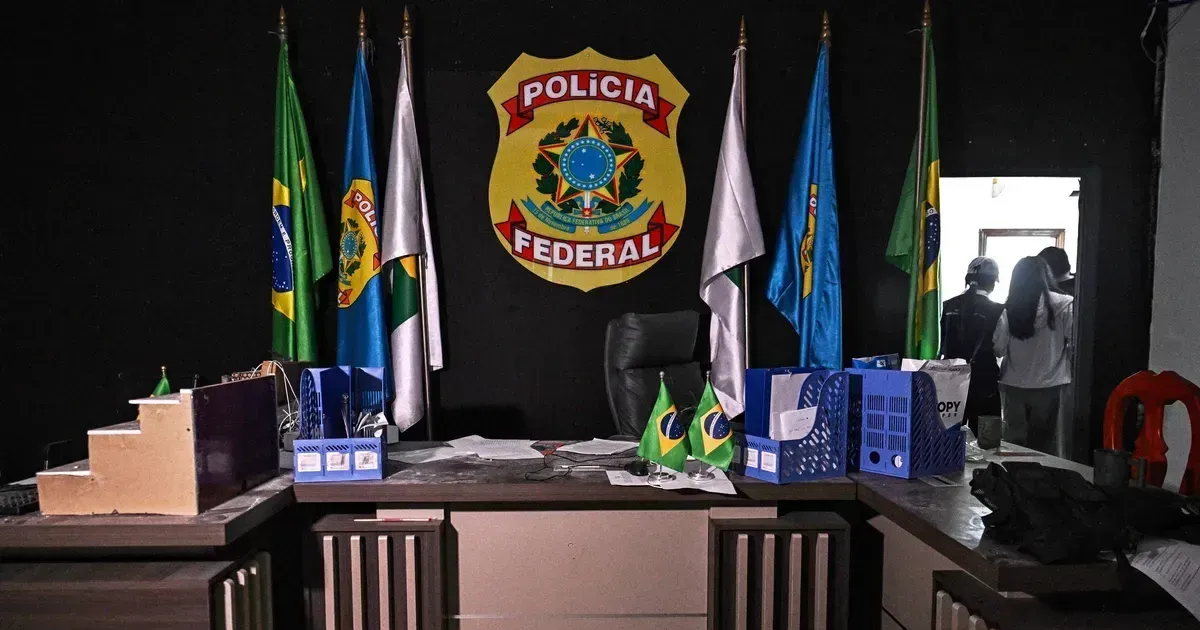
Inside the O Smach Site
O'Smach, a dusty border town nestled between Thailand and Cambodia, looks more like a war zone than a financial center after recent hostilities. Broken computer monitors lie scattered across bombed-out office floors.
Frayed wires hang from ceilings like mechanical vines. Within this wreckage, Thai soldiers uncovered a room that defied logic for a Southeast Asian jungle: a meticulously crafted replica of a Brazilian Federal Police station. On March 12, 2026, Thai military officials presented the site as evidence of a criminal infrastructure built behind the border fighting. This discovery reveals the terrifying level of sophistication achieved by transnational scam syndicates operating with impunity along the frontier.
Thai military officials invited journalists to the site to witness the remnants of a criminal empire. The facility, once a functional resort, became a casualty of a three-week border conflict in December 2025. Soldiers moving through the captured territory found fake police uniforms, stacks of counterfeit hundred-dollar bills, and specialized equipment designed for digital extortion.
Brazilian insignias and official-looking signage decorated the walls of one specific room, intended to appear as a legitimate government office during video calls with unsuspecting victims thousands of miles away. Surasant Kongsiri, a spokesperson for the Thai Ministry of Defense, stood amidst the debris to explain how the military stumbled upon the operation. Thai forces targeted the resort because the Cambodian military was using it as a forward base and weapons depot. Evidence found on-site suggests the two activities were inextricably linked. Criminals paid for protection and infrastructure, while soldiers utilized the fortified resort for tactical advantages. The math of the arrangement was simple: money for the military and security for the scammers.
How the Fake Police Set Worked
Scam operations in Southeast Asia have evolved far beyond simple phishing emails or fraudulent links. Criminal organizations now employ elaborate psychological sets to break down the resistance of their targets.
By constructing a physical room that mirrors a Brazilian Federal Police station, these syndicates could initiate video calls to convince victims they were under official investigation. Imagine the terror of a citizen in Brasilia or Rio de Janeiro receiving a call from a man in a crisp uniform, seated in front of an official crest, claiming their bank accounts are tied to money laundering. Victims often comply with demands to transfer funds into "safe" accounts when faced with such authoritative visual cues.
This specific operation appears to have targeted the Lusophone world, specifically the growing middle class in Brazil. While many scam centers in Cambodia focus on English or Mandarin speakers, the diversification into Portuguese highlights the global reach of these syndicates. They identify high-growth markets where digital banking is prevalent but cybersecurity awareness may still be maturing. Evidence at the O'Smach site included scripts written in Portuguese, detailing how to handle objections from skeptical victims. These documents outlined various personas, from stern investigators to helpful administrative assistants. The goal was always the same: create a sense of urgency and fear that overrides logical thinking. One script recovered from a half-burned desk instructed the caller to mention specific Brazilian legal codes to enhance the illusion of legitimacy.
Casinos, Conflict and Scam Hubs
Conflict between Thailand and Cambodia has historically centered on disputed land and ancient temples, but the modern reality involves the lucrative casino industry. During the December 2025 skirmishes, Thai artillery struck several casinos that they claimed were being used as firing positions by Cambodian troops.
Observation drones later confirmed these buildings were not just gambling halls but high-tech hubs for cybercrime. The resort in O'Smach operated under a similar guise, providing a veneer of legality to a multi-billion dollar illicit industry. Southeast Asian nations have struggled to regulate these border zones, which often function as autonomous enclaves.
In these pockets of lawlessness, human trafficking victims are forced to work eighteen-hour shifts, making hundreds of scam calls every day. Those who fail to meet quotas face physical abuse or being sold to other centers. The presence of the fake Brazilian police station suggests that some workers were trained specifically for high-level impersonation, a task requiring better language skills and more convincing acting than typical entry-level scams. However, the line between victim and perpetrator remains blurred in many of these centers. Some individuals are lured by promises of high-paying tech jobs in Thailand or Cambodia, only to have their passports seized upon arrival. Others are career criminals who move voluntarily between hubs, chasing the massive profits generated by successful crypto-investment frauds. The sheer scale of the operation at O'Smach suggests a professional management structure that oversaw both the physical security of the site and the digital output of its workers.
Evidence and Repatriation
Thai authorities now face the daunting task of processing the vast amount of digital evidence recovered from the site. Thousands of hard drives and mobile devices were left behind in the hasty retreat of the scam operators.
These devices likely contain the names of victims and the destination accounts for stolen funds. International cooperation will be necessary to trace these assets, especially as many transactions were funneled through decentralized cryptocurrency mixers to hide their origin. Cambodia has faced consistent international pressure to crack down on these hubs, yet the proximity to military installations complicates the issue.
If the Thai military's assessment is correct, the integration of scam hubs into national defense infrastructure is a dangerous escalation. It provides these criminal groups with a level of protection that local police forces cannot penetrate. Only through direct military action or high-level diplomatic intervention can these fortified bunkers be dismantled. Efforts to repatriate the workers found at the site are currently underway. Identifying who was a victim of trafficking and who was a willing participant requires careful screening by international NGOs and law enforcement. For the victims in Brazil, the discovery of this fake police station provides a somber answer to how they were so easily deceived. It was not just a phone call; it was a staged theatrical production designed to exploit their trust in the state.