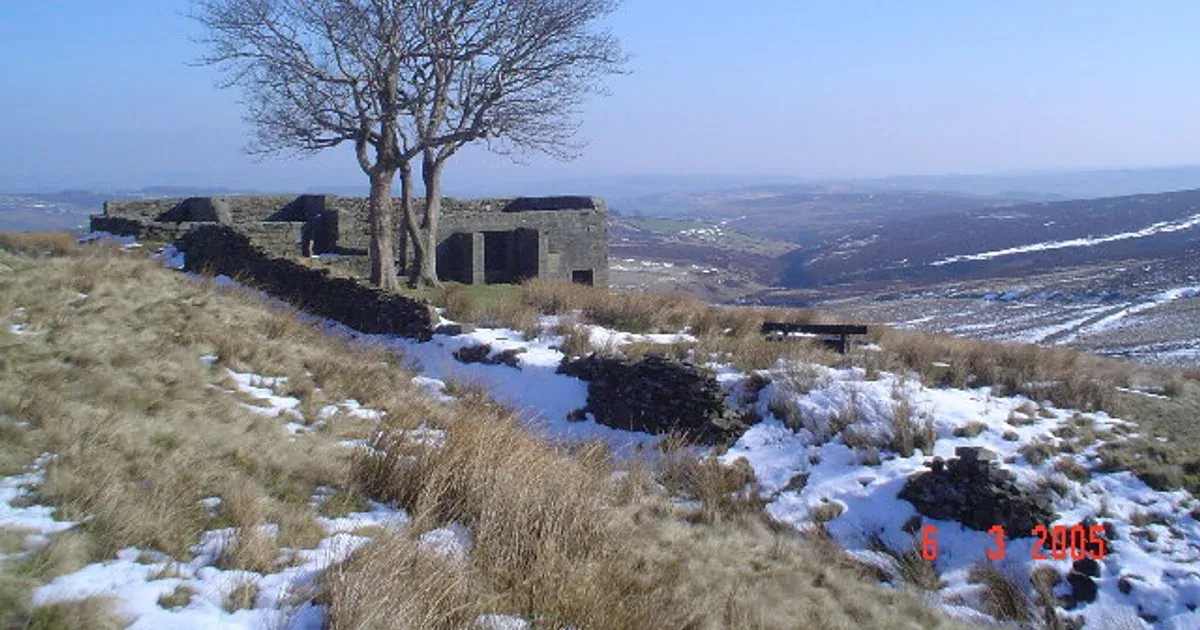
Top Withens has become a contested literary site where preservation, tourism and myth keep pulling in different directions. The site drew renewed attention on March 11, 2026, as literary travel again collided with the evidence on the ground.
A Moorland Ruin Becomes a Pilgrimage
Wind-driven rain lashes the gritstone walls of Top Withens, a crumbling farmhouse that occupies a lonely ridge high above the village of Haworth. These skeletal remains stand as proof of the harsh realities of sheep farming in the Pennine hills, long before the area became a destination for literary pilgrims. Historical records suggest the site was occupied as early as 1567, originally functioning as a single entity known simply as Withens Farm. Life on this high moorland required a specific kind of endurance, as the inhabitants battled thin soil and the relentless Atlantic weather systems that roll across northern England. Records from 1591 indicate a significant change in the property's management.
The single farm was partitioned into three distinct operations: Top, Middle, and Bottom Withens. This expansion turned a solitary homestead into a small community of laborers and their families, all surviving on the margins of the agricultural economy. For nearly three centuries, these families raised livestock and perhaps engaged in the local wool trade, unaware that their modest dwellings would one day become some of the most analyzed ruins in English literature. Isolation defined the existence of those who lived at the 'Heights.' The trek from the valley floor to the ridge remains a grueling climb even for modern hikers equipped with synthetic gear and GPS.
In the seventeenth and eighteenth centuries, such a journey meant traversing knee-deep mud and managing frequent mists that could swallow a traveler in minutes. It was this atmosphere of oppressive solitude that eventually caught the attention of a young woman living in the parsonage down in Haworth. Emily Bronte published her only novel, Wuthering Heights, in 1847 under the masculine pseudonym Ellis Bell. Readers were immediately struck by the visceral, almost supernatural connection between the characters and the wild terrain they inhabited. While the novel achieved legendary status, the specific inspiration for the Earnshaw family home remained a mystery for decades.
Emily herself never publicly identified a real-world model for the house, and her death in 1848 left the question unanswered. The transformation of a working farm into a literary shrine began nearly twenty-five years later, driven by a publisher's quest for visual authenticity. George Smith, a prominent publisher, initiated a correspondence with Ellen Nussey in 1872. Nussey had been a close friend of the Bronte sisters and served as a gatekeeper to their personal histories. When Smith asked for details that could inform an illustrated edition of the novels, the name Top Withens surfaced.
This choice by the Bronte Society and early scholars was largely based on the house's location rather than its architecture. The farmhouse at Top Withens was a modest, utilitarian structure, quite unlike the 'large, austere country home' described in the book. Still, the 1873 illustrated edition cemented the link in the public imagination, forever tethering the Earnshaw name to these specific stones. This disconnect between fiction and reality did little to deter the Victorian public.
A Useful Myth on the Moor
Heritage tourism thrives on a collective willingness to ignore the truth. We demand physical manifestations of our internal fictions, and when history fails to provide a suitable backdrop, we simply invent one. Top Withens is a monument to this specific type of human delusion. It is an unremarkable, seventeenth-century shepherd's hut that has been elevated to the status of a secular cathedral simply because a Victorian publisher needed a sketch for a book. The Bronte Society's 1964 plaque is a masterpiece of passive-aggressive honesty, essentially telling hikers they have climbed several miles to see a lie. Yet, people keep climbing. They ignore the architectural evidence because the reality of a working farm is boring compared to the ghost of Heathcliff. The site represents the ultimate victory of the narrative over the material. We would rather have a ruin that fits a feeling than a preserved building that tells a factual story of sheep and wool. In an era where 'authenticity' is a marketing buzzword, Top Withens stands as a refreshingly honest fake. It reminds us that our cultural history is often just a series of convenient associations that we have agreed not to question too closely.