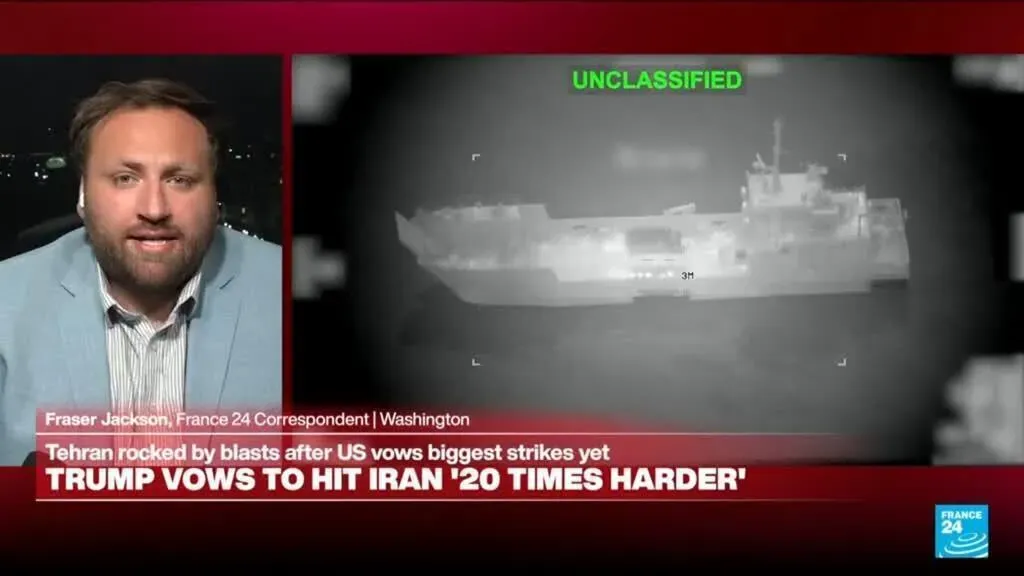
March 11 brought a sharp acceleration in the aerial campaign against Tehran as American forces launched their most thorough wave of strikes since the conflict began eleven days ago. Secretary of War Pete Hegseth predicted that Tuesday would represent the highest volume of fighters, bombers, and precision munitions deployed in the theater to date. Military officials in Washington confirmed that the focus remains on degrading Iranian capabilities to disrupt global commerce in the Persian Gulf. Central Command reports indicate that US naval assets identified and neutralized sixteen Iranian mine-laying vessels operating in the vicinity of the Strait of Hormuz. President Donald Trump clarified that his administration would not tolerate any attempt to shutter the world's most key energy transit point. He previously noted the destruction of ten inactive vessels, but the recent engagement involved active threats to maritime security.
Naval commanders described the operation as a systematic removal of Tehran's asymmetric tools. Sixteen ships were sent to the bottom of the Gulf because they were caught preparing to deploy naval mines. These mines pose a significant risk to commercial tankers and US warships alike. President Trump issued a blunt warning to the Iranian leadership, stating that any explosives placed in the water must be removed by the Islamic Republic immediately or face even more severe consequences. Success in these naval engagements has not eased the political pressure mounting in Washington. Democratic lawmakers emerged from a classified briefing on Tuesday expressing deep frustration with what they termed a disturbing lack of clarity regarding the ultimate objectives of the war.
American credibility now rests on the outcome of a naval blockade that has only just begun.
Lawmakers on Capitol Hill remain divided over the White House's refusal to define a clear exit strategy or a specific endgame for the military intervention. Al Jazeera reported that several prominent Democrats decried the justifications provided during the briefing as vague and insufficient. They argued that the administration has failed to explain how these strikes will lead to a diplomatic resolution or a sustainable peace. Critics fear that without a defined goal, the US risks becoming entangled in a prolonged regional conflict with no path to withdrawal. White House officials countered that the mission is focused on the immediate protection of international shipping lanes and the elimination of direct threats to American personnel. Still, the absence of a long-term plan continues to fuel skepticism among those responsible for authorizing war funding.
Market analysts observed a surprising reaction to the escalation as oil prices dipped despite the increased military activity. This campaign of strikes led to a temporary decline in crude costs because President Trump publicly projected that the war could end soon. Investors appear to be betting on a swift American victory rather than a protracted disruption of oil supplies. Bloomberg data suggests that traders are pricing in the possibility of a total collapse of Iranian naval resistance within the next few days. Such optimism may be premature if the conflict moves from the sea to the Iranian mainland. Energy experts warned that any damage to fixed infrastructure in the Kharg Island terminal could reverse the current price trend instantly.
Ali Larijani did not mince words.
Tehran's top security chief issued a chilling warning to the American president through state-aligned media outlets. Larijani dismissed the US threats as empty and urged Trump to be careful not to get eliminated himself. The rhetoric coming from the Islamic Republic suggests that the leadership has no intention of backing down despite the loss of sixteen vessels. Sources in the region claim that Iran is preparing a multi-pronged response that could involve its network of proxies in Iraq, Lebanon, and Yemen. While US intelligence monitors for signs of missile launches, the psychological warfare between the two nations has reached a boiling point. Larijani's comments were interpreted by many as a direct threat to the personal safety of high-ranking American officials. This naval engagement has clearly forced the Iranian regime into a corner where they feel compelled to use their most aggressive diplomatic language.
Pentagon officials spent much of Tuesday evening coordinating with regional allies to ensure that the increased strike tempo did not lead to accidental civilian casualties. Pete Hegseth emphasized that the rules of engagement are designed to minimize collateral damage while maximizing the destruction of military assets. Air Force B-2 bombers were reportedly used to hit hardened command and control centers deep inside Iranian territory. These missions require complex refueling operations and coordination with carrier strike groups positioned in the Arabian Sea. Each strike is vetted through a rigorous targeting process, yet the sheer volume of ordinance dropped on Tuesday makes the risk of errors much higher than in previous days. Military analysts at Reuters noted that the scale of the bombardment indicates a shift toward a total air superiority doctrine.
This political vacuum at the heart of the administration's policy remains the biggest hurdle for domestic support. Republican leaders have largely backed the president, arguing that decisive action was necessary after months of Iranian provocations. They pointed to the mining of the Strait as a red line that had to be enforced with overwhelming force. But the lack of a formal declaration of war or a clear congressional mandate has left the legal standing of the operation in a gray area. Constitutional scholars suggest that the War Powers Act could soon be invoked if the strikes continue without a vote on the floor of the House and Senate. The administration maintains that the president has the inherent authority to protect American interests abroad under Article II.
Logistical challenges are beginning to emerge as the intensity of the air campaign strains the supply of precision-guided munitions. Defense contractors have been asked to expedite deliveries of Tomahawk missiles and Joint Direct Attack Munitions. While the US maintains deep stockpiles, a sustained campaign of this magnitude could deplete inventories of specific high-end weapons. Naval logistics ships are working around the clock to ferry supplies to the five carrier strike groups currently assigned to the Middle East. Allied nations like the United Kingdom and France have offered limited logistical support but have stayed out of the direct kinetic engagements for now. Their caution reflects a broader international concern about the potential for a global economic shock if the Strait of Hormuz remains a combat zone for several months.
Strategic analysts believe that the next 48 hours will be decisive for the future of the Iranian regime's naval capabilities. If the US can successfully clear the remaining mine-laying threats and neutralize the coastal missile batteries, the threat to global energy supplies will be greatly diminished. Iran may then be forced to choose between a humiliating retreat or an all-out land war that it is ill-equipped to win. The Revolutionary Guard Corps remains a potent force, but its ability to project power across the water is fading with every sunken vessel. Total dominance of the sea remains the primary objective for the Pentagon in this current phase of the war.
The Elite Tribune Perspective
History rarely rewards the strategist who confuses tactical dominance with political victory. The current bombardment of Iran may look impressive on a Central Command briefing slide, but it reveals a profound emptiness in American foreign policy. We are watching the same movie for the third time in twenty-five years: a massive air campaign, a series of triumphant press conferences, and a total vacuum where a strategy should be. Sinking sixteen mine-layers does not solve the fundamental problem of Iranian regional influence or its nuclear ambitions. It merely kicks the beehive and hopes the bees decide to stop stinging. President Trump's claim that the war will end soon is either dangerously naive or a calculated lie to keep the markets from panicking. If the administration cannot articulate a clear endgame to its own party in a classified setting, it has no business sending pilots into harm's way. The reality is that air power alone has never forced a regime change without a crushing ground presence or a viable internal alternative. By escalating without a plan, the White House is not demonstrating strength; it is demonstrating a reckless gamble that the other side will blink first. History suggests that when a regime feels its survival is at stake, it does not blink. It bites.