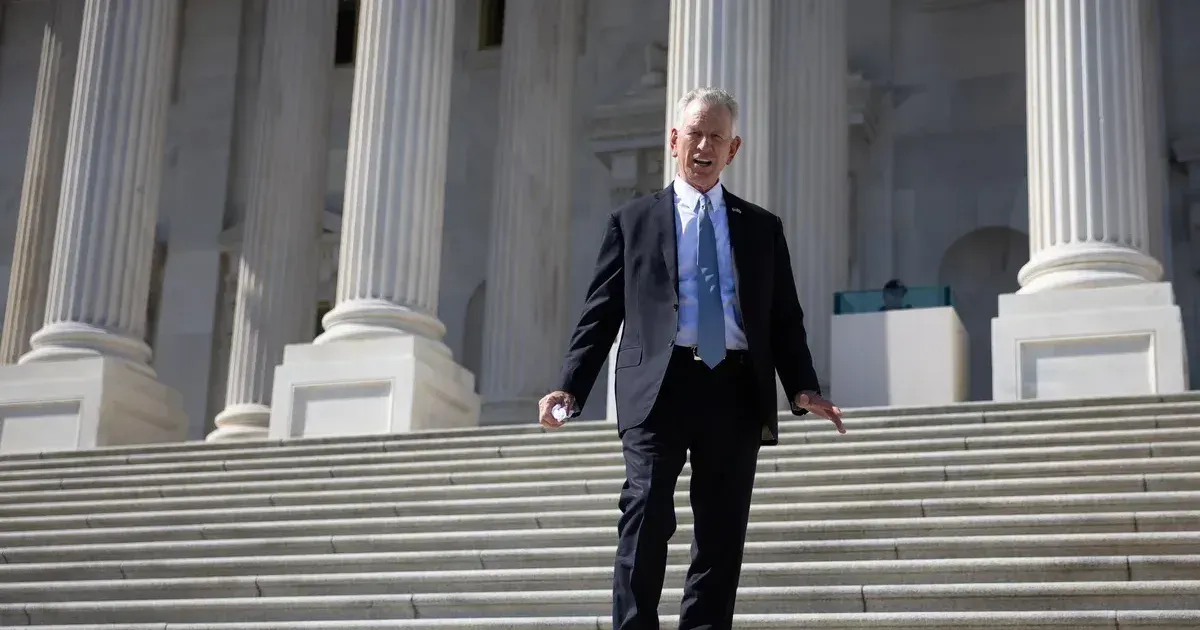
Tuberville Post Draws Backlash
The online dispute quickly became a governing test. March 12, 2026, marked a period of unprecedented digital friction in Washington as two high-profile government figures faced intense scrutiny for their social media conduct. Senator Tommy Tuberville, a Republican from Alabama, triggered a national firestorm on Thursday by sharing a post that labeled Muslims as the enemy of the United States.
His digital activity specifically targeted New York City Mayor Zohran Mamdani, the first Muslim to lead the nation’s largest metropolis, by juxtaposing a modern photo of the mayor with the burning Twin Towers from the September 11 attacks. Tuberville added a blunt caption to the retweet, stating that the enemy is inside the gates. Such language from a sitting member of the Senate Armed Services Committee has ignited a fierce debate over the boundaries of political speech and the responsibilities of elected officials on public platforms.
Mamdani was pictured in the post sitting on a floor surrounded by constituents, a scene Tuberville’s shared content contrasted with a tragedy that occurred nearly 25 years ago. The implication was clear to many observers, yet the Senator’s office remained defiant. A spokesperson for Tuberville pointed toward a separate post where the Senator argued that calling Islam a cult does not qualify as Islamophobia, a defense that did little to quiet the growing chorus of critics in New York and the District of Columbia.
Mamdani responded with a focus on governance rather than grievance. He urged politicians in Washington to show as much outrage for hungry children as they do when he breaks bread with fellow New Yorkers. These remarks highlight a growing divide between the municipal leadership of diverse urban centers and a faction of the federal legislature that has become increasingly vocal about religious and cultural identity. The conflict is not an isolated incident but rather the latest in a series of targeted attacks by Republican members of Congress against Muslim Americans in public life. Representative Andy Ogles of Tennessee recently faced a wave of condemnation for suggesting that Muslims do not belong in the United States, while Representative Randy Fine of Florida drew censure calls for comparing a religious group unfavorably to animals.
Leadership Avoids a Direct Rebuke
Senate Republican leadership has largely avoided direct engagement with the controversy. Majority Leader John Thune and Majority Whip John Barrasso did not offer immediate comments when pressed by reporters on Thursday.
This absence of formal reprimand contrasts sharply with the reaction from across the aisle, where Senate Minority Leader Chuck Schumer described the post as an expression of hate. Schumer’s swift condemnation reflects a broader Democratic effort to frame these outbursts as a threat to national social cohesion. Meanwhile, Speaker Mike Johnson has similarly declined to publicly discipline members for similar rhetoric, suggesting a party-level hesitancy to police the digital footprints of its most firebrand members.
Accountability remains elusive in a legislative environment where viral engagement often carries more weight than bipartisan decorum. Internal factions such as the Sharia-Free America Caucus have begun to formalize these sentiments within the halls of Congress. This caucus seeks to prioritize federal and state laws over religious tenets, though legal experts frequently point out that the US Constitution already establishes the supremacy of secular law. Critics of the caucus argue that its primary purpose is the marginalization of a specific faith group rather than any genuine legal concern. The rise of such groups provides a legislative home for the rhetoric seen in Tuberville’s social media feed, moving these ideas from the fringes of the internet into the formal structures of American government.
Agencies Tighten Social Media Control
Across the capital, the executive branch is grappling with its own social media liabilities. Energy Secretary Chris Wright announced on Thursday that he will personally oversee his department’s posts on X, the platform formerly known as Twitter.
Across the capital, the executive branch is grappling with its own social media liabilities.
Wright made the commitment following a significant blunder involving a deleted post about a military escort. While the Department of Energy had initially posted about the security detail, the White House quickly disputed the details, leading to an awkward retraction and a promise of greater oversight from the Secretary himself. Wright’s situation is a different category of digital failure, one rooted in administrative coordination rather than ideological provocation.
Wright’s decision to personally review content suggests a realization that even technical or logistical posts can carry heavy political weight if they contradict the official White House narrative. His commitment to a personal audit of Department of Energy communications highlights the vulnerability of high-ranking officials to the speed of modern information cycles. One errant post can necessitate a week of damage control and draw unwanted attention to internal discrepancies between a cabinet agency and the West Wing. Unlike the legislative branch, where individual senators operate with significant autonomy, the executive branch requires a disciplined, singular voice to maintain its credibility. Data regarding the impact of these posts remains difficult to quantify, but the political cost is visible in the deepening polarization of the electorate. When a Senator suggests that a sitting mayor of the nation’s largest city is an internal enemy, the repercussions extend beyond a single news cycle. It alters the nature of the relationship between federal and local governments, making cooperation on issues like infrastructure or public safety more difficult. The Energy Department gaffe, while less inflammatory, also erodes public trust by creating the appearance of a government that cannot agree on basic facts regarding military movements or security protocols.
Accountability Runs Through Politics
Religious tension in American politics has deep roots, but the current era of digital communication has accelerated the pace of these conflicts. Previous generations of politicians often relied on dog-whistle politics or coded language to appeal to specific demographics.
Today, the filter has been removed. Tuberville’s directness reflects a shift in strategy where confrontation is viewed as a virtue by a specific segment of the voting base. This maneuver prioritizes base mobilization over the broad-based appeal that once defined American political campaigning.
Because the algorithms of social media favor high-arousal content, inflammatory posts often receive more visibility than policy proposals, creating a cycle that rewards the very behavior being criticized by leadership. Legal frameworks for addressing these outbursts are limited. The First Amendment provides broad protections for the speech of elected officials, even when that speech is viewed as hateful or factually inaccurate. Congressional rules for censure or expulsion require a high bar that is rarely met unless there is evidence of criminal activity or extreme ethical breaches. The primary mechanism for accountability remains the ballot box or the internal disciplinary actions of party leaders. Without a change in the political incentives that drive these posts, the digital environment of Washington is likely to remain a site of constant conflict.