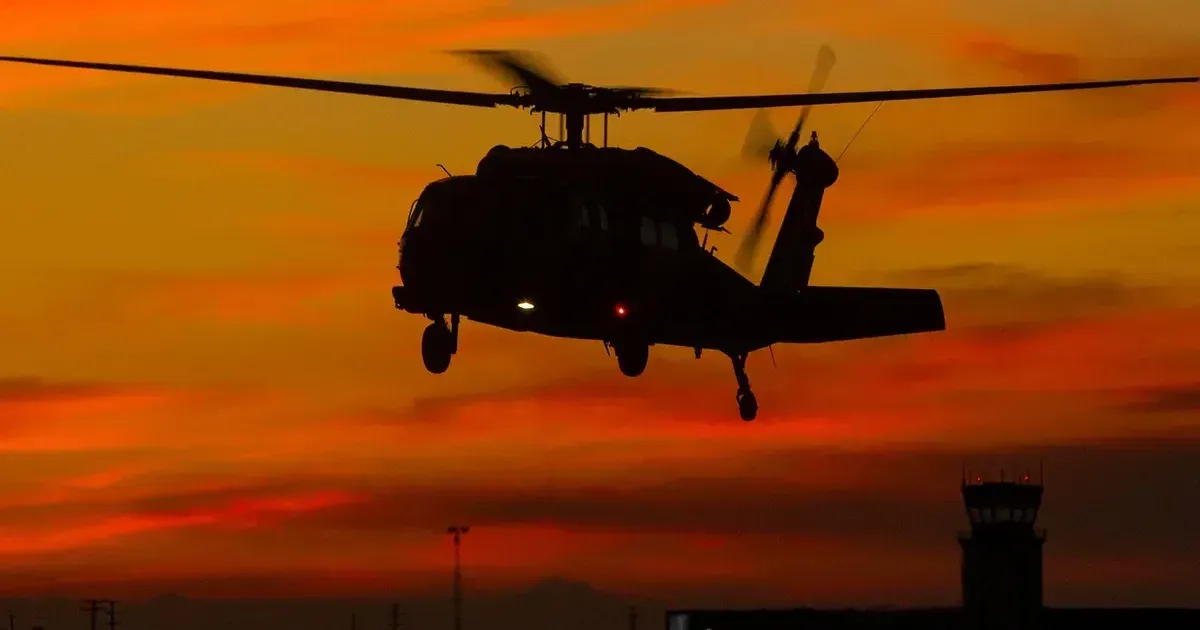
A United Airlines flight's reported near miss with a Black Hawk helicopter has put Southern California airspace coordination back under review. The important point is separation, not drama. Investigators still need to determine how close the aircraft came. The incident was reported on March 27, 2026, after Flight 589 made an avoidance maneuver during a close encounter with a California Air National Guard aircraft.
No crash occurred, and the flight landed safely. The safety question is still serious because commercial jets and military helicopters move through the same crowded regional airspace under different operating needs.
What Investigators Need to Know
The Federal Aviation Administration and military investigators would need to reconstruct the flight paths, radio communications, transponder data and controller handoffs. The key question is whether the helicopter deviated from its assigned area, whether the jet received timely warnings and whether both crews were working from the same traffic picture.
Near-miss investigations often turn on seconds and procedures. A safe landing does not mean the system worked perfectly. It may mean pilots, controllers and onboard alerts prevented a mistake from becoming a disaster.
Military Training and Civilian Corridors
Southern California is a difficult environment because civilian traffic, military training, private aircraft and helicopters all share complex routes. National Guard units need realistic training space, while airlines need predictable separation around arrival and departure corridors. That tension is not new. The challenge is making sure training missions remain compatible with commercial schedules, especially when airspace is busy or weather reduces margins. A single communication gap can create a dangerous closing speed between a jet and a slower helicopter.
FAA Review and Safety Technology
Investigators are likely to examine whether the Black Hawk was visible with enough precision to civilian systems and whether the United crew followed the correct resolution advisory. Commercial pilots are trained to prioritize collision-avoidance instructions when they conflict with routine controller guidance.
Military aircraft technology can vary by model and mission. Some helicopters carry modern avionics and tracking systems, while older equipment may provide less detail to civilian controllers. The review will need to determine whether technology, procedure or human coordination created the risk.
The passenger experience also matters. A sudden avoidance maneuver can be frightening even when the aircraft remains under control. Airlines usually review whether anyone was injured, whether the aircraft needs inspection and whether crews followed the required reporting chain after landing.
For controllers, the incident may reveal whether civilian and military systems shared enough information in real time. A helicopter operating legally can still become a hazard if its position is not visible to the right controller at the right moment. The investigation will need to separate rule compliance from operational safety.
Southern California adds terrain and traffic complexity. Helicopter training routes, commercial arrivals, private aviation and weather patterns can compress decision time. That makes clear boundaries and shared situational awareness more important than they would be in a quieter region.
The National Guard also has legitimate training needs. Pilots must practice in realistic conditions, and restricting every busy corridor could reduce readiness. The policy challenge is to protect commercial traffic while preserving enough training space for missions that cannot be simulated entirely on the ground.
A final report may recommend changes that look technical rather than dramatic: different altitudes, revised handoff procedures, equipment upgrades or new coordination windows. Those details are exactly where aviation safety usually improves. Airlines will also want reassurance that the fix is systemwide rather than limited to one crew or one training unit. A near miss can reveal a local error, but it can also expose a pattern in how military flights and commercial traffic share information across a region. Passengers rarely see that infrastructure, yet they depend on it. The safest outcome is a review that identifies specific procedural gaps and closes them before another crew has to rely on last-second avoidance. The airline and the Guard also have communication incentives after the fact. Each side wants to reassure the public without assigning blame before the investigation is complete. That makes the final report more important than early statements. If the report is specific, passengers and crews can trust that the event produced a concrete fix. If it is vague, the same route-sharing concerns will return the next time a close call is reported.
The FAA review will also look beyond a single cockpit decision. Near misses usually expose a chain of assumptions involving altitude, radio traffic, visibility and route design, which is why the agency is likely to focus on procedure as much as blame. Investigators may also compare the incident with earlier airport approach concerns to see whether traffic patterns have become too dependent on routine familiarity. The presence of military aircraft near busy civilian corridors also makes the review politically sensitive. Even if no single actor is blamed, regulators may face pressure to tighten coordination rules around shared airspace. Airport officials will also have to explain whether existing separation rules are clear enough for mixed civilian and military traffic during periods of heavy demand. That question could outlast the immediate investigation. The review may therefore end with technical recommendations rather than dramatic findings, but those recommendations could still alter how approach corridors are managed around congested airports.
Airspace Coordination Test
The policy response may involve better shared frequencies, tighter training corridors, clearer exclusion areas or new equipment requirements for military aircraft operating near major airports. Each option carries trade-offs for readiness and civilian safety. Passengers usually encounter these debates only after a frightening incident. Aviation systems, however, improve through exactly this kind of review: identify the weak link, change the procedure and prevent a close call from repeating. The United incident should therefore be treated neither as proof of widespread failure nor as a harmless scare. It shows that crowded airspace depends on coordination that has to work every time.