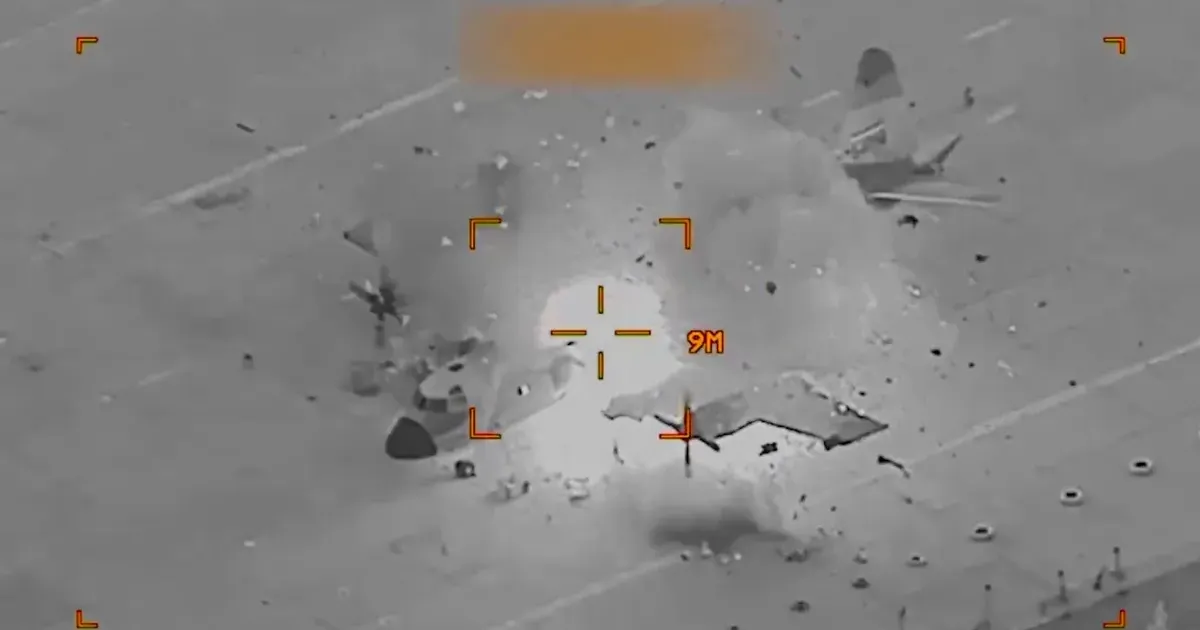
US airstrikes destroyed Iranian warplanes near a blockaded strait, escalating military risk around Gulf energy routes. The update was dated March 12, 2026. The operation turned aging aircraft and frozen shipping lanes into one connected crisis.
Airstrikes Hit Iranian Warplanes
Plumes of black smoke rose above several Iranian military airfields on Wednesday, as US Central Command confirmed a series of kinetic strikes targeting the Islamic Republic air capability. Footage released by the Pentagon shows the precise destruction of various assets, including Soviet-era freighters and American-made surveillance craft. These operations occur while a tense naval standoff persists in the Persian Gulf. Video evidence specifically captured the incineration of a Lockheed C-130 Hercules and a Lockheed P-3F Orion. These aircraft were grounded on runways when the munitions struck. The C-130 airframe appeared to collapse instantly under the heat of the explosion. Centcom officials described the mission as a methodical dismantling of threats rather than a simple defensive posture. The math of modern warfare favors the side with the bigger hammer. Tehran maintains an aging fleet of equipment that dates back to the era of Shah Mohammad Reza Pahlavi. Iran's pre-1979 reliance on U.S. hardware created the irony of American weapons now destroying American-made planes on Iranian soil. This historical irony reached a boiling point this week when American-made missiles destroyed American-made planes on Iranian soil. Satellite imagery confirms that the strikes also targeted the Ilyushin Il-76, a Russian-designed strategic lifter that provides Tehran with key logistics reach. Bloomberg reports that the simultaneous closure of the Strait of Hormuz will likely last for months.
Before the 1979 Islamic Revolution, the United States was the primary supplier of military hardware to Iran.
The Strait Becomes the Center of Gravity
, as the blockaded strait became the military and economic center of the crisis. Analysts suggest this maritime blockade will create a profound economic vacuum in global energy markets. Oil prices have already reacted with sharp upward volatility because the world cannot easily replace the millions of barrels that pass through that narrow waterway daily. Markets in London and New York are bracing for a prolonged period of instability. Shipping insurance premiums for tankers in the region have tripled within forty-eight hours. While some energy experts believe Saudi Arabia could increase production to offset losses, the logistics of rerouting such massive volume remain daunting. Shipping lanes are effectively frozen. Most major carriers refuse to send vessels into the Gulf of Oman without naval escorts. The economic pain will be felt far beyond the Middle East. High energy costs act as a hidden tax on every sector of the global economy, from manufacturing to consumer transport. Tehran now faces a strategic vacuum it cannot fill with Russian leftovers.
Detailed surveillance photos obtained by Business Insider show that Iranian F-14 Tomcat fighter jets are also in the crosshairs. These iconic twin-engine aircraft were purchased in the mid-1970s under a multibillion-dollar deal that included the AIM-54 Phoenix missile system. Only a handful of these fighters remain operational due to decades of international sanctions and a lack of spare parts.
Escalation Narrows Diplomatic Space
US military planners recognize that removing these remaining assets effectively blinds the Iranian Air Force. Without maritime surveillance from the P-3F Orion fleet, the regime loses its ability to track Western naval movements in the Arabian Sea. This systematic erasure of capability suggests Washington is preparing for a much longer engagement than previously disclosed. Commanders at Centcom believe the Iranian regime is losing air capability day by day. This strategy aims to force a diplomatic concession by removing the military options available to the Supreme Leader.
Iran previously operated about twenty-eight C-130 transport planes. Recent strikes have sharply reduced that number. The loss of the P-3F Orions is particularly damaging because Iran only had five of those maritime patrol aircraft left in its inventory. Every destroyed airframe is an irreplaceable loss for a nation that cannot buy modern Western replacements. Russia remains a possible supplier, but its own domestic demand for the ongoing conflict in Eastern Europe limits what it can export to Tehran.
Logistics analysts point to the Il-76 destruction as a move to hamper Iranian support for regional proxies. Those heavy lifters are the backbone of the air bridge between Tehran, Damascus, and Beirut. Striking them on the ground prevents the transport of drone components and missile parts.
Energy Routes Carry the Real Cost
Military historians might compare this campaign to the initial phases of the 1991 Gulf War, where the coalition focused on blinding the enemy before any ground movement. Yet the current context is different because of the global reliance on the Hormuz passage. A closed strait creates a bottleneck that could trigger a recession in several European nations by the end of the second quarter. Security experts in Washington argue that the window for a peaceful resolution is closing. Iran has shown no sign of reopening the shipping lanes despite the heavy toll on its military infrastructure.
Instead, the regime appears to be doubling down on its asymmetric capabilities, such as fast attack boats and coastal missile batteries. These assets are harder to target from 40,000 feet than a C-130 sitting on a tarmac. The next phase of the conflict will likely involve these smaller, more mobile threats. If the blockade continues into the summer, the United States may be forced to consider a larger naval presence to clear the mines and escort tankers through the chokepoint. Defense contractors are watching the performance of US precision munitions with keen interest.
The ease with which old American hardware is being neutralized by modern systems provides a clear contrast in technological evolution. Many of the Iranian planes are fifty years old. They rely on vacuum tubes and analog dials while their attackers use satellite-linked guidance and stealth technology.
Air Superiority Does Not End the Crisis
US airstrikes reportedly destroyed Iranian warplanes near a blockaded strategic strait. The attack raised the risk of wider retaliation around Gulf maritime routes. Energy markets and shipping insurers are likely to price a longer conflict. Military success does not remove the danger of miscalculation.
The strait is a key route for oil and gas shipments, so disruption can affect global energy prices. Airstrikes may reduce immediate military capacity, but they can also provoke retaliation and deepen the crisis. Destroying aircraft is a tactical result, not a strategy. The harder question is whether each strike restores deterrence or simply gives both sides another reason to widen the war.
Energy corridors do not care who wins the press briefing.