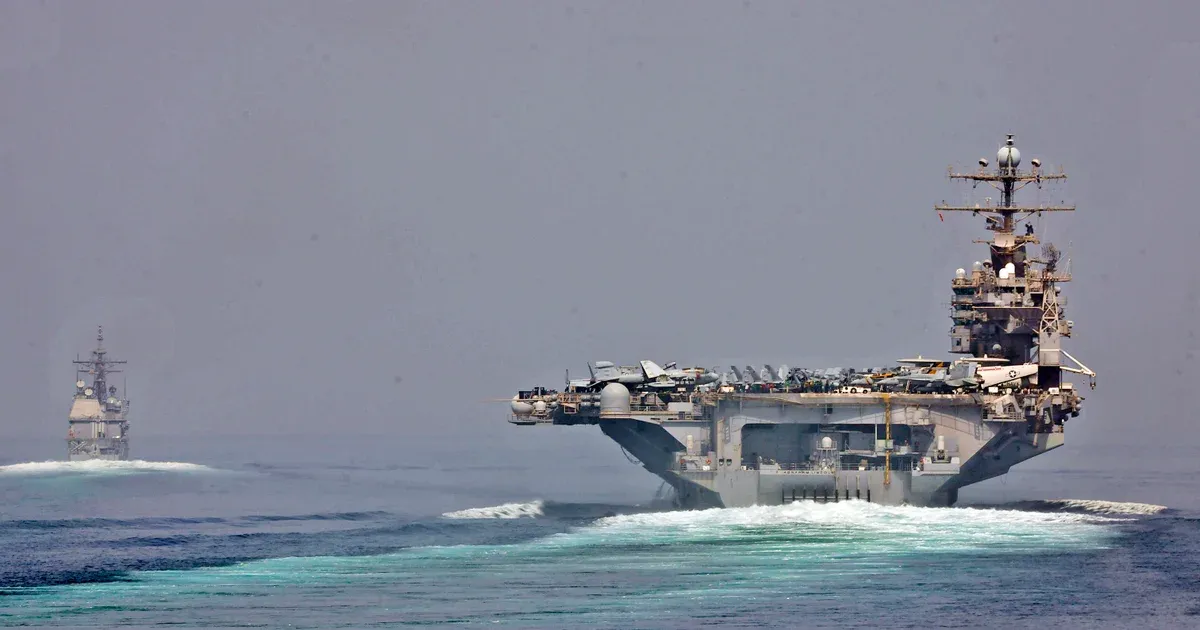
U.S. military action in Iran has pushed oil markets into a supply-risk story that traders cannot treat as temporary noise. By March 12, 2026, the market reaction had turned the military action into an energy shock.
Energy Infrastructure Under Siege in the Persian Gulf
Crude oil tankers sit motionless in the humid haze of the Persian Gulf, trapped on either side of the world's most sensitive maritime chokepoint. Markets had little time to absorb the military news. The first reaction came through crude prices. Suspected Iranian drone attacks have paralyzed the region, forcing a total cessation of movement through the Strait of Hormuz and triggering a panic in global energy sectors. Mike Sommers, the president and CEO of the American Petroleum Institute, warned that the current gridlock constitutes a nightmare scenario for world energy. Approximately 20 percent of the world's daily oil supply passes through this narrow corridor, and the sudden cessation of flow has already begun to impact domestic pricing across the United States and Europe.
Sommers detailed the gravity of the situation during a recent briefing, noting that tankers are essentially sitting ducks in a theater of war. Oil markets are notoriously sensitive to logistics, but the physical presence of stalled vessels creates a supply vacuum that cannot be filled by other regions. Commercial shippers now face prohibitive insurance premiums, which further discourages any attempt to break the blockade without direct military escort. Political instability in Tehran has only worsened the outlook for a quick resolution, as the Iranian military appears willing to use its geography to inflict maximum economic pain on the West.
The math doesn't add up.
Washington's strategic objectives remain under heavy fire from within its own borders. Representative Adam Smith of Washington state, the ranking Democrat on the House Armed Services Committee, recently voiced his exhaustion with the lack of progress. Smith argued that the United States seems to be spinning its wheels without achieving any permanent behavioral change in the Iranian regime. His opposition to the escalating war highlights a deepening rift in the Democratic Party, where many fear that another open-ended conflict in the Middle East will drain national resources while failing to secure the very energy routes the military was sent to protect. Smith is now calling for Congress to exert more authority over the mission, insisting that the executive branch has overstepped its constitutional bounds.
A Divided Congress Struggles with War Aims
Senate corridors echo with a vastly different sentiment from Senator John Fetterman. The Pennsylvania Democrat has taken a lonely stand within his party, becoming the sole Democratic voice in the Senate to commend the military action initiated by President Trump. Fetterman described the accomplishments of the U.S. military as remarkable, pointing to the degradation of Iranian infrastructure as a necessary step toward regional stability. His support for the war effort persists despite the ongoing partial government shutdown that has hampered other federal operations. Fetterman seems convinced that a decisive military victory is the only way to break the cycle of Iranian aggression, regardless of the temporary economic or political costs at home.
Republican Representative Don Bacon of Nebraska shares some of this hawkish optimism, though his support is tempered by fiscal anxiety. Bacon characterized the war as long overdue, stating that the confrontation had to be done to address years of unchecked proxy warfare. However, his endorsement comes with significant caveats regarding the endgame of the conflict. Bacon expressed deep uncertainty about the eventual trajectory of oil prices and the creeping risk of inflation that threatens to destabilize the American economy. Like many of his colleagues in the House GOP, he is looking for a clear exit strategy that does not involve a decade of nation-building or a permanent military occupation of the Iranian coastline.
Military victory remains an abstract concept when the price of gasoline is ten dollars a gallon.
Bloomberg analysts recently pointed out that while the U.S. military has technical superiority, the asymmetric nature of drone warfare allows Iran to maintain a low-cost blockade indefinitely. This strategy forces the Pentagon to expend millions in high-tech munitions to intercept drones that cost only a few thousand dollars to manufacture. Reuters reports from the region suggest that the Iranian Revolutionary Guard has hidden launching sites deep within coastal mountain ranges, making them nearly impossible to eliminate through traditional air strikes alone. This persistence of the threat keeps the Strait of Hormuz closed to commercial traffic, leaving the American Petroleum Institute to wonder how long the global economy can survive such a bottleneck.
Inflation Risks and the Search for an Exit Strategy
Domestic pressure is mounting as the ripple effects of the Strait of Hormuz crisis reach the average American household. Inflation, already a sensitive political issue, has been supercharged by the sudden spike in energy costs. Republican lawmakers are increasingly caught between their desire to support a strong military stance and their need to answer for the rising cost of living. Bacon and his allies are demanding a more coherent economic plan from the administration, one that accounts for the potential of a multi-year disruption in Middle Eastern oil exports. Without such a plan, the political will for the war may evaporate long before the military goals are achieved.
Adam Smith continues to push for a diplomatic alternative, though his voice is often drowned out by the drums of war. He maintains that the U.S. must engage in regional dialogue to secure the shipping lanes, rather than relying solely on kinetic force. This view is diametrically opposed to the stance of Fetterman and Bacon, who believe that diplomacy has failed and only strength will deter Tehran. The ideological clash between these lawmakers reflects the broader uncertainty of the American public, which is torn between a desire for national security and the reality of an unaffordable energy crisis. Such a conflict will likely define the political environment through the 2026 midterm elections and beyond.
Energy Shock Test
The energy-market lesson is that military action can outrun reserve planning. Emergency barrels help with supply volume, but they do not remove fear from shipping lanes or give traders confidence about the next escalation point.
That is why the story belongs in both foreign policy and business pages. Oil prices are reacting to security risk, and consumers eventually feel that risk through fuel, freight and inflation expectations.