Valentino Leaves a Red Legacy
Valentino Garavani forged a legacy in red, and Rome felt heavy today. The sun hit the cobblestones of the Piazza Mignanelli with a cruel, indifferent brightness. On March 13, 2026, his death reframed the house’s newest Rome show as a moment of succession.
Valentino Garavani, the man who dressed the most famous women of the 20th century, has passed away at the age of 93. His death occurs on March 13, 2026, just as the fashion house he founded prepares for its latest iteration under the creative direction of Alessandro Michele. The timing feels both poetic and disruptive, marking the final departure of the last true emperor of high fashion.
Voghera gave birth to him in 1932, but it was Paris that polished him. He studied at the École des Beaux-Arts and the Chambre Syndicale de la Couture Parisienne before returning to Italy to open his first atelier in 1959.
Fashion House Faces a New Era
Success did not come instantly. He struggled with debt and the logistical nightmares of a burgeoning business until he met Giancarlo Giammetti, a student of architecture who would become his lifelong partner in both love and commerce.
Giammetti handled the ledgers, allowing Valentino to focus entirely on the silhouette. Does any modern creative director enjoy such specialized luxury today? Red became his signature, a specific shade of poppy that defied the muted expectations of mid-century couture.
He claimed the inspiration came from a night at the opera in Barcelona, where a woman in a balcony box wore a dress of such vibrant intensity that it burned into his memory. This choice of hue would eventually define an entire segment of the luxury market.
Michele Inherits the Archive
Every woman who wore a Valentino gown knew she was wearing more than a garment; it was armor of unapologetic opulence. Who else could command such a monochromatic monopoly on a single color?
Luxury brands are no longer houses; they are machines. Valentino and Giammetti were among the first to understand that a name could be a global franchise. They sold the company in 1998 for approximately 300 million dollars to the Italian conglomerate HdP.
It later passed to the Marzotto Group and finally to Mayhoola for Investments, a Qatari-backed vehicle, for over 700 million euros in 2012. Despite these transitions, the founder remained a permanent fixture in the front row, a tan and impeccably tailored ghost of the industry’s golden age. His retirement in 2008 was celebrated with a three-day gala in Rome that cost an estimated 5 million dollars, involving a choreographed display of archival dresses at the Ara Pacis. How much of that grandeur remains in the current era of spreadsheet-driven fashion? Revenue at the house has seen fluctuations as it moves away from the strict, ladylike elegance of the Garavani years. Under Pierpaolo Piccioli, the brand found a new, younger audience through bold colors and inclusive casting. Now, the baton has passed to Alessandro Michele, whose debut Fall 2026 ready-to-wear show in Rome today was meant to be a celebration of his new vision. Instead, it has become a somber reflection on the end of a lineage. Michele’s approach, heavy with maximalism and 1970s nostalgia, stands in sharp contrast to the sleek, architectural precision that Garavani favored. Can a brand survive when its aesthetic DNA is so radically rewritten? Alessandro Michele’s Fall 2026 collection arrived with a sense of urgent historical curiosity. Backstage, photographer Kevin Tachman captured a scene of controlled chaos, where models stood draped in layers of lace, brocade, and heavy embroidery. The atmosphere was thick with the scent of lilies and the quiet murmurs of a crew aware of the morning’s news. This tension between old-world glamour and new-age maximalism defined the collection. Michele seems less interested in the clean lines of the 1960s and more obsessed with the dusty, layered history of Rome itself. The garments were beautiful, but they were not Valentino in the traditional sense. Beauty was the only metric that mattered to Garavani. He once famously remarked that he knew what women wanted, which was simply to be beautiful. Such a sentiment feels almost radical in 2026, where fashion is often used as a platform for political statements, conceptual art, or digital performance. Garavani’s obsession was simpler and perhaps more honest. He focused on the curve of a shoulder, the fall of a silk crepe, and the precise placement of a bow. The Fall 2026 show attempted to bridge this gap, but the results were mixed. Is it possible to honor a man who despised clutter with a collection that embraces it?
Paltrow Connects Valentino to Hollywood Memory
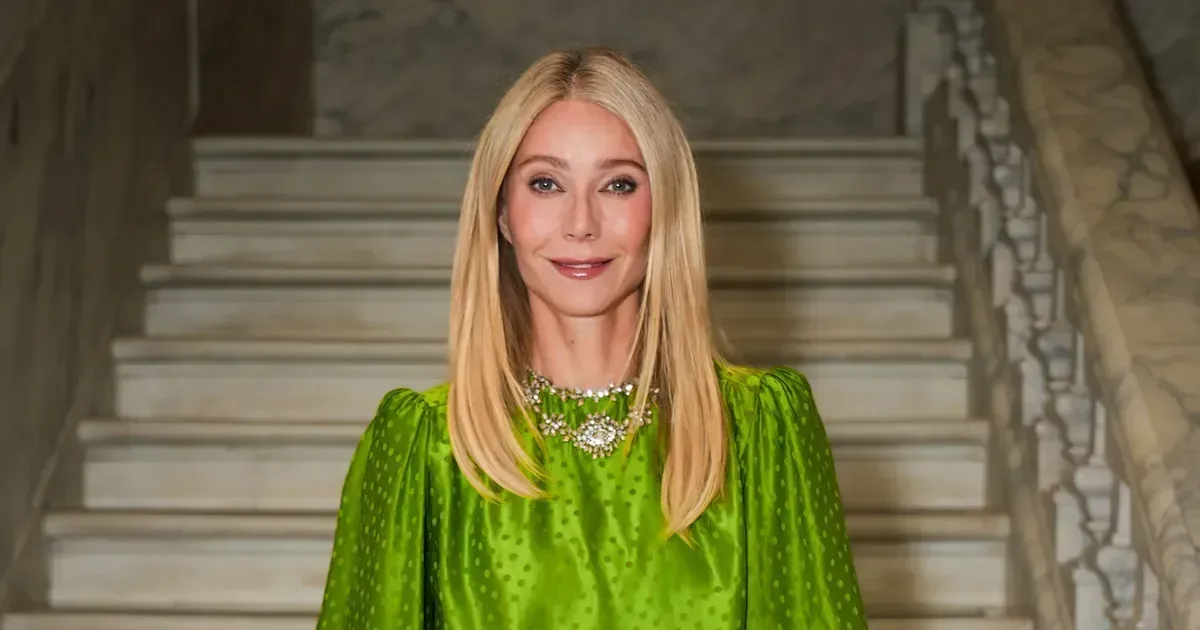
Gwyneth Paltrow arrived at the show today looking like a woman who had lost a mentor. She was one of the many Hollywood stars who turned the brand into a staple of the Academy Awards red carpet. Paltrow spoke candidly about her friend, noting that beauty was infused in everything he touched. She recalled the way he lived, surrounded by pugs, fine china, and an unwavering commitment to the high life. Her presence served as a bridge to a time when celebrities and designers shared deep, personal bonds rather than fleeting transactional contracts.