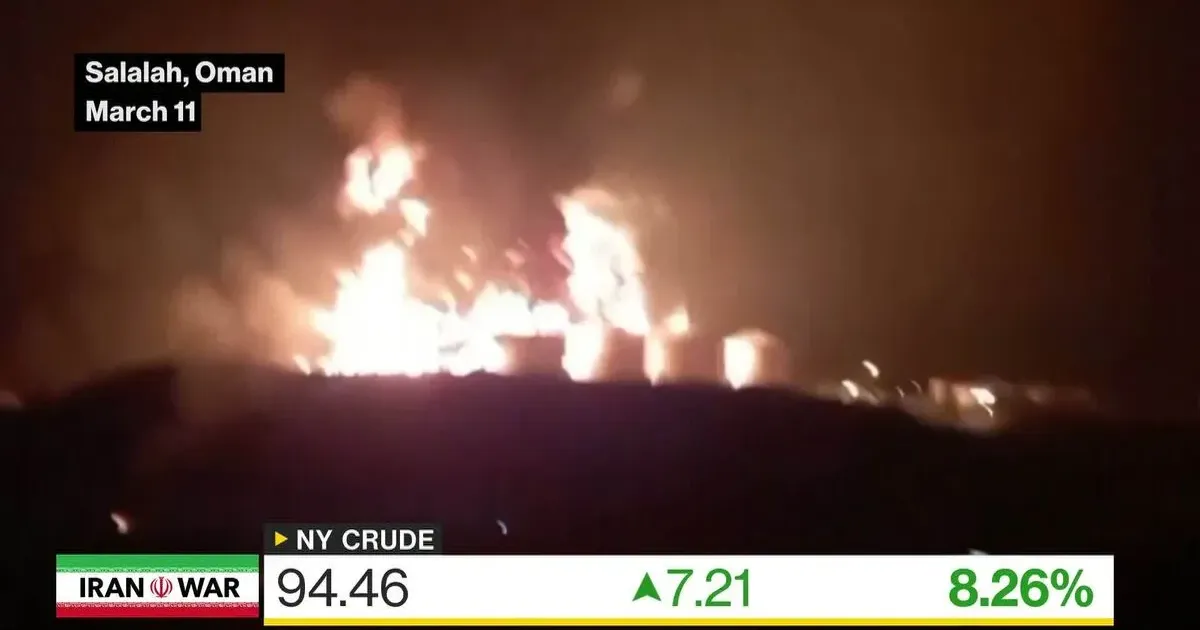
The Middle East war is choking maritime energy corridors that global trade had treated as reliable infrastructure. The corridor risk widened on March 12, 2026
Energy Corridors Start to Close
The disruption began with a frantic radio silence from the Gulf of Oman. Port authorities in Muscat issued a directive for the immediate evacuation of Oman's primary oil export terminal early Thursday. Escalating military threats in the region made the facility untenable. Bloomberg's Joumanna Bercetche reported from Dubai that workers were seen boarding transport buses and fleeing the coastal zone. Rising maritime risks triggered the move. Chaos at the port sent local crude prices surging. Security personnel established a 10-mile exclusion zone around the terminal to prevent further incursions. Crude oil intended for European and Asian markets remains trapped in storage tanks as the conflict expands. Projectiles struck two crude tankers in Iraqi waters shortly before noon. These vessels were loading heavy crude when the strikes occurred. Firefighting tugs raced to the scene to prevent a massive environmental disaster. No group has yet claimed responsibility for the hits. Iraqi oil officials suspended all loading operations at southern berths. Crude exports from Basra fell to zero within hours. Energy traders reacted by pushing Brent futures higher. Global energy supply depends on these Iraqi outputs. Military analysts suggest that the precision of the strikes points to state-level drone technology. Smoke plumes from the burning tankers were visible from the shore. The damage appears to be significant, requiring extensive repairs before the ships can move. Markets across the globe shuddered at the news. Investors sold off equities in favor of gold and government bonds, as war pressure moved from headlines into shipping, insurance and energy pricing.
Insurance Prices the War First
Energy companies saw their valuations fluctuate wildly. Crude oil prices moved toward the $150 mark per barrel. Supply chains already under stress face new bottlenecks. Consumer sentiment in the United States and United Kingdom is declining. Economists worry that a sustained closure of these lanes will trigger a recession. Inflationary pressures are mounting. Central banks are reconsidering their interest rate paths. Global trade relies on the predictability of these shipping routes. Uncertainty has replaced that predictability. Iron ore shipments originally destined for Middle Eastern steel mills are now swinging toward East Asia. Bloomberg reports confirm that at least six major bulk carriers changed course mid-voyage. Conflict in the Persian Gulf has made regional deliveries too dangerous for commercial insurance. China and Japan are the primary recipients of these diverted cargoes. Diversions of this scale have rarely been seen in the dry bulk sector. Steel production in the Middle East is expected to grind to a halt. Industrial projects in the Gulf will face severe material shortages. Builders are reporting price spikes for reinforcement bars. Ship captains are prioritizing the safety of their crews over delivery schedules. Maritime corridors in the Indian Ocean are crowded with vessels seeking alternative routes. Global logistics firms are scrambling to recalculate arrival times. Global trade is fracturing in real time.
Supply Chains Feel the Strait Risk
East Asian markets are welcoming the sudden influx of raw materials. Iron ore prices in Singapore fell slightly as supply increased unexpectedly. This move protected the cargo from the direct line of fire. Australian mining giants are monitoring the situation closely. They depend on the stability of these shipping lanes for their annual revenue. Western Australian ports are seeing a shift in docking requests.
Mining executives are holding emergency meetings to discuss the long-term impact. Contracts are being rewritten to include stronger force majeure clauses. Logistics managers are choosing the longest routes to avoid the Red Sea and the Persian Gulf. Freight rates for bulk carriers are climbing. Every day of delay adds millions to the final cost of the ore. Financial Times data shows supertankers racing toward Saudi Arabia's Red Sea ports.
Riyadh is pushing its trans-peninsular pipeline to its physical limits to bypass the Strait of Hormuz. This strategy carries immense risk for the Saudi energy ministry. The East-West Pipeline allows crude to travel from eastern fields to the western coast. From there, ships can theoretically reach the Suez Canal and Europe. Supertankers are queuing up at Yanbu to receive their loads. Saudi officials are working around the clock to manage the surge.
Pipeline capacity is reaching its maximum throughput. Technical teams are monitoring the infrastructure for leaks or mechanical failure. Success depends on the pipeline remaining operational.
Governments Face the Strategic Bill
Any disruption to this inland link would be catastrophic for the Saudi economy. Braving the Red Sea brings its own set of dangers. Houthi militants remain a persistent threat to vessels managing these waters. This vulnerability has turned the Red Sea into a notorious hotspot for drone and missile attacks. Naval escorts are now a requirement for tankers moving through the Bab al-Mandab Strait. American and British warships are patrolling the lanes to deter interference.
Cargo ships are traveling in convoys for mutual protection. Still, the risk of a lucky strike remains high. Electronic warfare units are deployed to jam incoming signals. Tanker captains are under orders to darken their AIS tracking systems. Maneuvering these massive ships in such high-stress environments is difficult. Crews are exhausted by constant drills and alerts.
Security is now the only currency that matters in the Strait of Hormuz. Tehran's influence over the region remains the central variable in this crisis. Diplomats are working through backchannels to prevent a total shutdown of the Gulf. These efforts have yet to produce a breakthrough. Regional powers are choosing sides as the economic stakes rise. Qatar and Kuwait are looking for their own alternative export routes.
Infrastructure projects that were once deemed too expensive are now being fast-tracked. Pipelines through Jordan and Israel are back on the table. Regional cooperation is being tested by the immediate need for survival.
The Corridor Is the Commodity
Middle East war pressure is choking vital maritime energy corridors. Shipping insurance, tanker availability and rerouting costs are rising. Energy importers face higher prices even before physical shortages appear. Corridor security has become a macroeconomic issue, not only a military one.
War pressure is turning maritime energy corridors from background infrastructure into the main source of market anxiety.
Higher insurance can make shipping uneconomic or force cargoes onto slower, more expensive routes. Some supplies can reroute, but rerouting adds time, fuel cost and capacity pressure across global trade. The market is not only buying oil. It is buying confidence that the route exists, the ship can move and the insurer will stand behind the voyage. Once that confidence breaks, every barrel carries a security surcharge. Governments that spent years optimizing for cheap routes are now rediscovering the price of redundancy, naval protection and reserve capacity.