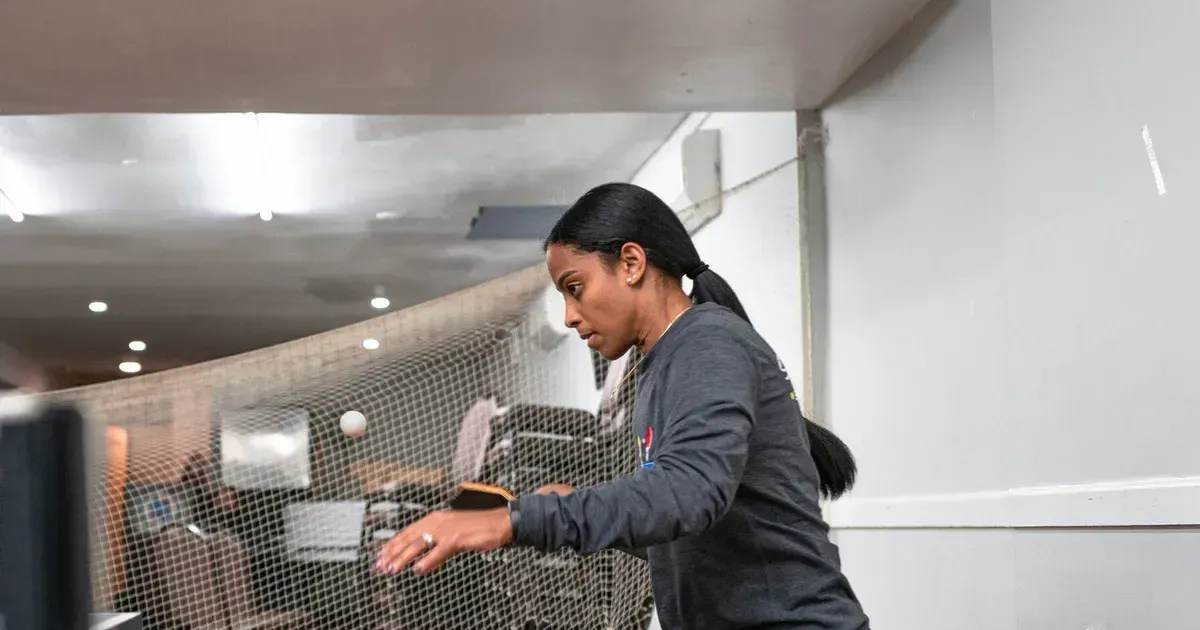
Yasiris Ortiz grips her carbon-fiber paddle with a focused intensity that suggests a professional tournament rather than a community center basement in the Bronx. At 28, the world-class athlete has moved beyond the pursuit of individual medals to address a systemic gap in urban recreational access. Ortiz is expanding free table tennis sessions in New York, turning a niche sport into a practical youth-development program. Growing up in one of the most underserved corridors of New York City, she recognized early that elite coaching in table tennis remained a luxury reserved for the affluent. Many residents of the five boroughs now associate the sport with the upcoming cinematic release of Marty Supreme. Hollywood often sanitizes the grit of the competitive circuit in favor of 1950s nostalgia. Ortiz represents the contemporary reality of a sport that demands high-level aerobic fitness and lightning-fast cognitive processing. Her initiatives focus on the immediate needs of children who lack safe spaces for after-school engagement. Competitive table tennis is a vehicle for academic discipline. The sport requires players to calculate ball path and spin in milliseconds, a process that mimics high-level mathematical problem-solving. Ortiz launched her free programming to ensure that financial barriers do not prevent the next generation of Bronx athletes from reaching the international stage. Her sessions now reach over 600 participants across various municipal sites. Success in this arena requires more than speed.
Bronx Program Opens Access
Professional table tennis has long been dominated by programs in Western Europe and East Asia. Ortiz has spent years training in the Dominican Republic and other international hubs to refine a style that blends defensive patience with explosive attacks. She returned to her home borough with a particular mandate to democratize a game often relegated to exclusive social clubs or private lofts. These new community programs operate out of New York City Department of Parks and Recreation facilities where equipment was previously neglected. Public interest in the sport often waxes and wanes based on cultural trends. Meanwhile, Ortiz maintains a consistent presence in the gym, proving that longevity in sports requires more than a temporary surge in popularity. She recently secured support from local donors to provide high-quality tables and flooring to three new locations. Each table costs approximately $2,500, a price point that makes private ownership impossible for many local families. Table tennis is a game of chess played at one hundred miles per hour, and every child in this city deserves the chance to master the board. Elite competition involves not only hitting a ball over a net. Players must account for humidity, lighting, and the friction of the rubber on their paddles. Ortiz teaches these technical nuances to children as young as six. Many recreational programs in the city focus on casual play without technical instruction. Her approach treats these students as prospective professionals from their very first lesson.
Table Tennis Becomes Academic Support
Data from the initial pilot phases show a marked increase in student retention compared to traditional basketball or baseball leagues.
However, the struggle for permanent dedicated space remains a primary hurdle for the expansion plan. Most programs now share space with aerobic classes or senior lunch programs. Ortiz is now scouting vacant retail units that could serve as a dedicated table tennis academy. Such a facility would allow for 24-hour access and specialized training for top-tier prospects. Property taxes in the Bronx remain a major barrier for this nonprofit model.
Local government agencies have provided some relief through short-term grants. Private foundations have contributed to the purchase of robotic ball launchers for solo practice. These machines allow students to drill particular shots like the backhand loop or the pendulum serve without needing a partner. Yasiris Ortiz believes that technology is the great equalizer in modern sports training. The machines can fire up to 90 balls per minute at varying speeds.
Wait times for these robots can be long during peak afternoon hours. To manage the flow, Ortiz implemented a digital reservation system that teaches students time management skills. The program is not only about athletic prowess. It is about providing a plan for success in any professional field. One former student recently received a full scholarship to New York University after citing the program in an admissions essay. The university has one of the top collegiate teams in the country.
Attendance records show that 95 percent of participants arrive early for their scheduled slots. This level of engagement is rare for voluntary after-school programs. Ortiz attributes this to the inherent speed of the game. Kids today are used to rapid-fire stimuli from digital devices. Table tennis provides that same neurological hit but requires physical exertion and social interaction. The program recently hosted a city-wide tournament that drew over 1,000 spectators.
City Sports Funding Should Follow Real Work
Can a simple game of ping pong actually serve as a viable solution for the systemic neglect of urban youth? While the media swoons over Timothee Chalamet playing a fictionalized version of a table tennis hustler, Yasiris Ortiz is doing the unglamorous work of building a real-world infrastructure for the Bronx. We spend millions on cinematic recreations of New York's past while the present-day heroes struggle to secure enough paddles for a middle school gym. The fixation on nostalgia is a toxin that prevents us from seeing the elite talent now developing in our own backyards.
Ortiz is not just a coach; she is a disruptor of the traditional sports hierarchy that has long favored the wealthy. The city should stop treating these programs as optional amenities and start viewing them as essential academic tools. If New York City can find billions for stadium subsidies, it can certainly find the change in its couch cushions to fund a dedicated table tennis center for its most talented children.
The reality of the Bronx is far stronger than any Hollywood script, provided the city is willing to invest in the actual players rather than the actors portraying them. Ortiz has laid the blueprint. It is time for the municipal government to follow her lead or get out of the way.