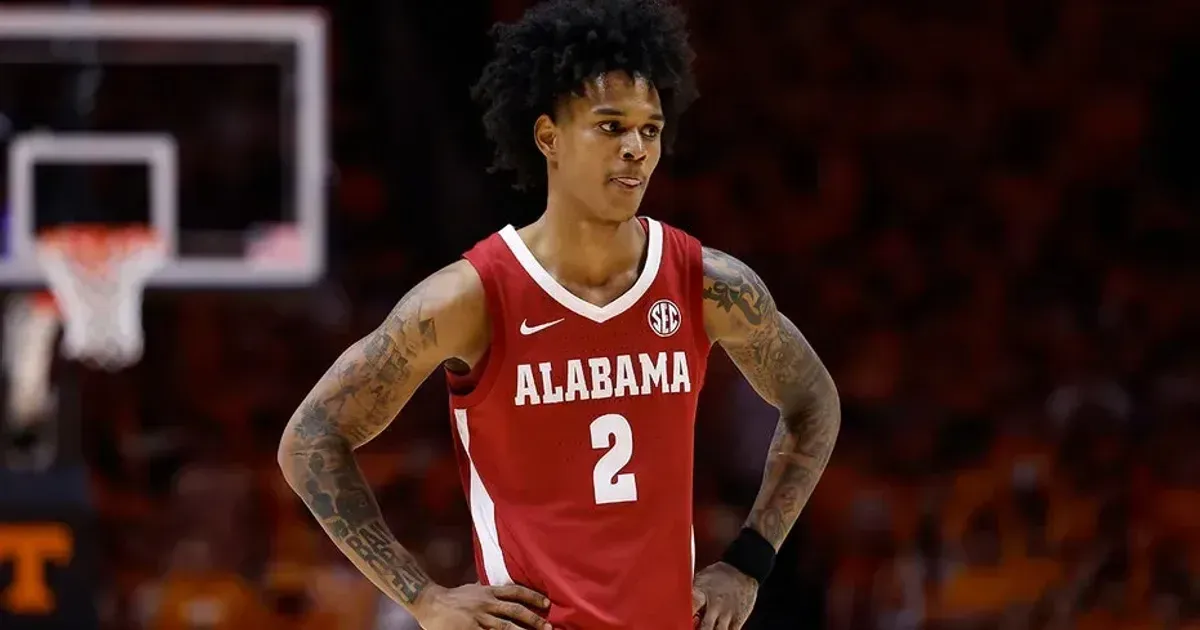
Aden Holloway sat in the Tuscaloosa County jail on Monday morning as his teammates began their final preparations for the NCAA Tournament. Aden Holloway was arrested by local authorities on felony drug charges just days before the team was set to travel to Tampa for their opening round game. The sudden removal of the starting guard has cast a shadow over a program that recently secured a No. 4 seed in the Midwest Region. Investigators with the West Alabama Narcotics Task Force initiated the action that led to the athlete being taken into custody.

Tuscaloosa Police Detail Aden Holloway Drug Charges

Agents entered a residence early Monday morning and discovered a significant quantity of illegal substances during a coordinated search. Stephanie Taylor, a spokesperson for the Tuscaloosa Police Department, confirmed that officers recovered more than a pound of marijuana during the operation. Police also seized unspecified drug paraphernalia and an amount of cash that suggested a scale of operation beyond personal use. These findings led to immediate felony charges against the 21-year-old athlete.

Holloway faces one count of first-degree possession of marijuana and a separate charge for failing to affix a tax stamp to the controlled substance. Alabama state law requires anyone in possession of a certain threshold of marijuana to purchase and display tax stamps issued by the Department of Revenue. Failure to comply with this administrative requirement is a felony that prosecutors often use to compound primary drug charges. The legal pressure on the young star grew rapidly as the formal documentation was filed in the Tuscaloosa County Circuit Court.

Bond for the star guard was set at $5,000, a sum that allowed for his prompt release on Monday morning. Records show he was processed at the county jail at 9:48 a.m. and walked out of the facility at 10:45 a.m. Despite his quick exit, the fallout from the arrest was immediate within the athletic department. Nate Oats addressed the media on Tuesday, clarifying that the program has already begun the process of adjusting its roster and strategy for the postseason.

NCAA Tournament Impacts for Alabama Crimson Tide

Still, the loss of Holloway is a massive hole in the offensive production for the Alabama Crimson Tide. He served as the team’s second-leading scorer throughout the 2025-2026 season, averaging 16.8 points per game while providing elite perimeter defense. His performance in the SEC Tournament quarterfinals against Ole Miss showcased his value, as he recorded 18 points in a narrow loss. Coaches must now find a way to replace nearly 17 points of nightly production against a dangerous Hofstra squad.

Meanwhile, the Hofstra Pride enter the matchup with a 24-10 record and a reputation for disciplined, veteran play. They will likely view the absence of a starting SEC guard as a significant opening to pull off a first-round upset in Tampa. Alabama has relied on a high-octane offense that thrives on transition buckets and rapid-fire three-point shooting. Holloway was the engine for many of those sequences, acting as both a primary ball-handler and a secondary scoring threat.

We are preparing to play without him in the tournament right now.

Nate Oats delivered that blunt assessment during his first press conference following the news of the arrest. He emphasized that the focus must remain on the players who are eligible and available to compete in the Midwest Region. Internal discussions regarding disciplinary measures are ongoing, but the immediate priority is the Friday tip-off at Standard International Arena. Rotation players like Latrell Wrightsell and Mark Sears will likely see a significant increase in their minutes and usage rates.

Legal Conflict and NCAA Marijuana Policy Shift

In fact, the arrest highlights a growing disconnect between state law enforcement and the internal rules of collegiate athletics. The NCAA Division I Council voted in June 2024 to remove marijuana from the list of banned substances for championships and postseason play. This policy change was intended to align collegiate sports with the shifting social and legal field across much of the United States. However, these internal athletic guidelines provide no protection against the criminal statutes of the State of Alabama.

By contrast, Alabama remains one of the more restrictive states regarding marijuana, particularly when the amount exceeds the threshold for personal use. Possession of more than one pound is almost always treated as a felony with intent to distribute, regardless of the individual’s status or profession. The West Alabama Narcotics Task Force is known for its rigorous enforcement of these specific weight-based statutes. Holloway now finds himself caught between a progressive athletic policy and a traditionalist legal system.

Separately, the failure to affix a tax stamp charge is a uniquely punitive measure designed to maximize the financial penalties of drug arrests. Under Alabama Code Section 40-17A, the tax is $3.50 per gram for marijuana. Since Holloway was allegedly in possession of over 450 grams, the unpaid tax liability alone is substantial. Prosecutors use these civil-tax violations to ensure that even if a possession charge is reduced, the defendant still faces felony-level consequences. The legal strategy is a hallmark of local drug enforcement in Tuscaloosa.

Alabama Basketball Rotation Adjustments After Arrest

For one, the depth of the Alabama bench will be tested more than at any other point this season. The team won nine of its last 11 games heading into the postseason, building a rhythm that many analysts thought could lead to a Final Four run. This momentum is now jeopardized by the loss of a player who started nearly every game of his third season in Tuscaloosa. Scouts had previously noted Holloway's improved shot selection and leadership on the floor.

Yet, the Crimson Tide have handled roster turbulence under Oats in previous seasons with mixed success. The coaching staff is reportedly working overtime to reconfigure the defensive schemes that previously relied on Holloway’s lateral quickness to contain opposing guards. Hofstra’s Tyler Thomas, one of the nation’s top scorers, presents a specific threat that Holloway would have typically drawn as a defensive assignment. Without him, the perimeter defense appears sharply more vulnerable to dribble penetration.

According to sources within the program, the players held a closed-door meeting on Monday evening to discuss the arrest and its impact. The sentiment among the team is reportedly focused on forward progress, though the emotional weight of losing a core member is evident. Senior leaders have stepped up to manage the distractions that inevitably follow a felony arrest of a high-profile athlete. The university has not yet released a formal statement regarding Holloway's scholarship status or long-term future with the program.

At its core, the situation is a logistical nightmare for a team that must fly to Florida in less than 48 hours. Equipment managers and travel coordinators are adjusting the travel roster while the legal team monitors the court filings. If Holloway is formally suspended indefinitely, the program must prepare for a scenario where he never wears an Alabama jersey again. His professional aspirations in the NBA draft will also likely suffer a severe blow due to the felony nature of the charges.

To that end, the legal proceedings will move slowly even as the basketball season reaches its fastest pace. A preliminary hearing date has not been set, and Holloway’s legal representation has not yet issued a public defense against the allegations. The presence of cash and scales, if confirmed during discovery, could lead to additional charges related to distribution. For now, the focus remains on the specific evidence collected during the Monday morning raid.

The Elite Tribune Perspective

Why does the Alabama athletic department continue to find itself in the crosshairs of local law enforcement during the most critical weeks of the season? This recurring theme in Tuscaloosa suggests a profound failure of internal culture that no amount of SEC wins can mask. Nate Oats has built a winning machine, but he has simultaneously cultivated an environment where star players feel shielded from the consequences of the real world until the police are at the door. The removal of marijuana from the NCAA banned list was a sensible move, but it is not a get-out-of-jail-free card for athletes living in a state with some of the harshest drug laws in the nation. Holloway is 21 years old and entirely responsible for the contents of his residence, yet the program’s response feels more like a PR pivot than a genuine moral reckoning.