California's rail project is now a warning about cost control as much as transit ambition. The $126 billion estimate has turned a climate infrastructure promise into a credibility crisis.
The project now has to defend both its route and its governance.
Cost escalation has become the story before service has begun.
California High-speed Rail Authority board member Anthony Williams confirmed on April 6, 2026, that the projected cost for the state's ambitious transit project has climbed to a record $126 billion. Speaking to national media, Williams acknowledged that the figure reflects current optimization efforts although no functional tracks have been laid between Los Angeles and San Francisco. This enormous financial adjustment is a nearly fourfold increase from the $33 billion budget originally presented to voters during the 2008 bond initiative. Critics in Washington and Sacramento now point to the project as a primary example of public-sector inefficiency. Economic analysts suggest the rising price tag threatens to drain resources from other essential infrastructure needs across the West Coast.
California Rail Authority Projects Mounting Debt
State Transportation Secretary Toks Omishakin recently addressed the growing chasm between public expectations and the current status of the rail line. Omishakin admitted that some criticisms regarding the project's management are fair and grounded in reality. Public-sector leaders, he noted, did not fully grasp the immense scope of the undertaking when it was first authorized. Such admissions do little to appease taxpayers who have seen the timeline for completion slip repeatedly over the last two decades. Construction delays have been worsened by legal challenges over land acquisition and environmental impact reports. Every year of delay adds billions in inflationary costs to the materials and labor required for heavy rail construction.
Current estimates suggest that even if the Central Valley segment is completed, the connection to major coastal hubs requires funding that has not yet been secured. Funding gaps persist despite meaningful federal grants aimed at modernizing American transit. Local municipalities have expressed concern that the rail project is cannibalizing funds intended for regional road repairs and bridge maintenance. Construction firms involved in the project continue to cite labor shortages and supply-chain volatility as primary drivers of the recent cost spikes. Logistics managers are struggling to coordinate the delivery of specialized steel and concrete components to remote work sites. The fiscal burden continues to grow while the real benefits to commuters remain theoretical.
Legislative Scrutiny Intensifies Over Infrastructure Waste
President Donald Trump recently classified the California rail effort as the worst cost overrun he has ever seen in government contracting. This assessment aligns with his administration's broader push to re-evaluate federal participation in state-led infrastructure ventures. While the White House claims to be bringing a Golden Age of Transportation, the California high-speed rail nightmare is a counterpoint to that narrative. Legislative leaders in the House of Representatives have threatened to claw back unspent federal funds allocated to the project. Republicans argue that the money would be better used on traditional highway expansion or airport modernization.
By contrast, proponents in the California State Legislature maintain that abandoning the project now would result in a total loss of the billions already spent.
"I don't think the voters fully understood, and neither did we in the public sector, what it was going to take to actually get this project delivered," stated California Transportation Secretary Toks Omishakin.
Historical Romance Meets Modern Fiscal Reality
Rail travel has always occupied a meaningful space in the American story, often described as iron horses galloping across the steel tracks of the frontier. This romanticized view of the locomotive helped propel the 2008 initiative through the ballot box. Modern high-speed rail was marketed as a 21st-century update to the transcontinental tradition. However, the disconnect between that historical vision and the bureaucratic reality of 2026 is becoming impossible to ignore. Urban planners argue that the United States lacks the population density required to make high-speed rail profitable outside of the Northeast Corridor. Suburban sprawl in California makes the last-mile problem particularly difficult for a system designed for high-volume city-to-city travel.
Technology has also advanced since the project's inception, leading some to question the utility of traditional rail. Autonomous vehicles and electric aviation are emerging as potential competitors for the mid-range travel market. Some transport analysts believe the California project is building a 20th-century solution for a 21st-century world. Proponents counter that high-capacity rail is the only way to meet carbon reduction targets in the transportation sector. They argue that the high initial cost is a necessary investment for a sustainable future. Skepticism persists among the public as the promised 200-mile-per-hour trains remain absent from the landscape. The iron horse has stalled in the bureaucracy of the Central Valley.
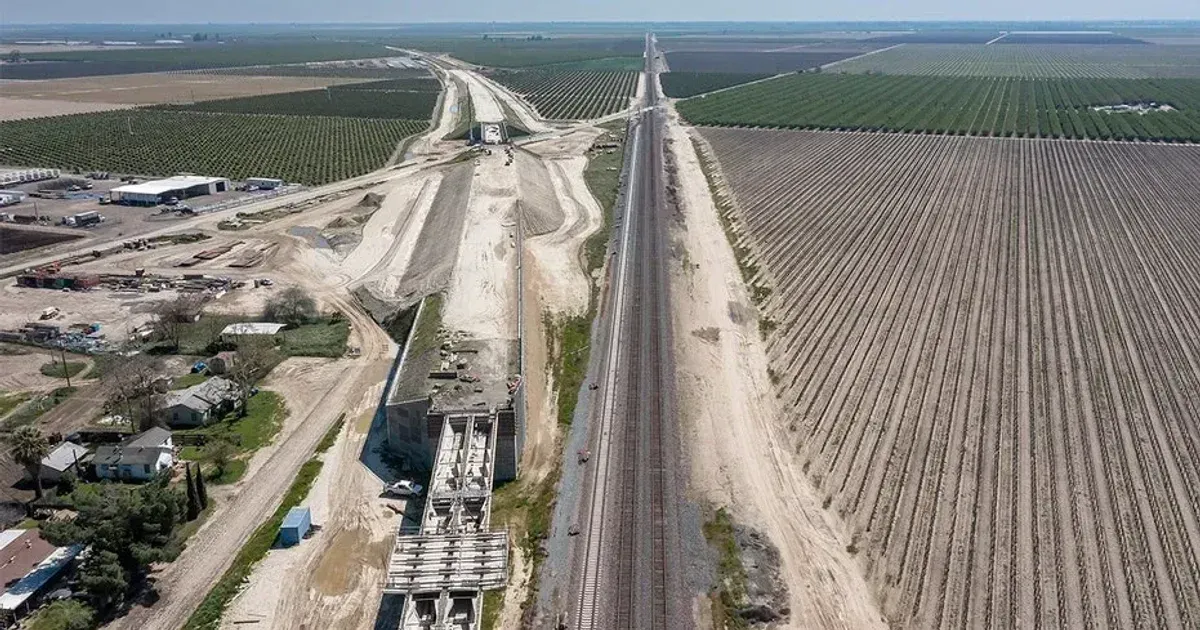
Voters initially supported the initiative under the impression that a high-speed link would be operational within a decade. Today, the reality on the ground consists largely of disconnected bridge structures and environmental mitigation sites in the Central Valley. Representative Vince Fong, a Republican from California, described the situation as a complete bait and switch during a recent oversight discussion. Fong argued that the project needs to stop before further billions are committed to a system that may never reach its destination. Political tension remains high as the state attempts to balance its green energy goals with a deteriorating fiscal outlook.
Infrastructure experts note that the logistical hurdles of tunneling through the Tehachapi Mountains have proven more complex than initial surveys suggested.
Financial transparency has become a central theme in the ongoing debate over the project's survival. Audits of the California High-speed Rail Authority have revealed serious discrepancies in how early consultants estimated tunneling costs. Early geological assessments failed to account for the seismic activity and soil instability found in several key segments. Engineering firms are now forced to redesign bridges and overpasses to meet more stringent safety standards. These revisions have pushed the per-mile cost of the track far beyond international benchmarks set by rail systems in France or Japan. Accountability remains elusive as different administrations trade blame for the project's lack of progress.
Infrastructure Credibility Test
California is currently teaching the world an exercise in how to kill an idea through sheer incompetence. The $126 billion price tag for a rail line that possesses no tracks is more than a fiscal error; it is a deep betrayal of the public trust that will poison the well for American infrastructure for a generation. By the time a single passenger boards a train from Los Angeles to San Francisco, the technology will likely be as relevant as a telegraph.
The picture emerging is of a state government that prioritizes a vanity project over the basic maintenance of its existing roads and bridges. If this project is not terminated immediately, it will serve as a permanent drain on the economic vitality of the most populous state in the union.