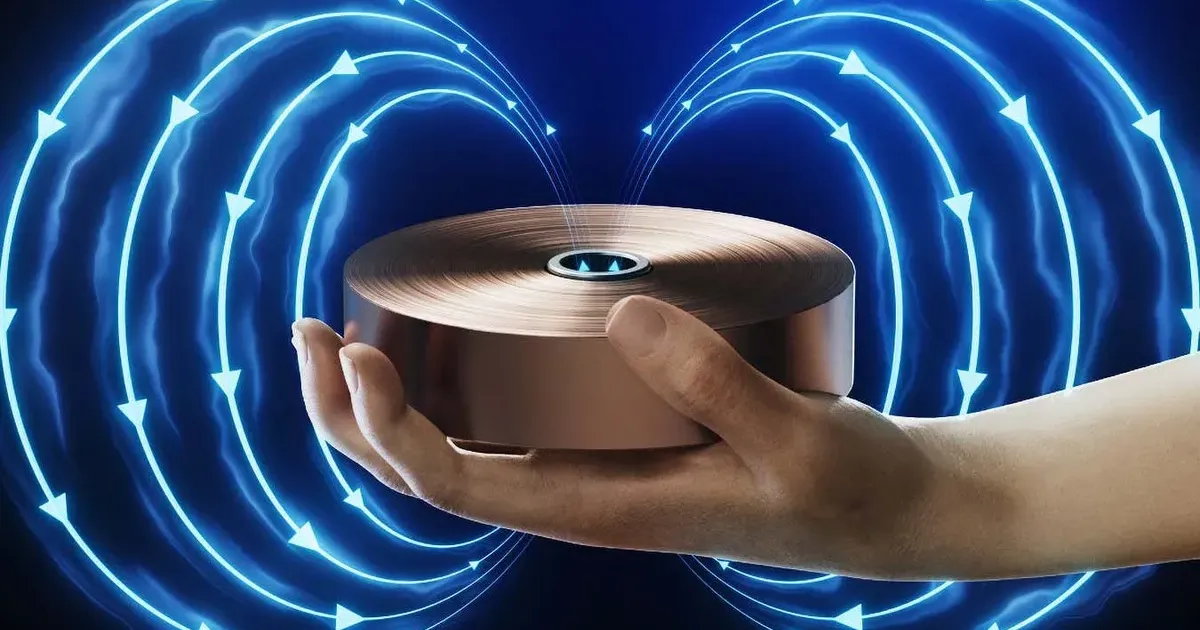
Laboratories in the Massachusetts high-tech corridor unveiled a device this week that challenges the basic architecture of modern physics. The engineering result drew attention beyond physics circles. On March 12, 2026, the compact magnet result reached a broader technology audience. It fits comfortably in a human palm, yet generates a magnetic field once reserved for machines the size of two-story houses. Magnetism has long been a game of scale, requiring massive cooling systems, thousands of gallons of liquid helium, and power substations capable of fueling a small town. Recent data from the test phase suggests those days are ending. Size does not define strength anymore. Engineers achieved this milestone by using high-temperature superconducting tape, specifically rare-earth barium copper oxide. Known as REBCO in scientific circles, this material allows for much higher current densities than the traditional niobium-tin wires used in legacy MRI machines or the Large Hadron Collider. By winding this tape into a remarkably tight configuration, the team managed to sustain a 20-tesla magnetic field. For context, 20 tesla is roughly 400,000 times stronger than the magnetic field of the Earth. Most hospital MRI scanners operate at a mere 1.5 or 3 tesla. Traditional magnets of this caliber require Bitter solenoids, which are massive stacks of copper plates with cooling holes. These behemoths consume megawatts of electricity and generate enough heat to melt the copper if the water cooling fails for even a second. The new miniature design operates with minimal power consumption because it relies on superconductivity, where electricity flows without resistance. This development removes the requirement for massive power infrastructures, potentially democratizing high-field research for smaller universities and private startups. Superconductors usually demand temperatures near absolute zero.
Liquid helium, which boils at 4 Kelvin, has become increasingly scarce and expensive over the last decade. High-temperature superconductors like the ones used in this palm-sized magnet can operate at 20 Kelvin or higher. While 20 Kelvin is still incredibly cold, it can be reached using mechanical cryocoolers rather than constant baths of liquid helium. This shift simplifies the engineering requirements sharply. Researchers no longer need to build an entire building around a single magnet just to handle the cryogenics and the pressure of the support structures.
The Engineering of Immense Pressure
Magnetic fields exert a physical force known as Lorentz pressure. At 20 tesla, the magnet coils endure pressure in the same extreme class as the stress at the bottom of the Mariana Trench. In larger magnets, massive steel housings prevent the device from literally exploding under its own internal forces. Scientists solved this in the miniature version by using the REBCO tape as its own structural support. The high tensile strength of the stainless steel backing on the tape allows it to withstand these forces without the need for external bracing.
At 20 tesla, the internal pressure on the magnet coils is comparable to the stress at the bottom of the Mariana Trench.
Precision is the only thing keeping the device intact.
Every micron of the winding must be perfect. A single flaw in the tape or a slight misalignment in the wrap would create a hot spot, leading to a quench where the superconductor suddenly becomes a normal conductor. Such an event would release all the stored magnetic energy in a fraction of a second, likely vaporizing the device. Advanced robotic winding machines, guided by sub-millimeter sensors, ensured that every layer of the tape was positioned with mathematical certainty. Still, the risk remains a primary focus for engineers looking to move this technology out of the lab and into the marketplace.
Medical imaging stands to benefit first from this miniaturization. Current MRI machines are stationary, heavy, and expensive, confining them to ground-floor suites with reinforced foundations. A compact 20-tesla magnet could lead to portable, ultra-high-resolution imaging tools that provide cellular-level detail of human tissue. Doctors might eventually use these devices in emergency rooms or remote clinics, areas where traditional MRI infrastructure is impossible to maintain. This achievement could redefine the early detection of neurological disorders and cancers.
Energy and Exploration Applications
Fusion energy research relies heavily on magnetic confinement to hold plasma at millions of degrees. Large tokamaks like ITER in France use massive magnets to achieve this, but the sheer scale of the project has led to decades of delays and billions in cost overruns. Compact, high-field magnets could allow for smaller, more efficient fusion reactors. If you can double the magnetic field, you can theoretically shrink the volume of the reactor by a factor of eight while maintaining the same fusion power. Smaller reactors are easier to build, test, and fund.
Space exploration offers another frontier for compact magnets.
Protecting astronauts from cosmic radiation is a major hurdle for Mars missions. Earth's magnetic field protects us here, but a spacecraft in deep space is vulnerable. A portable, high-strength magnet could create a localized magnetic bubble around a crew module, deflecting charged particles just like a miniature version of our planet's magnetosphere. Because this new magnet is lightweight and energy-efficient, it becomes a viable component for long-duration space flight where every kilogram of mass counts.
Comparison with the National High Magnetic Field Laboratory in Florida highlights how far this tech has come. The MagLab's 45-tesla hybrid magnet is a marvel, but it is a permanent fixture of national infrastructure. It requires a dedicated power plant and an industrial cooling system. While the palm-sized magnet does not yet reach 45 tesla, its 20-tesla performance at a fraction of the size suggests that the gap is closing. Innovation usually happens at the fringes before it disrupts the core, and this is the disruption high-field physics has waited for since the 1980s.
Compact Power Changes the Physics Budget
The compact magnet matters because scale is often the barrier between laboratory achievement and practical deployment. Matching the power of larger superconducting systems can change the economics of research infrastructure.
The next question is durability outside controlled demonstrations. If the design holds up under repeated use, it could influence fusion research, medical imaging and other fields that depend on powerful magnetic systems.