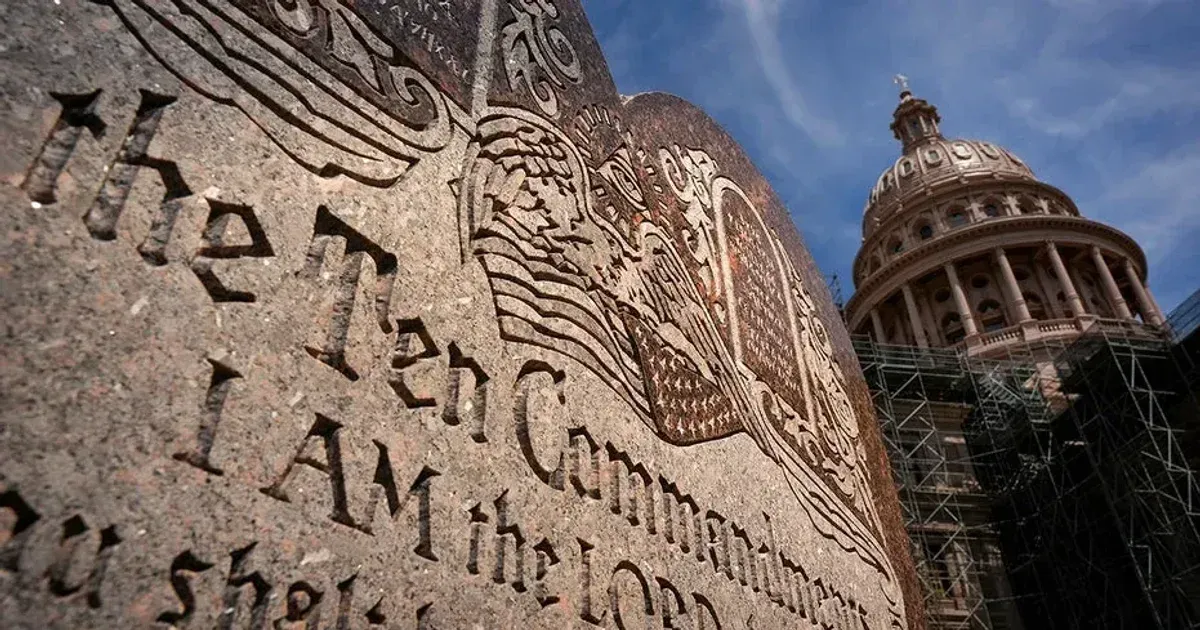
The Fifth Circuit’s narrow decision clears the way for Texas to require Ten Commandments displays in public-school classrooms and sets up another constitutional fight. April 22, 2026, marks a major milestone in the American legal struggle over religion in the public square as the Fifth Circuit Court of Appeals issued a definitive ruling on Texas classroom displays. Judges sitting on the 17-member panel narrowly decided that the state may enforce a mandate requiring all public schools to post the Ten Commandments. Senate Bill 10, the legislative engine behind this shift, had been stalled by lower courts for over a year. Tuesday’s decision effectively removes those barriers, allowing the Republican-led legislature to proceed with its vision of incorporating biblical texts into the educational environment.
A 9–8 ruling from the New Orleans-based court highlights the deep ideological fractures within the federal judiciary regarding the Establishment Clause. Writing for the majority, the court held that the plaintiffs failed to prove the law substantially burdens their right to religious exercise. Legal experts observe that the decision reverses a 2025 preliminary injunction issued by a federal judge who found the law lacked a sufficient historical foundation. Supporters of the mandate characterize the victory as a restoration of moral heritage, while opponents prepare for an immediate appeal to the United States Supreme Court.
Phil King, the Republican State Senator who authored the legislation, expressed his satisfaction with the judicial outcome immediately after the announcement. King argues that the Ten Commandments represent a foundational element of American law and civic life. He maintains that the state has no obligation to erase these historical influences from the sight of students. Instead of viewing the displays as proselytization, King presents them as an acknowledgment of the moral codes that informed the nation’s founders during the revolutionary era.
Jonathan Saenz, the president and lead attorney for the advocacy group Texas Values, played a central role in defending the statute. Saenz described the ruling as one of the most important religious liberty victories in the history of the states. He contends that acknowledging the historical foundations of American law is fully consistent with the First Amendment. Under his legal theory, the biblical text is a secular educational tool as much as a religious one. His organization has spent years lobbying for such a mandate, viewing it as a necessary correction to decades of secularist judicial overreach.
Texas Senate Bill 10 and Historical Jurisprudence
Legal challenges to the mandate originally centered on whether the display of religious text in classrooms constitutes a state establishment of religion. The Fifth Circuit majority disagreed, leaning heavily on the precedent established in recent Supreme Court cases. These cases moved away from the decades-old Lemon test, which once scrutinized the purpose and effect of government actions regarding religion. Modern interpretations, the court suggests, must rely on an analysis of historical tradition and the original understanding of the Constitution.
Critics of the law, including civil liberties organizations, argue that the mandatory nature of the display creates a coercive environment for children. These groups point out that students are a captive audience, unlike adults who might encounter religious symbols in a public park or courthouse. The 9-8 split in the court reflects these concerns, with dissenting judges suggesting that the ruling ignores the diversity of religious beliefs held by Texas families. Despite these arguments, the majority opinion remained focused on the failure of plaintiffs to demonstrate a specific burden on their free exercise of faith.
5th Circuit Reverses Federal District Court Injunction
Judicial history in this case began in 2025 when a federal district judge blocked the law before it could take effect. That judge argued that Texas failed to demonstrate a continuous historical tradition of public schools posting the Ten Commandments. Such a tradition is now a primary requirement for laws that might otherwise appear to violate the separation of church and state. By overturning that injunction, the Fifth Circuit has signaled a much broader interpretation of what constitutes a historical tradition. The court suggests that the presence of the Ten Commandments in various government buildings and legal iconography throughout American history provides enough justification.
"The Ten Commandments have been referenced throughout our nation’s civic life because they are part of the historical tradition that influenced American law," Phil King stated.
Public schools across the state must now prepare for the logistical requirements of the law, which mandates that the displays be at least 16 by 20 inches. Schools must also ensure that the text is legible and prominently placed in every classroom. Funding for these displays often comes from private donations, a provision included in the bill to insulate the state from claims of using taxpayer money for religious purposes. School boards in liberal-leaning districts, such as Austin and Houston, find themselves in a difficult position as they weigh compliance against the vocal opposition of local parents.
Texas Values Advocacy and Religious Liberty Claims
Jonathan Saenz frequently highlights that the Ten Commandments appears in the architectural design of the Supreme Court of the United States. He uses this fact to argue that the Texas mandate is simply bringing that same recognition of legal history to the classroom level. The legal strategy employed by Texas Values focused on the idea that the commandments are a historical document, similar to the Magna Carta or the Declaration of Independence. This framing seeks to bypass traditional arguments about religious indoctrination by emphasizing a secular, historical pedagogy.
Religious freedom advocates argue that excluding the commandments from schools is itself a form of hostility toward religion. They contend that the Constitution requires neutrality, not a complete absence of religious references in the public sphere. For Texas Values, the Fifth Circuit’s decision is a validation of this worldview. Saenz and his team have indicated they are prepared to defend the law all the way to the highest court in the country if necessary. They believe the current conservative majority on the Supreme Court will look favorably upon the Fifth Circuit’s reasoning.
Legal Challenges and Supreme Court Projections
Observers of the court system expect the Supreme Court to grant a stay or a writ of certiorari in the coming months. The narrow 9-8 margin in the Fifth Circuit indicates that the legal community remains deeply divided on the issue. While Bloomberg suggests that the ruling might be seen as a regional anomaly, other sources claim it is the forefront of a nationwide shift toward increased religious presence in government institutions. The case will likely force the Supreme Court to clarify exactly how the historical tradition test applies to the unique setting of public primary and secondary schools.
National implications of the Texas case extend far beyond the state’s borders, as other Republican-led legislatures consider similar measures. Lawmakers in Oklahoma and Louisiana have already introduced bills that mirror the language used by Phil King in Texas. If the Supreme Court upholds the Fifth Circuit’s decision, it could effectively end the era of strict separation between school and sanctuary that has defined American education since the mid-20th century. Attorneys for the plaintiffs are currently drafting their petition for a rehearing en banc or a direct appeal to the Supreme Court. The timeline for these legal maneuvers suggests a final resolution could take another year or more.
Texas Ruling Tests Religious Display Law
Stripping away the veneer of constitutional debate reveals a calculated effort to use the judiciary as a blunt instrument for cultural restructuring. The Fifth Circuit’s 9-8 decision goes beyond legal interpretation; it is a political declaration that the Establishment Clause is effectively a dead letter despite majoritarian religious sentiment. By elevating historical tradition over the actual lived experience of a diverse student body, the court has prioritized an idealized version of the past over the pluralistic reality of the present. This ruling essentially grants the state permission to curate which religious histories are worthy of classroom space and which are not.
Proponents like Phil King and Jonathan Saenz speak of moral heritage, yet their strategy relies on a narrow, exclusionary definition of that heritage. The claim that the Ten Commandments are purely historical documents is a convenient legal fiction designed to survive judicial scrutiny while satisfying a base that views the secularization of schools as a spiritual failing. This is a game of semantic gymnastics where a sacred text is stripped of its divinity in the courtroom only to have it restored the moment it is nailed to a classroom wall.
The Supreme Court now faces a choice between maintaining a neutral public square or endorsing a state-sanctioned religious identity. If the high court follows the Fifth Circuit’s lead, the precedent will invite an avalanche of similar mandates, each one chipping away at the protection of religious minorities. The result will not be a more moral society, but a more fractured one. It is a deliberate push toward a soft theocracy. Verdict: Constitutional erosion.